
Charlie McMahon: Australian didgeridoo innovator and musician
Charlie McMahon is an Australian didgeridoo player and inventor, co‑founder of Gondwanaland, known for popularizing the instrument globally, touring widely and creating the sliding 'didjeribone'.
Charlie McMahon (born in the Blue Mountains, New South Wales, in the early 1950s) is an Australian musician widely associated with the modern, non‑Indigenous use of the didgeridoo. He came to prominence as a co‑founder of the ambient/world‑rock group Gondwanaland and through extensive touring in Australia, Europe and North America. McMahon helped bring the sound of the didgeridoo into contemporary contexts, collaborating with rock and alternative acts and performing at festivals and venues beyond the instrument's traditional settings. For background on his place of origin see Blue Mountains and New South Wales.
Image gallery
2 Images
Musical approach and techniques
McMahon's approach emphasizes amplification, sustained drones and rhythmic patterns that interact with electronic and rock instrumentation. While the didgeridoo has ceremonial and regional meanings among Aboriginal peoples, McMahon developed a stage practice that adapts traditional mouth‑crafted sounds to modern performance. His tone and phrasing influenced many contemporary players; he is often cited in discussions about how non‑Aboriginal musicians interpret and use the instrument. Readers can learn more about the instrument itself via general resources on the didgeridoo and its musical role.
Gondwanaland and collaborations
Gondwanaland, the band McMahon co‑founded, blended didgeridoo with keyboards, percussion and rock textures to create an atmospheric sound often labeled world or ambient rock. The group toured widely, performing across remote Australian districts and in international venues in Europe and the United States. McMahon also performed alongside prominent Australian acts; on several occasions he shared stages with bands such as Midnight Oil, helping introduce didgeridoo timbres to diverse audiences.
Invention: the didjeribone
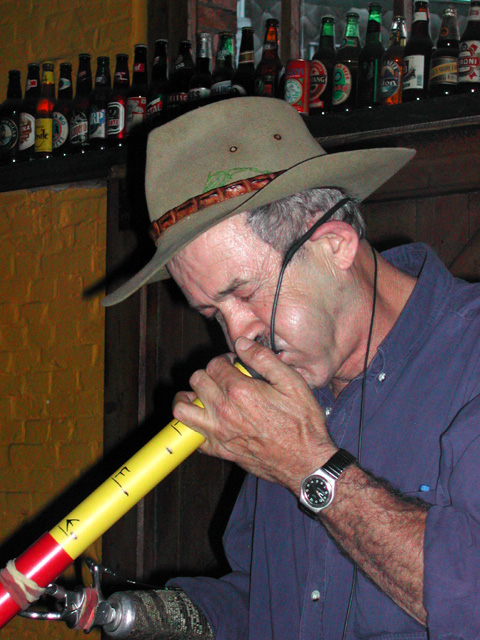
One of McMahon's best‑known contributions is the didjeribone, a sliding instrument made from plastic that functions similarly to a trombone's telescoping mechanism while preserving didgeridoo sound production. The didjeribone allows players to alter pitch by extending and contracting the tube, offering melodic movement uncommon in traditional fixed‑length didgeridoos. This innovation broadened the technical vocabulary available to contemporary performers and is often discussed in summaries of modern didgeridoo development; see general information about instrument variants at didgeridoo resources.
Reception, cultural context and legacy
As one of the earliest non‑Aboriginal musicians to gain international recognition for playing the didgeridoo, McMahon's career sits at the intersection of artistic innovation and cultural sensitivity. His performances and recordings contributed to wider interest in the instrument, while conversations about cultural appropriation and respect for Indigenous traditions have accompanied the instrument's global spread. McMahon has acknowledged the origins of the instrument and worked with— and visited—remote communities in the Australian outback; further reading on Indigenous perspectives and cultural protocols is available through educational links about Aboriginal culture and outreach to outback communities.
Notable points and further reading
- Founder and public face of Gondwanaland, a bridge between traditional sound and contemporary genres.
- Inventor of the didjeribone, expanding pitch possibilities for the instrument; useful for players seeking slideable pitch options similar to a trombone.
- International touring artist whose work increased global recognition of the didgeridoo, including collaborations and shared bills with well‑known Australian acts.
For overviews, recordings and biographical notes consult general music encyclopedias and artist profiles; some curated resources and interviews are indexed by music archives and cultural organizations—searchable through program pages and artist registries such as local cultural guides, general instrument introductions at didgeridoo portals and event listings referenced by music festivals and touring histories at regional pages. Additional context on modern instrument adaptations and ethical engagement with Indigenous traditions can be found via instrument histories and community outreach resources.
Related articles
Author
AlegsaOnline.com Charlie McMahon: Australian didgeridoo innovator and musician Leandro Alegsa
URL: https://en.alegsaonline.com/art/116280
Sources
- didgeridoobreath.com : "Didgeridoo Facts, Didgeridoo History & Aboriginal Music Knowledgebase"