
Didgeridoo: Traditional Australian Wind Instrument and Cultural Role
The didgeridoo is an Australian Aboriginal wind instrument known for its long hollow tube, continuous drone, and cultural significance. This article covers construction, history, playing technique, and contemporary uses.
Overview
The didgeridoo is a mouth-blown musical instrument developed by Indigenous Australians. Often appearing as a long hollow tube, it produces a continuous drone that forms the sonic foundation for many ceremonial songs and contemporary compositions. Although commonly associated with northern Australia, it is widely recognised across the continent and beyond through recordings, performances and educational use.
Image gallery
9 Images






Materials and construction
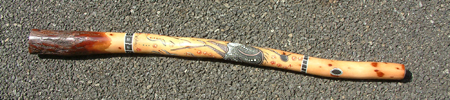
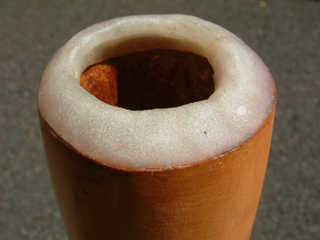
Traditional didgeridoos are made from eucalypt or other hardwood branches that have been naturally hollowed by termites. Craftspeople select a branch, trim it to length and finish the ends; a soft beeswax rim is frequently added to shape the mouthpiece. Modern makers also produce instruments from metal, glass, acrylic or PVC for portability and consistency. Length, bore shape (more cylindrical or more conical), and internal irregularities all affect pitch and timbre: longer instruments tend to sound lower, while diameter and taper influence overtone balance and ease of play.
Sound, classification and characteristics
Acoustically, the didgeridoo is a lip-vibrated aerophone that generates a sustained drone with rich harmonics, similar in principle to brass instruments though constructed from wood or synthetic materials. Players shape the instrument’s harmonics with subtle changes of lip tension and by modifying the shape of the oral cavity, producing rhythmic articulation, melodic inflections and vocalizations. Musicologists sometimes describe it as a drone instrument or wooden trumpet; classification places it among lip-reed aerophones rather than reed instruments (aerophone).
History and cultural context
Pinpointing an exact date for the didgeridoo's origin is difficult, but archaeological and pictorial evidence indicates long-standing use. Rock art and other cultural records in northern Australia attest to its presence over centuries. In Arnhem Land the instrument is particularly associated with the Yolngu people, and depictions in galleries and rock paintings — for example a ceremonial scene in Ginga Wardelirrhmeng on the Arnhem Land plateau — show players alongside singers and dancers, linking the instrument to ritual and story-telling (Arnhem Land painting).
Playing technique and musical uses
Key techniques include circular breathing, which allows uninterrupted sound by inhaling through the nose while using air stored in the cheeks to keep the drone going. Players use rhythmic tonguing, vocal sounds, and throat modulation to create patterns and percussive effects. The didgeridoo is central to traditional song cycles but has also been embraced by jazz, ambient, world and experimental music. Contemporary performers sometimes integrate electronic processing or collaborate with other instruments.
Contexts, etiquette and notable facts
While the didgeridoo is widely recognised as an Aboriginal instrument, practices about who may play it vary between communities and ceremonial contexts. In many places traditional protocols remain important. The instrument’s global popularity has led to adaptations in teaching methods, commercial manufacture and cross-cultural performance. For practical resources, general overviews and cultural background appear in both academic and community publications and online guides (wooden trumpet descriptions).
Summary of distinguishing points
- Material: traditionally termite-hollowed hardwood, now also synthetic materials.
- Sound: continuous drone with rich harmonics, modified by oral cavity and vocalizations.
- Technique: circular breathing enables unbroken tone; rhythmic and vocal articulations expand expression.
- Cultural role: integral to ceremony and storytelling in parts of northern Australia, notably among the Yolngu; also widely used in contemporary music scenes.
For introductory demonstrations, cultural context and further reading consult community resources and reputable musicology texts, which can provide respectful, accurate detail about tradition and technique (rock art studies, regional records, instrument guides).
Questions and answers
Q: What is a didgeridoo?
A: A didgeridoo is an Australian Aboriginal wind musical instrument.
Q: Who used didgeridoos?
A: The Yolgnu people of Arnhem Land used didgeridoos.
Q: How long can didgeridoos be?
A: Didgeridoos can be anywhere from 1 to 3 meters (3 to 10 feet) long, with most being around 1.2 meters (4 feet) long.
Q: What is the shape of a didgeridoo?
A: A didgeridoo is a hollow wooden tube that can be either cylindrical or conical in shape.
Q: What is the sound of a didgeridoo like?
A: A didgeridoo can be best described as a wooden trumpet or drone, with musicologists classifying it as a brass aerophone.
Q: How long have didgeridoos been in use?
A: Studies of rock art in Arnhem Land indicate that didgeridoos have been in use for more than 1,500 years.
Q: What is depicted in a rock painting in Ginga Wardelirrhmeng?
A: A rock painting in Ginga Wardelirrhmeng shows a didgeridoo player and two singers playing in a ceremony during the freshwater period.
Related articles
Author
AlegsaOnline.com Didgeridoo: Traditional Australian Wind Instrument and Cultural Role Leandro Alegsa
URL: https://en.alegsaonline.com/art/27245
Sources
- commons.wikimedia.org : Didgeridoos
- h2g2.com : "h2g2 - Brass Instruments - Tuning and Harmonics - Edited Entry"
- environment.gov.au : "Kakadu National Park - Rock art styles"
- news.flinders.edu.au : "News –"
- aboriginalart.com.au : The Didgeridoo and Aboriginal Culture
- bushcrafts.com.au : "Women can play didgeridoo - taboo incites sales"
- news.bbc.co.uk : "Didgeridoo book upsets Aborigines"
- independent.co.uk : "'Daring Book for Girls' breaks didgeridoo taboo in Australia"
- bmj.bmjjournals.com : "Didgeridoo playing as alternative treatment for obstructive sleep apnea syndrome: randomised controlled trial"
- doi.org : 10.1136/bmj.38705.470590.55
- ncbi.nlm.nih.gov : 1360393
- pubmed.ncbi.nlm.nih.gov : 16377643