
Bill Nye the Science Guy: educational television series and public-science legacy
A concise overview of the American educational television series Bill Nye the Science Guy: format, history, production, educational approach, awards, and its influence on science education for young audiences.
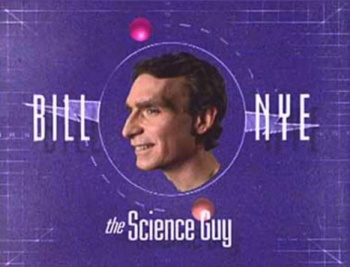
Bill Nye the Science Guy was an American live-action educational program and television program that combined comedy, experiments and short visual segments to introduce natural-science topics to children. Its original run ran from May 10, 1993, to June 20, 1998. The series was hosted by Bill Nye, a mechanical engineer turned science educator, and was produced for public television audiences. Episodes were distributed on PBS Kids and also syndicated to various local stations, helping the show reach a wide national audience.
Image gallery
4 Images

Format and educational approach
The series comprised roughly 100 half-hour episodes, each focused on a single science topic such as energy, ecosystems, sound, or chemistry. Intended for a preteen target audience, episodes blended fast-paced demonstrations, studio experiments, animated sequences and recurring comedic bits. The format emphasized clear, concrete examples and visual analogies to make abstract concepts accessible. Bill Nye performed demonstrations himself and often explained scientific principles directly to camera, using humor and repetition to reinforce key points.
Recurring segments and production elements
- Short experimental demonstrations that could be repeated in classrooms or at home.
- Sketches and characters that framed a scientific question or problem.
- Animated inserts to visualize microscopic, large-scale, or theoretical ideas.
- Studio pieces that showed measurements, comparisons and cause-and-effect relationships.
History and creative origins
The program emerged in the early 1990s amid a push for stronger science literacy in schools and public broadcasting. Bill Nye’s on-screen persona drew on his engineering background and experience with live performance, giving the show an energetic, approachable tone. Production partnerships with public television and commercial distributors allowed for both educational placement in schools and broader syndication on local commercial outlets.
Awards, recognition and legacy
The series received significant recognition for its contribution to informal science education. In 1999 the show was honored with a public service award from the National Science Board for its presentations of science to younger viewers. Over its five-year run it earned numerous industry awards, including a total of 19 Emmy Awards; Bill Nye personally won several Emmys for performing, writing and producing. These accolades underscored the program’s production quality and educational impact.
Importance and influence
Beyond its broadcast years, the show influenced how educators use television and short-form video to teach science. Teachers commonly used episodes as introductions or demonstrations in class, and the program’s mix of humor and experiment-driven presentation became a model for later educational media. Bill Nye’s public profile also expanded, enabling him to participate in public debates and outreach around science literacy and policy. While media and platforms have evolved, the series remains a frequently cited example of effective, entertaining science communication directed at young learners.
For further information about episodes, production notes and educational materials, see the program’s archival and reference listings via public broadcasters and educational resource sites: overview, series information, broadcast history, host biography, Bill Nye profile, production credits, PBS Kids resources, syndication details, local station guides, episode list, audience guidance, award citation, Emmy records, performance awards, writing credits.
Tags
Related articles
Author
AlegsaOnline.com Bill Nye the Science Guy: educational television series and public-science legacy Leandro Alegsa
URL: https://en.alegsaonline.com/art/11479
Sources
- nsf.gov : "Public Service Award Recipients 1998-Present"
- biography.com : "Bill Nye Biography"
- commons.wikimedia.org : Bill Nye the Science Guy