
Andrea Nahles
German Social Democratic politician, former federal labour minister and SPD leader (2018–2019); known for her trade‑union focus, leadership roles in the Bundestag and criticism of Agenda 2010.
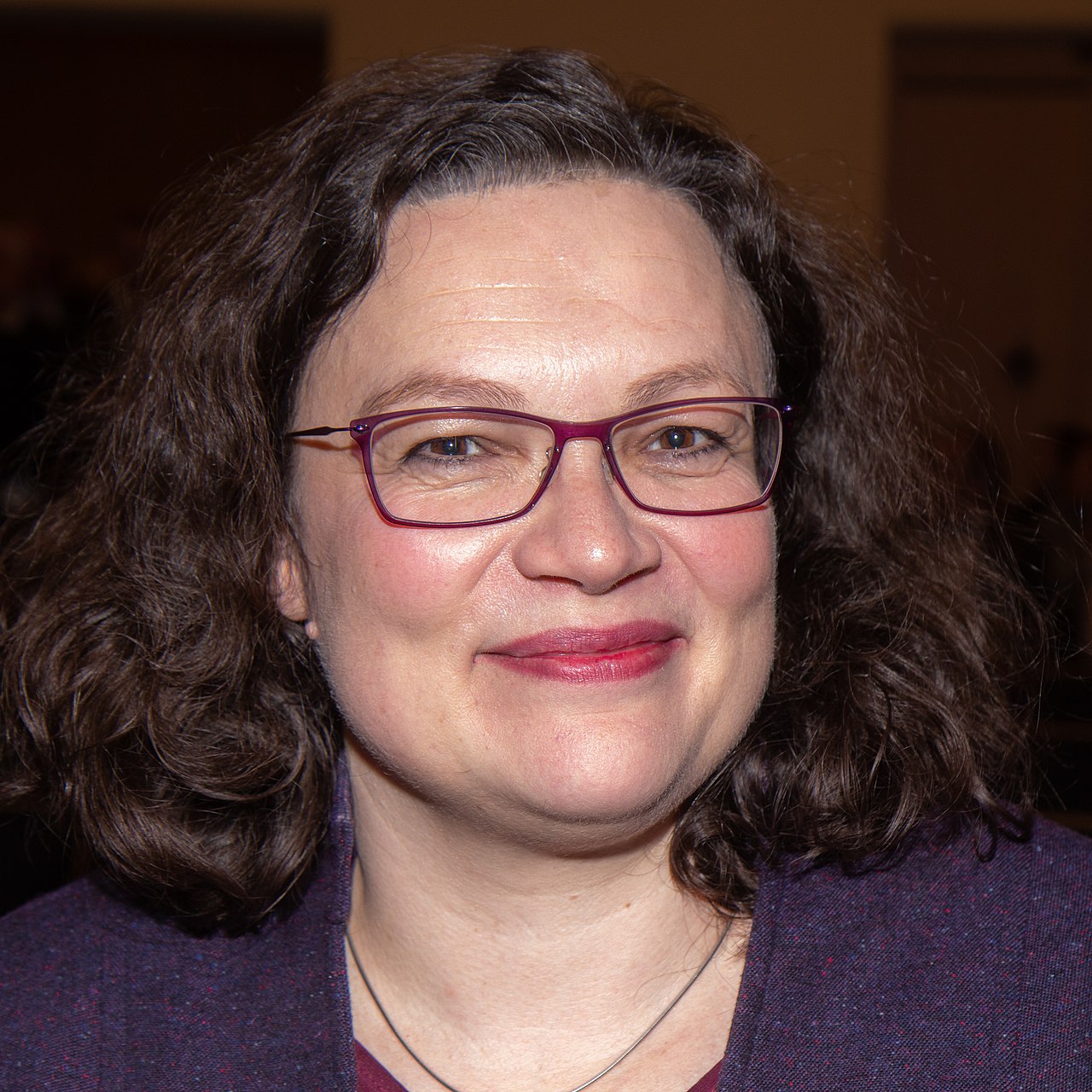
Andrea Nahles (born 20 June 1970) is a German politician associated with the Social Democratic Party. Over several decades she served in senior roles in the party and in the federal government, most prominently as Federal Minister of Labour and Social Affairs (2013–2017), leader of the SPD parliamentary group, and as party chair. Her public profile combines experience in government, parliamentary leadership and long involvement with the SPD youth movement. For an official profile see Andrea Nahles.
Image gallery
2 Images
Political career and offices
Nahles rose through the party ranks beginning with youth politics and then as a Bundestag member. She held important posts during Germany's grand coalition governments and within the SPD caucus in the Bundestag. Major offices include:
- Federal Minister of Labour and Social Affairs, 2013–2017 — ministerial portfolio focused on labour market policy and social insurance; see Labour Ministry.
- Leader of the SPD parliamentary group (Fraktionsvorsitzende), September 2017–June 2019, responsible for coordinating the party's work in the Bundestag.
- Chair of the Social Democratic Party, April 2018–June 2019, a period that included electoral challenges and internal debate over party direction; more on the SPD is at SPD.
Policy positions and party role
Nahles has been identified with social-democratic priorities such as workers' rights, social security and employment policy. During her ministerial tenure she worked on reforms and measures aimed at stabilizing pensions and addressing precarious employment. She is also known within the SPD for her critique of earlier market-oriented reforms, notably Agenda 2010, associated with former Chancellor Gerhard Schröder; discussions of that legacy and her stance are summarized in commentary linked from Gerhard Schröder. Her background in youth politics informed her emphasis on recruitment, social justice, and internal party renewal; readers can find historical notes at party youth records.
Leadership, challenges and legacy
In 2018 Nahles became the SPD's first woman to hold the party chair in its modern history, a milestone widely reported in German and international media. Her leadership coincided with difficult electoral cycles for the SPD. After disappointing results in regional and European ballots, she announced her resignation from the party chair and later from the parliamentary leadership in mid‑2019. Her tenure is often discussed in the context of debates about the SPD's direction, coalition strategy and relation to trade unions and the left wing of the party.
Notable facts
- Long experience spanning youth organisation leadership, ministerial office and parliamentary responsibility.
- Distinctive public profile as both a policy-focused minister and a sometimes polarising party leader during a period of electoral pressure.
- Her policy priorities have emphasized labour protections, social insurance stability and reversing what she and supporters saw as the most market-oriented effects of earlier reforms.
- Further biographical and parliamentary material can be consulted via official records and party summaries, for example official profile and SPD overview.
Related articles
Author
AlegsaOnline.com Andrea Nahles Leandro Alegsa
URL: https://en.alegsaonline.com/art/114091