
Akira Suzuki (chemist) — developer of the Suzuki cross‑coupling reaction
Japanese chemist Akira Suzuki (born 1930) developed the Suzuki cross‑coupling reaction and shared the 2010 Nobel Prize in Chemistry for advances in palladium‑catalyzed cross‑coupling.
Akira Suzuki (born 1930) is a Japanese chemist best known for introducing the reaction that bears his name, the Suzuki cross‑coupling. His work established a broadly applicable method for forming carbon–carbon bonds that transformed laboratory and industrial organic synthesis. In recognition of the significance of palladium‑catalyzed cross‑coupling methods, he was awarded the Nobel Prize in Chemistry in 2010, jointly with Richard F. Heck and Ei-ichi Negishi.
Image gallery
5 Images


What the Suzuki reaction is
The Suzuki reaction is an organic coupling between an organoboron compound and an organohalide to form a new carbon–carbon bond. Suzuki first reported this transformation in 1979. In its common form an aryl- or vinyl‑boronic acid is combined with an aryl- or vinyl‑halide in the presence of a base and a palladium(0) catalyst to give the coupled product. The reaction tolerates many functional groups and is valued for its reliability and relatively mild conditions.
Key characteristics and mechanism
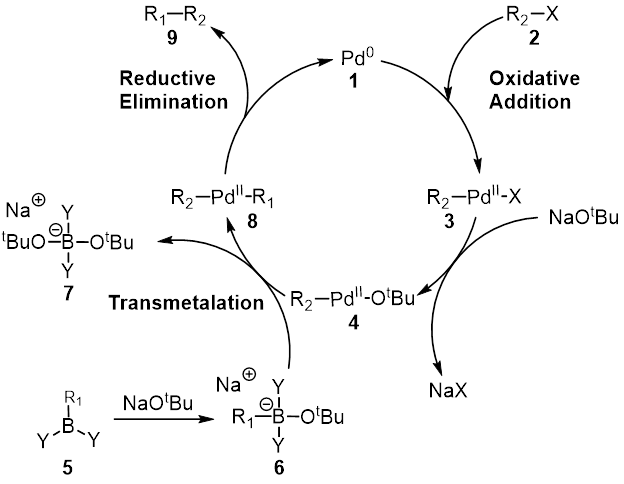
Mechanistically, the catalytic cycle typically involves oxidative addition of the halide to palladium(0), transmetalation with the organoboron reagent (assisted by base), and reductive elimination to release the coupled product and regenerate palladium(0). Organoboron reagents are nonvolatile, often stable, and less toxic than many alternatives, contributing to the method's practical advantages. The reaction can be run with a variety of ligands, solvents, and bases to suit specific substrates.
Applications and importance
The Suzuki reaction is widely used in the synthesis of pharmaceuticals, agrochemicals, natural products, and organic materials. Examples include the construction of biaryl motifs common in drug molecules, conjugated systems in organic electronics, and complex molecular frameworks in total synthesis. Its compatibility with sensitive functional groups makes it a staple in both academic and industrial laboratories.
Context and legacy
Suzuki's contribution sits alongside other palladium‑catalyzed cross‑couplings (such as the Heck, Stille, and Negishi reactions) that together expanded chemists' ability to assemble carbon skeletons with precision. The adoption of the Suzuki reaction has been driven by its operational simplicity and the ready availability of boron reagents. Today it is taught in courses on organic synthesis and remains a routine choice for forming carbon–carbon bonds.
- Historical note: First reported in 1979, the reaction grew in use through the 1980s and 1990s as catalyst and ligand systems improved.
- Awards: Suzuki shared the 2010 Nobel Prize in Chemistry for the development of palladium‑catalyzed cross‑couplings in organic synthesis.
Suzuki's work illustrates how a robust, general method can have long‑lasting impact across multiple fields of chemistry. For further technical details and variations of the transformation, consult specialized reviews and methodological summaries by practitioners of synthetic organic chemistry.
Related articles
Author
AlegsaOnline.com Akira Suzuki (chemist) — developer of the Suzuki cross‑coupling reaction Leandro Alegsa
URL: https://en.alegsaonline.com/art/113444
Sources
- eprints.lib.hokudai.ac.jp : "A new stereospecific cross-coupling by the palladium-catalyzed reaction of 1-alkenylboranes with 1-alkenyl or 1-alkynyl halides"
- doi.org : 10.1016/S0040-4039(01)95429-2