
Dmitri Mendeleev: Architect of the Periodic Table
Russian chemist Dmitri Mendeleev (1834–1907) organized the chemical elements into a periodic system, predicted undiscovered elements and shaped modern chemistry and chemical education.
Overview
Dmitri Ivanovich Mendeleev was a Russian chemist and educator best known for creating the first widely recognized periodic arrangement of the chemical elements. Born on 8 February 1834 (O.S. 27 January) near Tobolsk, he spent much of his career in Saint Petersburg. Mendeleev published his periodic table in 1869 and formulated a statement of periodic behaviour that helped chemists predict properties of then-unknown elements. He died on 2 February 1907 (O.S. 20 January).
Image gallery
10 Images




Arrangement and principles
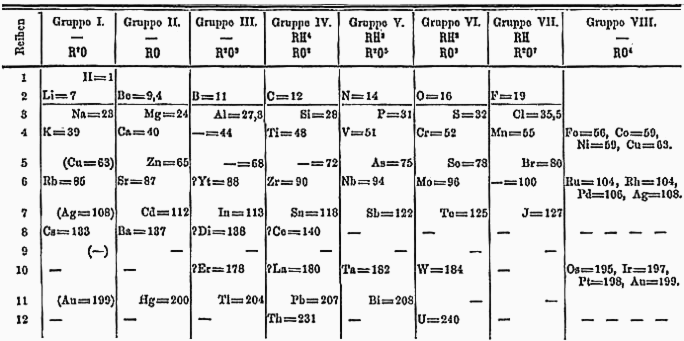
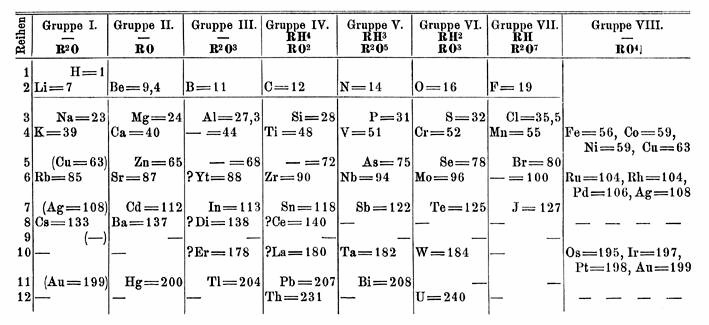
Mendeleev arranged elements primarily by increasing atomic weight and grouped them so that elements with similar chemical properties fell into the same columns. From this ordering he articulated what became known as the periodic law: when elements are ordered by atomic weight, certain properties recur periodically. This table emphasized chemical behavior over fixed placement and left intentional gaps where no known element fit the pattern.
History and development
The periodic table Mendeleev published in 1869 emerged from his work as a teacher and textbook author: he wanted a coherent classification for chemical elements that would aid instruction and research. He compared and organized known atomic weights and properties, and he frequently rearranged entries to preserve group similarities. Because the idea exposed relationships among elements, it attracted rapid attention. Contemporaries such as Lothar Meyer reached related conclusions independently, but Mendeleev is credited with making bold, testable predictions.
Predictions and later confirmation
One of Mendeleev's most striking contributions was predicting the existence and properties of elements not yet discovered. He described the properties of several hypothetical elements (often using the prefix "eka-"), and when elements such as gallium (discovered 1875), scandium (1879) and germanium (1886) were found, their measured properties closely matched his predictions. These successes strengthened acceptance of the periodic approach and encouraged its refinement.
Contributions, uses and legacy
- Practical classification: the table provided a systematic framework for chemistry, aiding research, teaching and chemical analysis.
- Predictive power: it guided discovery of new elements and informed expectations about chemical behavior.
- Educational impact: Mendeleev published influential textbooks and advocated for clearer presentation of chemical knowledge.
- Commemoration: element 101 was later named mendelevium in his honor.
Notable facts and distinctions
Although Mendeleev ordered elements by atomic weight, the later identification of atomic number as the fundamental ordering principle (after work by Henry Moseley) refined the table without overturning its structure. Mendeleev's willingness to revise atomic weights and to leave gaps for unknown elements set his work apart from more conservative classifications. His name and the periodic concept remain central to chemistry; modern periodic tables trace their lineage to his 19th-century synthesis and to subsequent experimental confirmation of the periodic law. For more on his life and works, see biographical and historical materials here and discussions of the periodic system here. Additional references on his biography and scientific contributions are available here.
Questions and answers
Q: Who was Dmitri Mendeleev?
A: Dmitri Mendeleev was a Russian chemist who created the periodic table of elements.
Q: What is Mendeleev's contribution to science?
A: Mendeleev created the periodic table of elements, which is a system for organizing the chemical elements based on their atomic properties.
Q: What is the significance of Mendeleev's periodic table?
A: Mendeleev's periodic table helped to predict the properties of elements that were undiscovered at the time.
Q: Were Mendeleev's predictions about undiscovered elements accurate?
A: Yes, many of Mendeleev's predictions about undiscovered elements were later proved correct by experiments.
Q: Which element was named after Mendeleev?
A: Chemical element 101 was named Mendelevium in honor of him.
Q: When and where was Mendeleev born?
A: Mendeleev was born on 8 February (O.S. 27 January) 1834 near Tobolsk, Russia.
Q: When and where did Mendeleev die?
A: Mendeleev died on 2 February (O.S. 20 January 20) 1907 in Saint Petersburg, Russia.
Related articles
Author
AlegsaOnline.com Dmitri Mendeleev: Architect of the Periodic Table Leandro Alegsa
URL: https://en.alegsaonline.com/art/117745
Sources
- mendcomm.org : Dmitriy Mendeleev: a short CV, and a story of life
- starina.library.tver.ru : Удомельские корни Дмитрия Ивановича Менделеева (1834–1907)
- wikidata.orgQ9106.html : wikidata.orgq9106.html
- authority.bibsys.no : 90089362
- catalogo.bne.es : XX1332367
- catalogue.bnf.fr : cb13088624t
- data.bnf.fr : (data)
- cantic.bnc.cat : a10421257
- ci.nii.ac.jp : DA00753632
- d-nb.info : 118641069
- isni.org : 0000 0001 0914 2724
- id.loc.gov : n81037129
- kopkatalogs.lv : 000078570
- id.ndl.go.jp : 00449750
- aleph.nkp.cz : jn19990210421