
Yakov G. Sinai — contributions to dynamical systems and mathematical physics
Russian‑American mathematician Yakov Sinai is a leading figure in dynamical systems, ergodic theory, probability and mathematical physics; known for Sinai billiards, entropy theory and foundational work in chaos.
Yakov Grigorevich Sinai (born September 21, 1935) is a prominent Russian American mathematician whose research has shaped modern ideas about deterministic chaos, statistical mechanics and random processes. Born in Moscow in the Soviet Union and later associated with institutions in Russia and abroad, Sinai combined tools from analysis, geometry and probability to clarify how complex long‑term behavior emerges from simple rules.
Image gallery
1 Image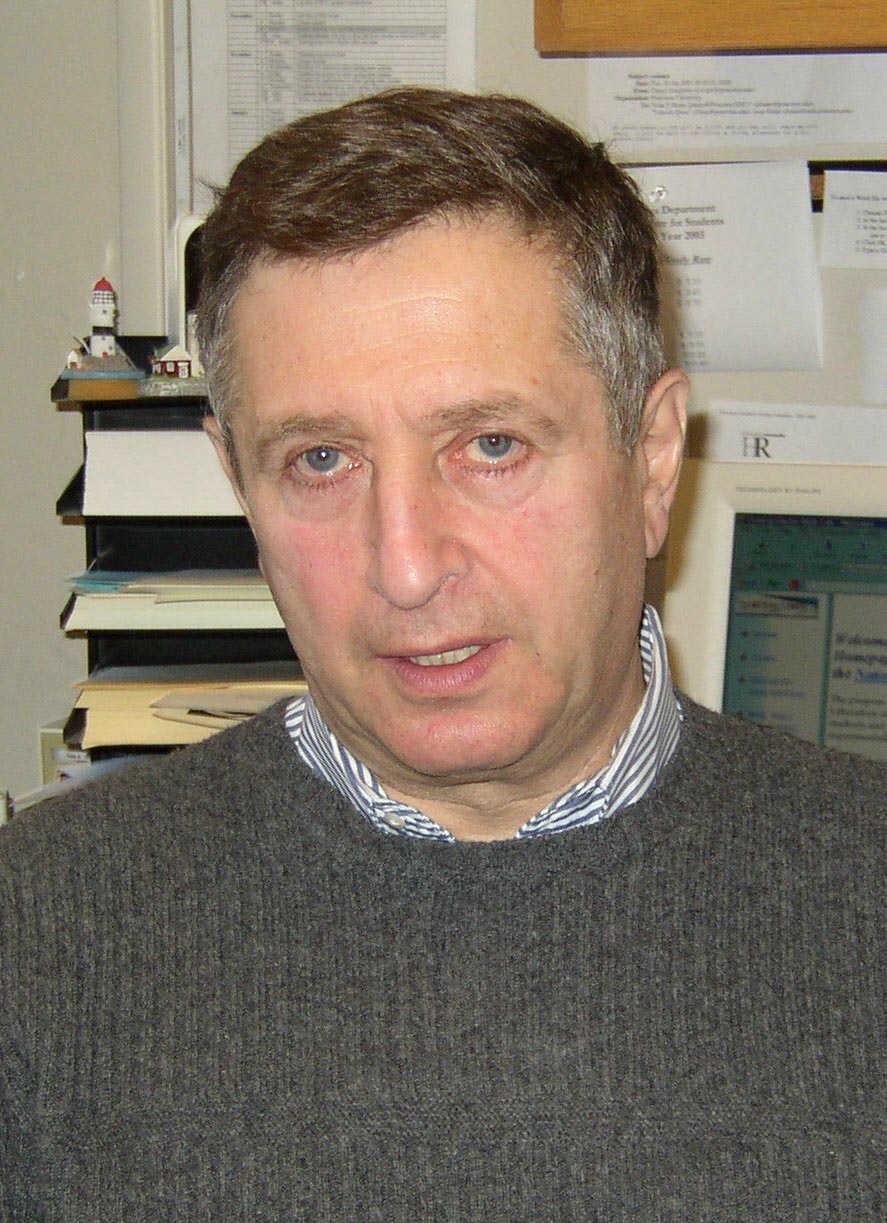
Overview of work
Sinai is best known for contributions to dynamical systems, in particular rigorous descriptions of chaotic behavior and invariant measures. He also made influential contributions to mathematical physics and to probability theory, often building bridges between these areas. His research introduced concepts and models that serve as standard examples and tools across ergodic theory and statistical mechanics.
Main contributions and concepts
- Metric entropy and ergodic theory: Sinai helped formalize entropy notions that quantify unpredictability in measure‑preserving systems.
- Sinai billiards: a family of dispersing billiard systems that display strong chaotic properties and whose study clarified statistical laws for deterministic dynamics.
- SRB measures and Sinai's theorem: work that characterizes physically relevant invariant measures for chaotic attractors in smooth dynamical systems.
- Interplay with probability and statistical mechanics: rigorous results on phase transitions, Gibbs measures and stochastic behavior in large systems.
These ideas underpin much of what is called modern chaos theory: they explain how deterministic rules can produce statistical regularities such as exponential mixing, central limit theorems, and rate‑of‑decay results that mirror classical probability statements.
Awards and influence
- Recipient of major honors, including the Wolf Prize (1996) and the Abel Prize (2014), awarded for deep and wide‑ranging contributions to mathematics.
- His work is widely cited and taught in graduate courses on ergodic theory, dynamical systems and mathematical physics; many later results build directly on his methods.
Beyond technical theorems, Sinai's legacy includes a set of paradigmatic models and rigorous methods that continue to guide research on chaos, transport phenomena, and stochastic limits of deterministic systems. For overview material and further reading, see general introductions and surveys in ergodic theory and mathematical physics (biographical sources and standard texts often cite his foundational papers).
Notable facts: Sinai's name is attached to multiple standard objects (for example, "Sinai billiards" and entropy notions), and his results provide a rigorous backbone for understanding how microscopic determinism leads to macroscopic randomness. While rooted in mid‑20th century developments, his influence remains active in contemporary research across mathematics and theoretical physics.
Related articles
Author
AlegsaOnline.com Yakov G. Sinai — contributions to dynamical systems and mathematical physics Leandro Alegsa
URL: https://en.alegsaonline.com/art/109558
Sources
- nature.com : "Chaos-theory pioneer nabs Abel Prize"
- www-groups.dcs.st-and.ac.uk : "Yakov Grigorevich Sinai"