
Wolff–Kishner reduction
A classical organic reaction that converts aldehydes and ketones to alkanes by formation and base-induced decomposition of hydrazones; requires hydrazine, strong base, and elevated temperature.
Overview
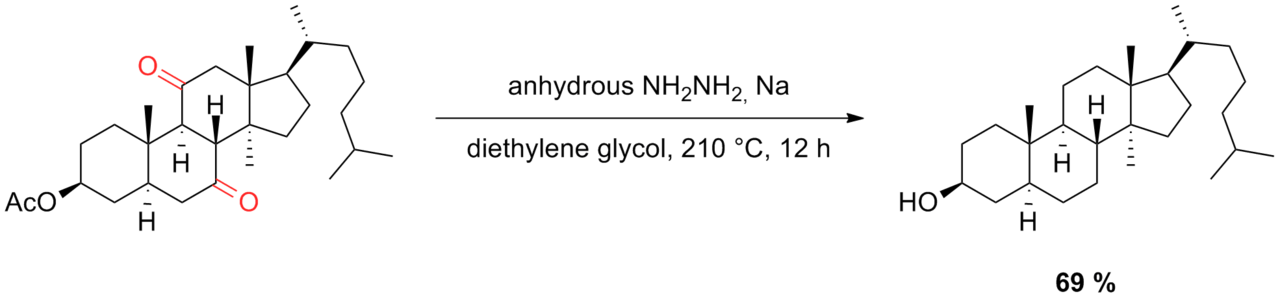
The Wolff–Kishner reduction is an important method in organic chemistry for converting a carbonyl functionality into a methylene group. In practice it transforms carbonyl compounds—most commonly ketones and aldehydes—into saturated hydrocarbons or alkanes. The process is valued for its chemoselectivity when acidic or catalytic hydrogenation is unsuitable.
Image gallery
10 Images


Mechanism and key steps
At the core of the reaction is formation of a hydrazone intermediate and its subsequent base-promoted deoxygenation. Broadly the sequence is:
- Condensation of the carbonyl compound with hydrazine (NH2NH2) to form a hydrazone.
- Deprotonation of the hydrazone under strongly basic conditions.
- Elimination steps that ultimately expel molecular nitrogen (N2) and give the saturated carbon (C–H) product.
Typical conditions and variations
The classical protocol uses hydrazine and an alkaline reagent (for example KOH) in a high‑boiling solvent such as ethylene glycol or diethylene glycol to achieve the temperatures required for decomposition. Because of the heat and base, several modified procedures have been developed to improve convenience or tolerance: for example, the Huang–Minlon modification employs simpler workup and often lower reagent excesses. Choice of solvent, base, and temperature is adjusted to balance reactivity with substrate stability.
Applications, advantages and limitations
Wolff–Kishner is widely used to remove carbonyl groups in multi‑step syntheses when retention of other functional groups under strongly acidic or catalytic hydrogenation conditions would be problematic. Advantages include avoidance of metal catalysts and clean conversion to CH2. Limitations are significant: the method requires strongly basic, high‑temperature conditions and hydrazine (a toxic reagent), so it is unsuitable for base‑ or heat‑sensitive substrates and for molecules bearing groups that are destroyed by strong base.
History and notable facts
The reaction is named after two chemists who independently described related procedures in the early 20th century. It remains a standard transformation taught in organic synthesis because of its conceptual simplicity and its complementary selectivity relative to acid‑mediated or catalytic reductions. Modern practice includes adaptations to improve safety, reduce reagent excess, or enable milder conditions where possible.
Choosing the Wolff–Kishner over alternatives
- Choose Wolff–Kishner if the substrate tolerates base and heat and metal catalysts are undesirable.
- Consider the Clemmensen reduction (acidic, metal) or catalytic hydrogenation when the substrate is base‑sensitive but acid‑tolerant.
- For sensitive or complex molecules, explore milder hydrazone decomposition variants or non‑classical deoxygenation methods.
For further reading on mechanisms and practical tips, consult modern organic synthesis texts and reviews. Reliable online resources and specialized protocols can provide experimental alternatives and safety advice for handling hydrazine and high‑temperature reactions.
Related articles
Author
AlegsaOnline.com Wolff–Kishner reduction Leandro Alegsa
URL: https://en.alegsaonline.com/art/108810