
Wilsonian Armenia
Wilsonian Armenia refers to the Armenian state boundaries drawn by U.S. President Woodrow Wilson under the 1920 Treaty of Sèvres — a plan never implemented and later superseded by other treaties.
Overview
"Wilsonian Armenia" is the name given to the borders proposed for an independent Armenian state by U.S. President Woodrow Wilson in the aftermath of World War I. The proposal appeared in the 1920 Treaty of Sèvres as an international arbitration to settle disputed frontier areas between Armenia and the defeated Ottoman Empire. It is best known for envisaging Armenian territory that would reach the Black Sea, providing strategic and economic access that Armenian national leaders had long sought.
Image gallery
4 Images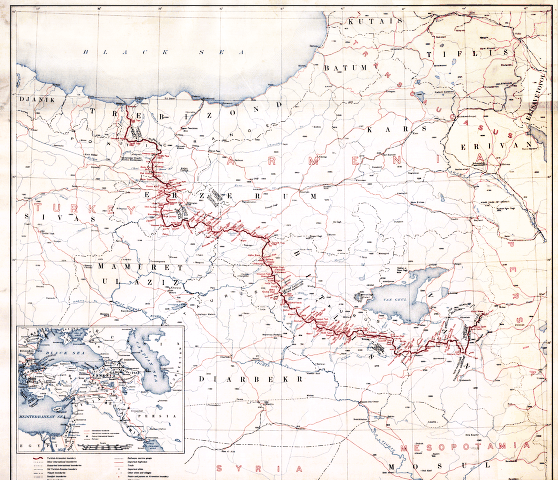



Main features
Rather than a simple extension of the existing First Republic of Armenia, the Wilsonian plan assigned to Armenia large sections of eastern Anatolia and a coastal corridor to the sea. This corridor would have linked the Armenian state to the Black Sea region around Trabzon, altering historic Ottoman provincial borders and creating a contiguous Armenian state with maritime access. The proposal emerged from international arbitration rather than local settlement.
Historical context and outcome
The map called Wilsonian Armenia was produced in the chaotic postwar negotiation environment following the collapse of the Ottoman central government. Although the Ottoman government signed the Treaty of Sèvres, Turkish nationalist forces opposed it and ultimately rejected its terms. The Turkish national movement led by Mustafa Kemal created a new political reality that made Sèvres unenforceable; the later Treaty of Lausanne and regional agreements removed the Wilsonian dispositions from practice. Subsequent treaties and Soviet diplomacy, including arrangements with Soviet Russia, established the borders that replaced the Wilsonian plan.
Significance and legacy
Wilsonian Armenia has persisted as a diplomatic and symbolic reference in Armenian political memory and diaspora discourse. For proponents it represented international recognition of Armenian territorial claims and of a right to sea access; for others it highlighted the limits of postwar peacemaking. The plan is often cited in discussions about the legal and moral aftermath of wartime population movements and border-making in the early twentieth century.
Comparisons and clarifications
- Wilsonian Armenia refers specifically to the arbitration-based map linked to the Treaty of Sèvres, not to the borders of the short-lived First Republic of Armenia (1918–1920) or the later Armenian Soviet Republic.
- The envisioned Black Sea connection was a distinctive element; proponents argued it would secure trade and security, while opponents pointed to practical and political obstacles to implementing such an arrangement.
Modern relevance
Today the term is used in historical writing, legal argument, and cultural memory rather than as a live diplomatic proposal. It helps explain aspects of Armenian national aspirations after World War I and illustrates how international arbitration and shifting on-the-ground power shaped the map of the Near East in the interwar period. Debates about Wilsonian Armenia intersect with wider issues of treaty law, national self-determination, and the transition from empires to nation-states in the region — topics that continue to be discussed in scholarship and public discourse around the legacy of the treaties that followed the Ottoman defeat and the rise of the modern Turkish Republic.
For further contextual reading on the region and its postwar treaties, see resources on the Treaty of Sèvres, the Paris peace negotiations, and contemporary accounts of maritime access including discussions of the Black Sea corridor.
Related articles
Author
AlegsaOnline.com Wilsonian Armenia Leandro Alegsa
URL: https://en.alegsaonline.com/art/108411