
Western long-beaked echidna (Zaglossus bruijni)
A mountain-dwelling monotreme from New Guinea, Zaglossus bruijni is a worm-eating echidna threatened by habitat loss and hunting; notable for its claws, size and fossil record.
Overview
The western long-beaked echidna (Zaglossus bruijni) is a species of monotreme found in the highlands of New Guinea. Monotremes are an ancient lineage of egg-laying mammals that also includes the platypus. Among living echidnas, Zaglossus species are larger and have different feeding specializations than the more widely distributed short-beaked echidna. The western long-beaked echidna is of interest to biologists because of its distinctive anatomy, specialized diet and its place in studies of mammal evolution.
Image gallery
4 Images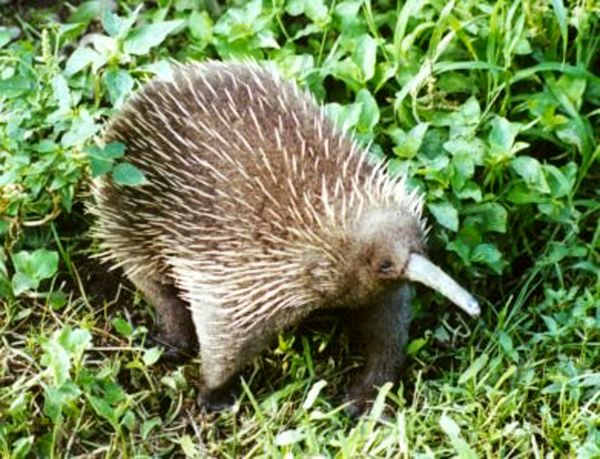


Physical characteristics
Adult western long-beaked echidnas are covered in coarse fur with interspersed spines. They have a long, slender snout or beak that houses a slender, sticky tongue used to capture prey. Limbs are robust and adapted for digging; a typical diagnostic character for this species is the number of claws, most commonly three on both fore and hind feet (occasionally four), which helps distinguish it from related Zaglossus species.
Range, habitat and fossil record
This echidna is associated with montane environments and has been recorded at relatively high elevations, generally reported from roughly 1,300 to 4,000 metres above sea level in various accounts of upland ecology and elevation-related habitats. It occupies alpine meadows, mossy forest and humid montane forests where soil and litter provide access to its prey. Fossil material attributed to long-beaked echidnas has been recovered from sites outside New Guinea, including deposits in Australia, and those finds form part of broader discussions of monotreme fossil evidence and historical biogeography.
Diet and foraging behaviour
Unlike the short-beaked echidna, which largely consumes ants and termites, the western long-beaked echidna mainly feeds on earthworms and other soft-bodied invertebrates found in soil and rotting wood. Its long beak and muscular snout are used to probe and dig; prey items are seized with a protrusible, adhesive tongue. Foraging is primarily solitary and terrestrial, with animals moving through leaf litter and soil to locate concentrations of worms and other prey (earthworms).
Reproduction and life history
As with other monotremes, reproduction involves laying a small, leathery egg. The egg is incubated externally for a limited period after which the juvenile hatches in an underdeveloped state and is nourished by secretions from the mother. Reproductive rates are low compared with many placental mammals, and life-history traits such as clutch size, juvenile development and maternal care have made the species a focus of research on early mammalian reproductive evolution.
Conservation status and threats
The species is regarded as endangered in several assessments because of habitat loss, fragmentation and hunting pressure. Highland forests and meadows are affected by agricultural expansion, logging and other land-use changes. In parts of its range the animal is hunted for food, a factor that has contributed to local declines; traditional hunting practices and the species' reputation as edible are important elements of human impact on populations.
Legal protections and conservation efforts
Legal protections vary by country: national regulations in Indonesia and in Papua New Guinea include restrictions on hunting and collection, though customary use and local exemptions can complicate enforcement. Conservation strategies emphasized by researchers and NGOs include habitat protection, community-based management, anti-poaching measures and further field surveys to clarify distribution and population trends. Notable fieldwork, including expeditions that documented montane fauna in places such as the Foja Mountains, has helped draw attention to the species and to highland biodiversity more generally.
Taxonomy and scientific interest
The western long-beaked echidna is one of several living species in the genus Zaglossus and is often compared with the short-beaked echidna in ecological and anatomical studies; detailed comparisons rely on skull characters, claw counts and body measurements to separate taxa and clarify relationships (this species). As a member of the small group of living monotremes, it provides insight into the early evolution of mammals and the diversity of reproductive and feeding strategies among mammals.
Human interactions and cultural context
In many highland communities the long-beaked echidna has traditional significance as a source of food and as part of local knowledge systems. Cultural practices, traditional hunting rights and food taboos influence how the species is used and managed. Conservation efforts that engage local communities and acknowledge customary practices are often recommended as part of effective protection measures.
Further reading and resources
For general background on echidnas and monotremes consult overview material on echidnas and broader treatments of monotreme biology. Field reports and conservation assessments that document the species' status, ecology and legal protections are available through regional faunal summaries and conservation organizations; targeted sources include reports addressing montane ecosystems and species records from New Guinea.
- Key distinctions: larger than the short-beaked echidna, primarily feeds on earthworms, normally three claws per foot.
- Conservation: threatened by habitat change and hunting; protections exist but vary by country.
- Scientific interest: an informative living monotreme alongside the platypus.
Questions and answers
Q: What is the western long-beaked echidna?
A: The western long-beaked echidna is a type of echidna that lives in New Guinea and has also been found in Australia.
Q: How many living echidnas are there?
A: There are four living echidnas, three of which are species of Zaglossus.
Q: Where does the long-beaked echidna live?
A: The long-beaked echidna lives in alpine meadow and humid forests in the mountains, at elevations of between 1300m to 4000m above sea level.
Q: What do Western long-beaked echidnas eat?
A: Unlike the short-beaked echidna which eats ants and termites, the long-beaked species eats earthworms.
Q: How has the population of long-beaked echidnas been affected?
A: The population of long-beaked echidnas has been reduced by habitat loss and hunting, and the species is now endangered.
Q: What distinguishes the western long-beaked echidna from other Zaglossus species?
A: The western long-beaked echidna can be distinguished from other Zaglossus species by the number of claws on the front and back feet, as it has three (rarely four) claws.
Q: What is special about echidnas and platypus?
A: Echidnas and platypus are monotremes, the only mammals to lay eggs.
Related articles
Author
AlegsaOnline.com Western long-beaked echidna (Zaglossus bruijni) Leandro Alegsa
URL: https://en.alegsaonline.com/art/107522
Sources
- departments.bucknell.edu : "Order Monotremata"
- google.com : Mammal Species of the World: A Taxonomic and Geographic Reference
- worldcat.org : 62265494
- dx.doi.org : "Zaglossus bruijni"
- msn.com : "MSN - Outlook, Office, Skype, Bing, Breaking News, and Latest Videos"
- commons.wikimedia.org : Zaglossus bruijni