
Weighing scale
A weighing scale measures the weight or mass of an object. This article describes common types, principles, components, calibration, accuracy, applications and practical guidance for selection and use.
Overview
A weighing scale is an instrument that determines how heavy an object is by converting a physical effect caused by the object into a readable value. Traditional balances compare an unknown mass to known masses, while modern scales measure a force or deformation and report a mass-equivalent value. Everyday language often uses the words "scale" and "balance" interchangeably, though technically they describe different measurement approaches.
Image gallery
10 Images




Common types and components
Scales are built in many formats to meet different accuracy, capacity and environmental needs. Typical categories include:
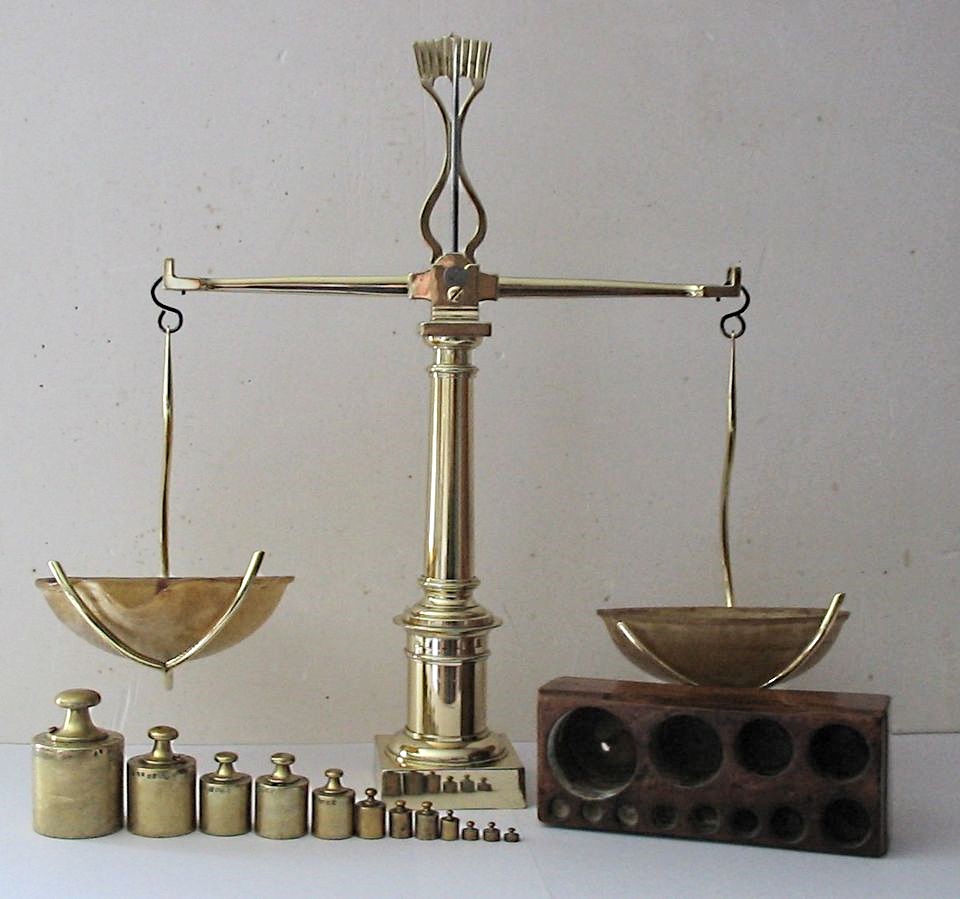
- Balance scales: Two-pan and beam balances use mechanical equilibrium and calibrated weights to determine mass.
- Spring scales: Measure weight by the extension or compression of a spring; simple and portable but affected by temperature and spring fatigue.
- Load-cell and electronic scales: Use strain-gauge or other transducers to convert force into an electrical signal processed by electronics to show a digital readout.
- Electromagnetic force-restoration balances: Maintain a balance by counteracting the load with an electromagnetic force; commonly used in high-precision analytical balances.
- Specialized scales: Platform and floor scales for heavy loads, checkweighers for production lines, postal scales, analytical and microbalances for laboratory work.
Principles of operation
Different types rely on different physical principles: mechanical equilibrium for balances, Hooke's law for spring scales, and elastic deformation of a material for strain-gauge load cells. Electronics convert small changes in resistance or current into a numerical value. Most devices present results in mass units such as grams or kilograms; these are effectively mass measures on Earth but originate from measured force due to gravity.
Calibration, accuracy and units
Calibration aligns a scale's output with known reference masses or internal standards and is essential for reliable measurements. Accuracy, resolution (smallest displayed increment) and repeatability are key performance attributes. Environmental factors—temperature, air currents, vibration and magnetic fields—affect precision. Commercial and scientific contexts often require periodic verification or certification to comply with local regulations for trade or safety.
Applications and examples
Weighing scales are used throughout society: in commerce for retail and postal services, in laboratories for chemical analysis and research, in industry and logistics for inventory and transport, and in medicine and homes for health monitoring. Specialized equipment supports batching, checkweighing, and dynamic measurement on conveyor systems.
Choosing, using and maintaining scales
- Consider capacity (maximum load), readability (smallest increment), and intended environment when selecting a scale.
- Use tare to subtract container mass; allow the instrument to warm up and level it if required.
- Perform regular calibration with certified weights or follow manufacturer procedures; protect instruments from overloads and harsh conditions.
- Be aware of buoyancy and local gravity variations when extreme accuracy is required; mass is invariant but weight depends on local gravity.
History and standards
Balance-type scales are among the oldest measurement tools, used since antiquity for trade. Over time they evolved into precise mechanical designs and, in the 20th century, into electronic and digital systems. Modern practice is supported by technical standards and legal metrology rules that define classes of accuracy, testing procedures and verification for instruments used in commercial transactions or safety-critical tasks.
Practical tips
Place scales on a stable, level surface away from drafts. Keep weighing pans clean and avoid touching the platform during measurement. For repeatable results, use appropriate sample handling and allow temperature equilibration. When in doubt about a result, repeat the measurement, check zero and tare settings, and verify calibration status.
Related articles
Author
AlegsaOnline.com Weighing scale Leandro Alegsa
URL: https://en.alegsaonline.com/art/107139