
Berber languages (Amazigh or Tamazight)
A family of closely related Afroasiatic languages spoken across North Africa—known as Berber or Amazigh—covering varieties like Kabyle, Tashelhit and Tuareg, with own scripts and growing official recognition.
Overview
The Berber languages, also called Amazigh or Tamazight, form a group of closely related languages of the Afroasiatic family. They are spoken across a broad swathe of North Africa, especially in Morocco and Algeria, but also in parts of Tunisia, Libya, Mauritania, Mali and Niger. Speakers traditionally identify as Imazighen (singular Amazigh). For an introduction to linguistic classification see language resources.
Image gallery
6 Images



Main characteristics
Berber varieties share common phonological and grammatical traits: rich consonant inventories including emphatic and uvular sounds, relatively simple vowel systems, and complex morphology that uses prefixes, suffixes and internal vocalic changes to mark gender, number and verb tense. Word order is typically VSO or SVO depending on dialect and context. Historically and today, Berber is written in Tifinagh, as well as Latin and Arabic scripts in different contexts.
Varieties and classification
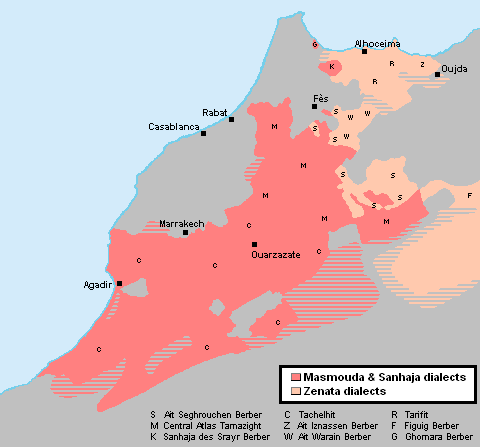
Rather than one single language, the Berber grouping is a dialect continuum with several major branches and many local varieties. Important named varieties include:
- Kabyle—widely spoken in northern Algeria.
- Tashelhit (Tachelhit) and Central Atlas Tamazight—common in Morocco.
- Tarifit—northern Morocco (Rif).
- Tuareg languages—southern Saharan varieties spanning Mali, Niger and Algeria.
- Mozabite, Zenaga and others—smaller regional varieties with distinct features.
History and development
Berber languages are one branch of the Afroasiatic family, related at a deep level to Semitic, Cushitic and other branches. Evidence of Libyco‑Berber (ancient inscriptions using early Tifinagh forms) shows continuity of indigenous North African speech. The expansion of Arabic from the 7th century and later state formations shaped patterns of bilingualism, borrowing and language shift in many regions.
Uses, revitalization and status
In recent decades there has been a cultural and political revival: standardization efforts, teaching in schools, radio and television broadcasting, and new literature in Berber languages. Morocco and Algeria have granted varying degrees of official recognition, and institutions, publishing houses and cultural organizations promote literacy in Tifinagh and Latin alphabets. Berber languages remain central to identity, music and oral traditions across many communities.
Notable distinctions
Some speakers and scholars prefer the autonym "Amazigh" over the exonym "Berber." Debates continue about whether particular varieties should be treated as separate languages or dialects, especially where mutual intelligibility is limited. Simple words like the greeting "azul" are recognized across many areas. For regional information and further reading consult available resources listed by linguistic and cultural institutions.
Related articles
Author
AlegsaOnline.com Berber languages (Amazigh or Tamazight) Leandro Alegsa
URL: https://en.alegsaonline.com/art/10653