
Benny Benson — designer of the Alaska flag
Benny Benson (1913–1972) was an Alaskan native who, as a teenager, designed the official Alaska flag. This article describes his life, the flag's symbolism, the contest, and his continuing legacy.
Overview
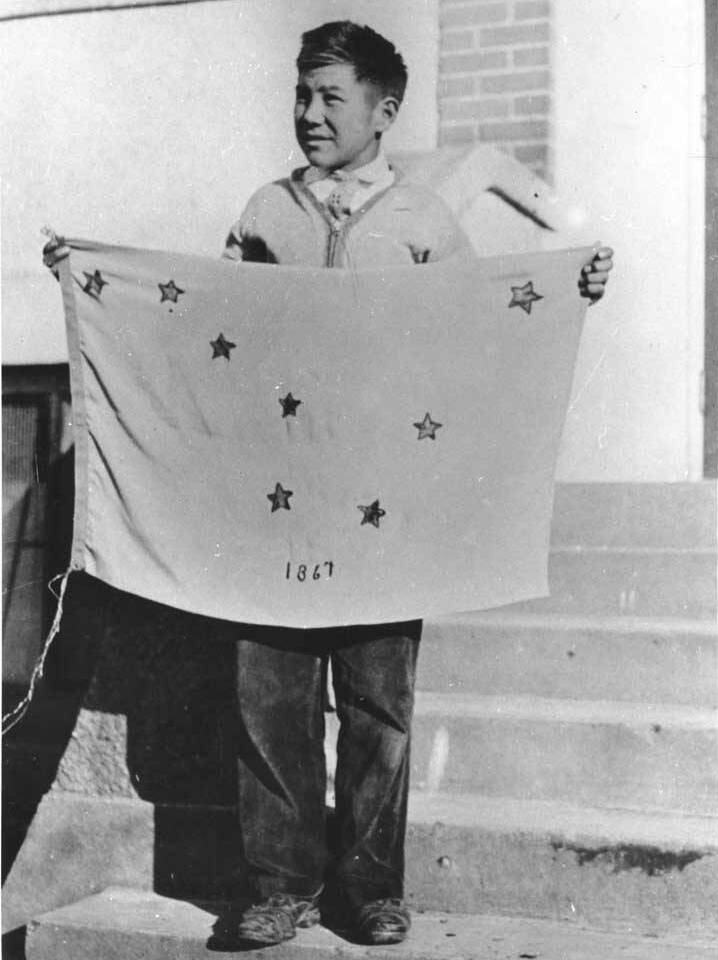
John Ben "Benny" Benson Jr. (October 12, 1913 – July 2, 1972) is best known for creating the design chosen as the official flag of the Alaska Territory when he was a young teen. His simple but evocative image — eight gold stars on a dark blue field — became a lasting symbol of Alaska and has been associated with the state ever since it was adopted in the late 1920s.
Image gallery
3 Images

Early life
Benson was born in Chignik, Alaska. After his mother died when he was three, his father placed him and his brother in a boarding home because he was unable to care for them. Benny spent part of his childhood in Unalaska and later lived at a children's home and school in Seward, where he received an education that included practical skills and trades. The institution where he studied and lived is often referenced in accounts of his youth and formative years; records and recollections emphasize the impact of that environment on his character and outlook. Learn more about the school.
Design contest and symbolism
In 1927 a territorial contest invited Alaska schoolchildren to submit flag designs. Benson, then a small teenager, entered and his proposal was judged the winner. His drawing showed the Big Dipper (part of Ursa Major) and the North Star (Polaris) on a dark blue background. The imagery was chosen for clear symbolic reasons: the North Star to represent Alaska's northern location and future statehood, and the Big Dipper as a well-known constellation suggesting strength and the natural world.
Recognition and later life
The winning design earned Benson public recognition and praise across the territory. He continued his life in Alaska and pursued work and training in practical trades typical of the region at the time. Over the years he received various honors and occasional invitations to speak about the flag and his youth. Benson's story is often cited as an example of how a single creative act by a young person can have a long-lasting cultural impact.
Legacy and notable facts
Today the Alaska flag is widely regarded as one of the more elegant and meaningful state flags in the United States. Benson's authorship is taught in Alaskan schools and commemorated in historical accounts and exhibits. Key points to remember:
- The design was submitted by a teenager living in Alaska territory.
- The flag uses celestial imagery to reflect place and aspiration.
- Benson's life story connects themes of indigenous and territorial life, childhood hardship, and creative achievement.
Benson's achievement remains a notable thread in Alaska's cultural history: a modest, visually striking flag created by a young resident that has endured as an emblem of place and identity. For further reading about sites and institutions linked to his life, see local histories and collections that document early twentieth-century Alaska and the communities of Unalaska, Seward, and other places associated with his upbringing. Additional resources are available through regional archives and educational materials about Chignik and the boarding home he attended in Seward.
Questions and answers
Q: Who is Benny Benson?
A: Benny Benson was a person who was born in Chignik, Alaska in 1913.
Q: At what age did Benny Benson lose his mother?
A: Benny Benson lost his mother when he was three years old.
Q: Why did Benny's father send him and his brother Carl to boarding school?
A: Benny's father sent him and his brother Carl to boarding school because he could not take care of them.
Q: Where did Benny grow up?
A: Benny grew up in Unalaska and later in Seward.
Q: When was Benny Benson born?
A: Benny Benson was born on October 12, 1913.
Q: When did Benny Benson die?
A: Benny Benson died on July 2, 1972.
Q: What is the full name of Benny Benson?
A: The full name of Benny Benson is John Ben "Benny" Benson Jr.
Related articles
Author
AlegsaOnline.com Benny Benson — designer of the Alaska flag Leandro Alegsa
URL: https://en.alegsaonline.com/art/10573
Sources
- dced.state.ak.us : Alaska State Website