
Upsilon (Greek letter Υ, υ)
Overview of the Greek letter Upsilon: form, sounds in ancient and modern Greek, numeric value, historical descendants, and uses in mathematics, physics and culture.
Upsilon (uppercase Υ, lowercase υ) is the twentieth letter of the Greek alphabet. It appears in written Greek as a character with distinct uppercase and lowercase shapes and carries both phonetic and symbolic roles. In alphabetic order and in the traditional Greek numeral system the letter has a fixed position and value; it also gave rise to several letters in other alphabets and is used today as a symbol in multiple scientific fields. For a general reference see Greek alphabet.
Image gallery
2 Images
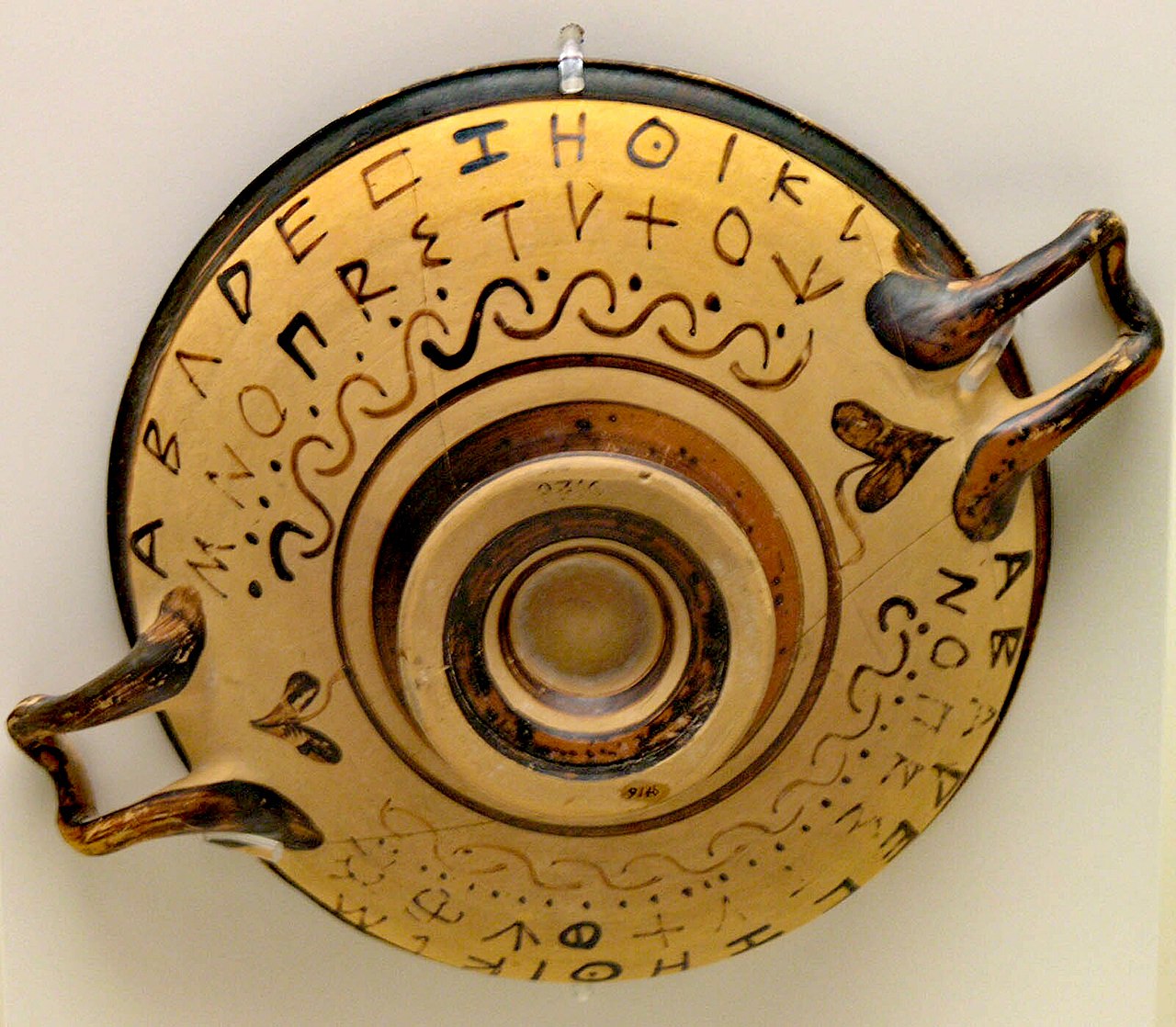
Form and pronunciation
The modern printed uppercase looks like Υ and the lowercase like υ. A stylized symbol of the uppercase form is often shown in typographic charts for ancient and modern pronunciation. Historically, Upsilon represented a close back rounded vowel similar to English "u" in Ancient Greek, while in Modern Greek its quality shifted to a close front vowel approximating the sound of "i". The letter functions both as a letter in writing and as a numeric sign: in the classical Greek numeral scheme its value is 400 (Greek numerals).
History and descendants
Upsilon is of Phoenician origin like other letters in the Greek set. Through the adaptations of the Greek alphabet by the Etruscans and Romans, the character influenced the shape and use of several Latin letters. In particular, characters that developed from Upsilon include U, V and Y in the Roman alphabet; the Cyrillic letter У is also a direct descendant. Each of these descendants took on different phonetic roles in their respective languages while retaining a visual kinship to the Greek ancestor. For more on letter evolution see Latin U, Latin V and Latin Y.
Uses in mathematics and science
Upsilon appears frequently as a symbol in technical fields. In mathematics the uppercase letter is sometimes used to name special functions or operators, while the lowercase form commonly serves as a generic variable or parameter in formulas; references to mathematical notation can be found at mathematical conventions and in discussions of related special functions such as the Riemann zeta family (see related zeta functions). In particle physics the uppercase Υ denotes the upsilon meson family — bound states of a bottom quark and its antiquark (a bottomonium series). These resonances are important in studies of the strong force and quark dynamics; readers can consult standard particle physics summaries for details.
Other usages and notable facts
Beyond linguistics and science, Upsilon has been employed as a mark or symbol in various scholarly and historical contexts. In some typographic and scholarly traditions Greek letters are used as shorthand labels for items or signs; older astrological or manuscript sources sometimes use Greek letters as identifiers (astrology manuscripts) and as symbols for particular signs or annotations (symbol lists). Today the letter remains a familiar emblem in academic notation, logos, and educational materials.
Quick reference
- Alphabet position: 20th.
- Numeric value (Greek numerals): 400.
- Ancient pronunciation: close back rounded vowel (like "u").
- Modern pronunciation: front vowel similar to "i".
- Descendants: Latin U, V, Y; Cyrillic У.
- Common symbolic uses: variables, special functions, and the upsilon meson in physics.
For introductory charts and further reading on characters and notation, consult general alphabet and scientific-symbol references linked above.
Related articles
Author
AlegsaOnline.com Upsilon (Greek letter Υ, υ) Leandro Alegsa
URL: https://en.alegsaonline.com/art/103517