
Treaty of New Echota (1835)
United States treaty signed in 1835 with a minority Cherokee faction that ceded southeastern Cherokee lands and led to forced removal known as the Trail of Tears.
Treaty of New Echota was an agreement signed on December 29, 1835, at New Echota, then the capital of the Cherokee Nation. It is recorded in the United States Statutes at Large as 7 Stat. 488. The treaty transferred Cherokee title to lands in the southeastern United States to the federal government in exchange for land in the designated Indian Territory and other considerations. The document and its aftermath remain central to understanding the U.S. policy of Indian removal in the 1830s. New Echota site
Image gallery
4 Images

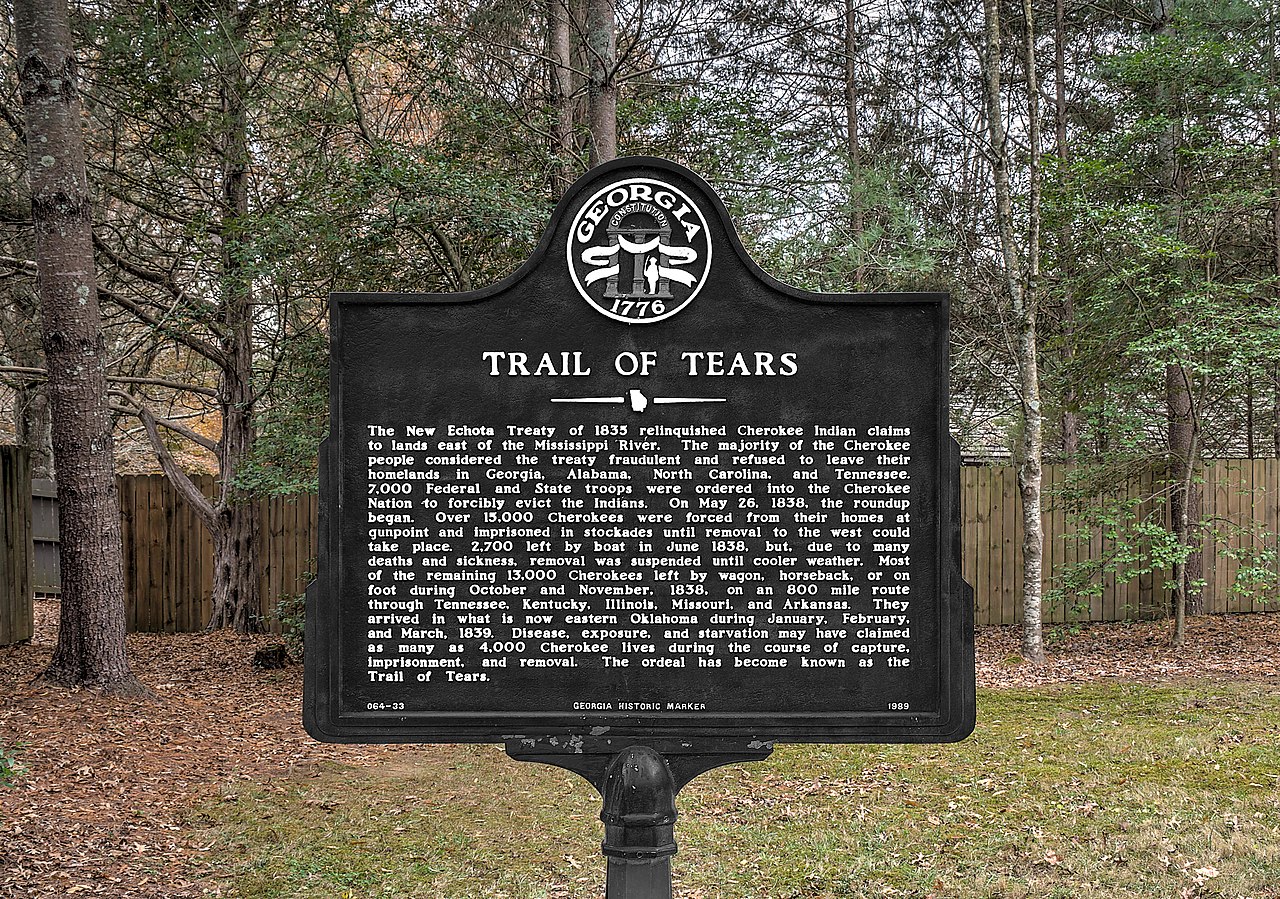

Background and negotiation
Negotiations took place amid intense pressure from state governments and following the Indian Removal Act of 1830. A small group of Cherokees, known as the Treaty Party and including several prominent members who believed removal was inevitable, signed the agreement with U.S. representatives. The Cherokee National Council and Principal Chief John Ross opposed the treaty as unauthorized and refused to accept its terms. The division within the Cherokee community produced a lasting political and moral controversy. Treaty Party context
Principal provisions
- Exchange of ancestral southeastern lands for specified territory in Indian Territory (present-day Oklahoma) and federal payments or annuities over time.
- Provision for voluntary relocation within a stated period, with guarantees of supplies and assistance, according to the treaty text.
- Clauses addressing property, debts, and protections for Cherokees who remained or became U.S. citizens.
These provisions were written to effect a complete cession of Cherokee lands in the Southeast and to establish a mechanism for removal and compensation. Treaty provisions
Ratification, enforcement, and the Trail of Tears
The U.S. Senate ratified the treaty amid heated debate in 1836 by a narrow margin, a decision that the Cherokee leadership and many historians later described as illegitimate because the signers did not represent the majority. Federal authorities enforced the removal policy in 1838–1839, when thousands of Cherokees were forced to march west in what became known as the Trail of Tears. On that journey, many died from disease, exposure, and hardship. The episode stands as one of the most tragic consequences of 19th-century Indian removal policy. Removal enforcement
Legacy and legal significance
The treaty has continued to affect legal and historical debates about sovereignty, treaty rights, and suffering caused by forced removal. Descendants, historians, and courts have examined compensation, land claims, and the circumstances of ratification. The event is commemorated and studied as an example of contested treaty-making and the consequences of federal Indian policy. For further reading and resources, see related archival and interpretive materials. Further resources
Related articles
Author
AlegsaOnline.com Treaty of New Echota (1835) Leandro Alegsa
URL: https://en.alegsaonline.com/art/101301