
Trdat the Architect
Armenian chief architect of the Bagratuni court (c. 950–1020), traditionally credited with the cathedral of Ani and the late-10th-century repair of the Hagia Sophia dome in Constantinople.
Trdat the Architect (Armenian: Տրդատ ճարտարապետ; c. 950–1020) was the principal royal architect for the Bagratuni kings of medieval Armenia. He is best known for his role in large stone church construction in the Armenian kingdom and for being sent to Constantinople to help repair the domed structure of Hagia Sophia after the great earthquake of 989. His career illustrates the technical skill and regional influence of Armenian builders at the end of the first millennium. Further reference
Image gallery
2 Images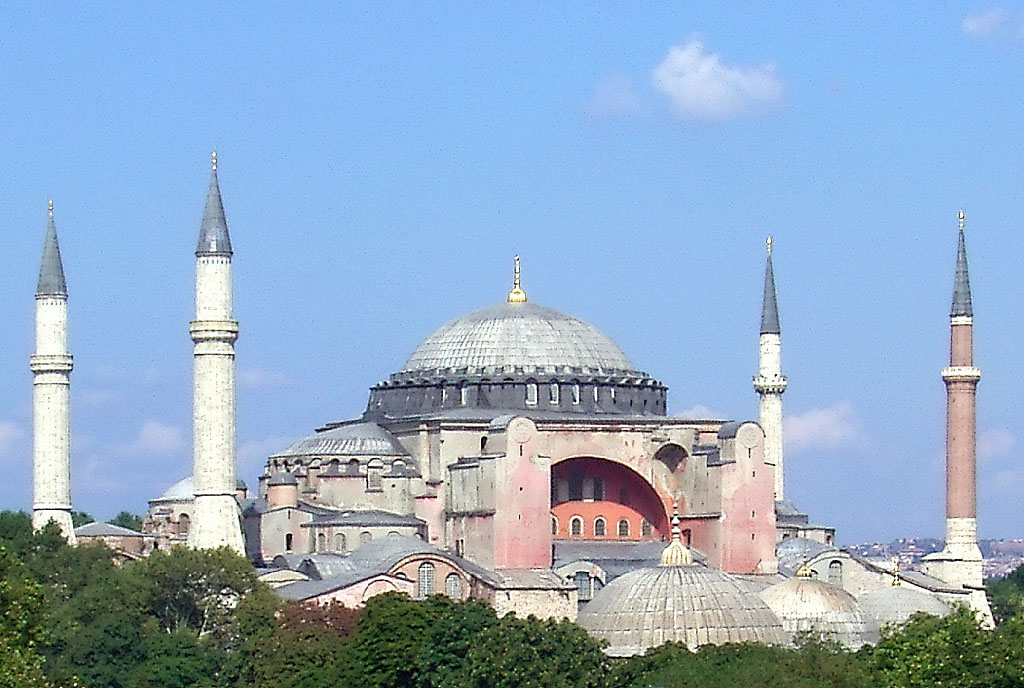

Overview and historical context
Trdat served under the Bagratid dynasty during a period of political and cultural flourishing. Armenian architecture of this era combined local masonry traditions with innovations in vaulting and dome construction, producing compact, vertically oriented churches often set on a cruciform plan. Trdat appears in later medieval chronicles and in architectural history as a master-builder who translated those traditions into major monuments. Context source
Major works and the Constantinople mission
Among works traditionally attributed to Trdat is the cathedral at Ani, the medieval Armenian capital, begun around the end of the 10th century. That cathedral demonstrates a bold drum-and-dome silhouette and refined stone carving, characteristics associated with his workshop. After the 989 earthquake damaged the dome of Hagia Sophia, Byzantine authorities invited Armenian craftsmen; Trdat is recorded as supervising repairs that were completed by about 994. This commission is often cited as evidence of technical exchange between Byzantine and Armenian builders. Primary note Byzantine link
Architectural characteristics
- Use of a tall cylindrical or polygonal drum to elevate a conical or hemispherical dome.
- Cruciform or centrally planned interiors with thick stone walls for seismic stability.
- Exterior articulation with blind arcades, pilasters and geometric stone carving.
These features reflect practical responses to local materials and earthquake risks as well as aesthetic preferences. Trdat's buildings emphasize verticality and carefully proportioned masses. Architectural study
Legacy and significance
Trdat's reputation rests both on surviving monuments and on historical accounts that show the mobility of craftsmen and ideas across political boundaries. His association with the Hagia Sophia repairs has been highlighted as a notable moment of cross-cultural cooperation in the medieval eastern Mediterranean. Modern scholars continue to study the surviving masonry and written records to better understand his methods and workshop organization. Scholarly review Archival note
Although many details of Trdat's life remain uncertain, his name endures in the study of Armenian medieval architecture and in discussions of Byzantine–Armenian technical exchange. For introductions and further reading see general surveys and specialized studies. Survey Specialized study
Related articles
Author
AlegsaOnline.com Trdat the Architect Leandro Alegsa
URL: https://en.alegsaonline.com/art/101269