
Tortoise: terrestrial shelled reptiles of the order Testudines
A tortoise is a land-dwelling member of the turtle order (Testudines). This article explains their anatomy, behavior, island giants, history, and conservation challenges.
Overview: A tortoise is a primarily land-dwelling reptile that belongs to the order of turtles commonly called Testudines. Tortoises are distinguished from many aquatic turtles by adaptations for life on land: they are generally slower, have stouter limbs, and carry a protective shell that serves as a mobile shield. The word "tortoise" is often used loosely in everyday speech, but in natural history it denotes the terrestrial members of the broader turtle group (reptile classification).
Image gallery
10 Images


Key characteristics
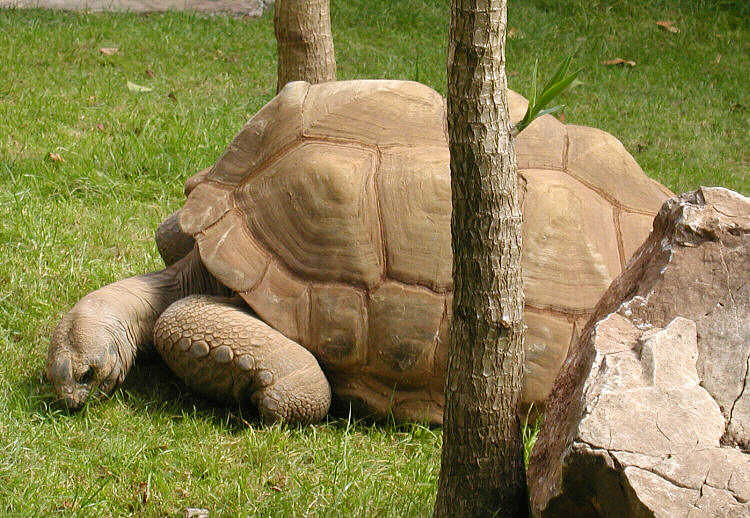
Tortoises share several morphological traits that suit a terrestrial lifestyle. Typical features include a domed, heavy shell made of fused bone and keratin, columnar and elephantine legs without webbing, and a herbivorous or omnivorous diet in many species. Their jaws are beak-like rather than toothed, adapted to cropping vegetation. Reproductive biology is similar to other turtles: females lay eggs in nests dug in soil and young emerge fully formed.
- Shell: rigid domed carapace and plastron protect organs and provide defense.
- Limbs: stout, adapted for weight bearing rather than swimming.
- Lifespan: many tortoises are long-lived; some species can live for decades and individuals are sometimes noted to exceed a century.
History, evolution and island gigantism
Tortoises have a long evolutionary history within the order that includes both terrestrial and aquatic lineages. On isolated islands, such as the Galápagos and the Seychelles, tortoises have independently evolved very large body sizes in a phenomenon known as island gigantism. Famous examples include the Galápagos and Aldabra giant tortoises, which became symbols of natural history study. Early naturalists, including Darwin, examined these populations; subsequent research showed that populations on different islands often develop distinct shell shapes and sizes, a pattern that informed later work on evolution and speciation. For general context on comparisons, see discussions of sea turtles and how aquatic habits differ from tortoise adaptations.
Variation among tortoises can be subtle or pronounced: some island forms reached very large sizes through repeated evolutionary shifts (size evolution on islands), while continental species tend to be smaller and more numerous. Taxonomists group most terrestrial tortoises in the family Testudinidae, but exact classifications continue to be refined as genetic data accumulate.
Conservation, human interactions, and notable facts
Tortoises are affected by habitat loss, introduced predators and competitors, hunting, and the pet trade. Conservation efforts include protected areas, captive-breeding and reintroduction programs, and invasive-species control on islands. Notable human interactions range from cultural reverence and scientific study to historical overexploitation. Key modern concerns are listed below.
- Habitat destruction and fragmentation reduce available forage and nesting sites.
- Introduced mammals (rats, pigs, goats) can destroy nests and compete for vegetation.
- Illegal collection and trade threaten some rare species.
For further reading about tortoise biology and conservation, consult general reptile guides and region-specific literature. Academic and public resources vary in depth and scope; readers may follow introductory links to broader turtle biology or conservation organizations for updates and practical guidance on coexistence and protection.
Classification overview • Order Testudines • Sea turtle comparisons • Island gigantism • Historical naturalists
Related articles
Author
AlegsaOnline.com Tortoise: terrestrial shelled reptiles of the order Testudines Leandro Alegsa
URL: https://en.alegsaonline.com/art/100770