
Toroid (geometry)
A toroid is a doughnut-like geometric form produced by revolving a plane figure about an external axis; it includes tori and related ring-shaped solids with applications in topology and engineering.
Overview
A toroid is a ring-shaped geometric object formed when a plane curve is revolved around an axis that does not intersect the curve. In everyday language it often evokes the familiar donut or inner tube, but the term covers a wider family of shapes. For a general discussion of geometric forms see shape and for related entries see related shapes. The classic case, obtained by rotating a circle, is the torus: see torus.
Image gallery
1 Image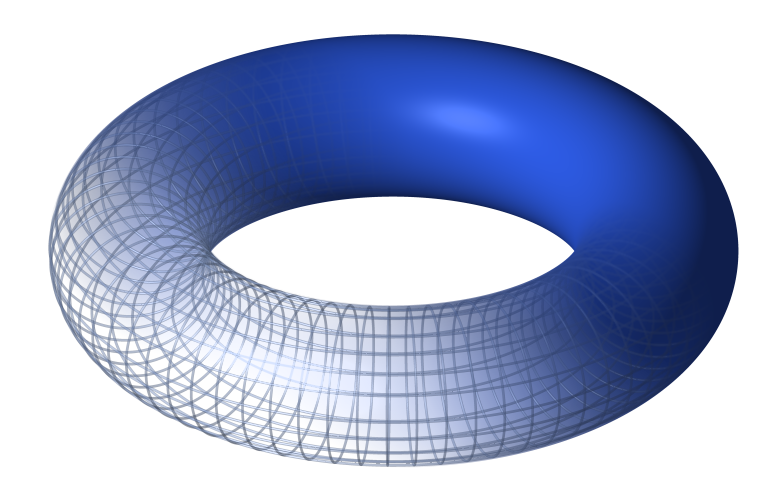
Construction and basic characteristics
Constructing a toroid typically means taking a planar curve (a circle, ellipse, polygonal arc, etc.) and revolving it about an external axis. This generates a central hole and a circular symmetry around the axis. Characteristics used to describe toroids include the major radius (distance from the center of the hole to the center of the cross-section) and the minor radius (size of the cross-section). The process of producing the shape is a kind of rotation or revolution; for technical details on rotational constructions see rotation.
Types and distinctions
- Ring torus: the common donut form with distinct hole.
- Horn torus: the hole reduces to a point.
- Spindle torus: self-intersecting when the generating circle crosses the axis.
Topology and mathematical importance
In topology the torus is a compact, orientable surface of genus one; it supports distinct properties such as nontrivial loops that cannot be contracted to a point. Toroidal geometry appears in differential geometry, algebraic topology and complex analysis as a standard example of a surface with a hole.
Uses and examples
Toroidal shapes appear in engineering (toroidal transformers and inductors), physics (toroidal magnetic confinement devices), everyday objects (doughnuts, swim rings) and computer graphics (modeling smooth, circularly symmetric forms). For a simple planar example consider rotating a circle about an external axis to obtain the standard torus.
Notes and further reading
Toroid is often used as a general descriptor for torus-like solids; when precision matters one distinguishes the torus (surface) from a solid toroid (filled ring). For introductory material consult pedagogical references or geometry texts linked under torus and shape.
Related articles
Author
AlegsaOnline.com Toroid (geometry) Leandro Alegsa
URL: https://en.alegsaonline.com/art/100708