
The Sunday Woman — 1975 Italian mystery film
1975 Italian thriller/mystery directed by Luigi Comencini, adapted from the novel La donna della domenica. Noted for performances by Marcello Mastroianni, Jacqueline Bisset and Jean‑Louis Trintignant.
The Sunday Woman is a 1975 Italian mystery film directed by Luigi Comencini, adapted from the bestselling novel La donna della domenica by Carlo Fruttero and Franco Lucentini. The motion picture updates the book's social portrait into a cinematic investigation that blends procedural elements with satirical observation of upper‑class life. It was released internationally and distributed by 20th Century Fox.
Image gallery
1 Image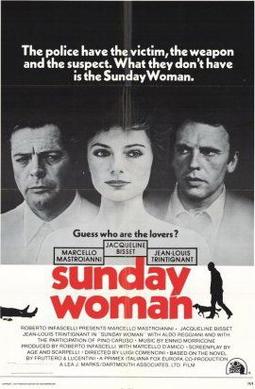
Overview and themes
At its center the film follows a murder inquiry that exposes rivalries, secrets and hypocrisies among Turin's bourgeoisie. Rather than emphasizing violent spectacle, the story focuses on character, motive and the cultural context that surrounds the crime. Themes include class tension, the interplay of private and public persona, and the ironies of polite society when confronted with scandal.
Production and principal cast
Luigi Comencini, known for films that mix comedy and human drama, steered a cast that combined Italian stars and international names. The ensemble is led by Marcello Mastroianni, alongside Jacqueline Bisset and Jean‑Louis Trintignant. The Italian title appears as La donna della domenica in credits and promotional materials. The production emphasizes atmosphere, dialogue and the choreography of social encounters as much as the procedural steps of the investigation.
Style and genre placement
Although often described broadly as a thriller, the film occupies a crossover space between mystery, social satire and character study. Unlike many Italian giallo films that foreground stylized violence, this picture is restrained and analytical, using the whodunit structure to examine attitudes and institutions. Its pacing and emphasis on performance make it as much a drama about manners as a crime story.
Reception and legacy
Upon release the film drew attention for its distinguished cast and literate source material. Critics noted Comencini's skill in adapting a popular novel while preserving its ironic tone. Over time the movie has been discussed in studies of Italian cinema for how it reflects 1970s urban life and for its place in the careers of the leading actors. It remains of interest to viewers who appreciate mystery narratives anchored in social realism.
Notable facts
- The film is an adaptation of a contemporary Italian novel that was popular at home and translated abroad.
- Its approach favors character and setting over sensational effects, distinguishing it from contemporaneous crime thrillers.
- It is commonly referenced in filmographies of the principal cast and in surveys of Italian cinema of the 1970s.
For readers seeking more detail about the book and film, production notes and cast listings are available in cinematic reference works and in editions of the original novel; the credited Italian title and principal performers are useful search terms for locating archival information and reviews.
Related articles
Author
AlegsaOnline.com The Sunday Woman — 1975 Italian mystery film Leandro Alegsa
URL: https://en.alegsaonline.com/art/98936