
The Night Watch (Rembrandt) — The Company of Frans Banning Cocq
A 1642 oil-on-canvas group portrait by Rembrandt, The Night Watch is a landmark of the Dutch Golden Age, renowned for its large scale, dramatic lighting, narrative composition, and its home in the Rijksmuseum, Amsterdam.
Rembrandt van Rijn’s The Night Watch is the popular name for the large group portrait formally titled The Company of Frans Banning Cocq and Willem van Ruytenburch. Painted in 1642 in oil on canvas, it depicts an Amsterdam civic militia company in a dynamic, almost theatrical arrangement rather than the static rows typical of the genre. Its scale, painterly handling and use of light make it one of the most celebrated works of the Dutch Golden Age.
Image gallery
6 Images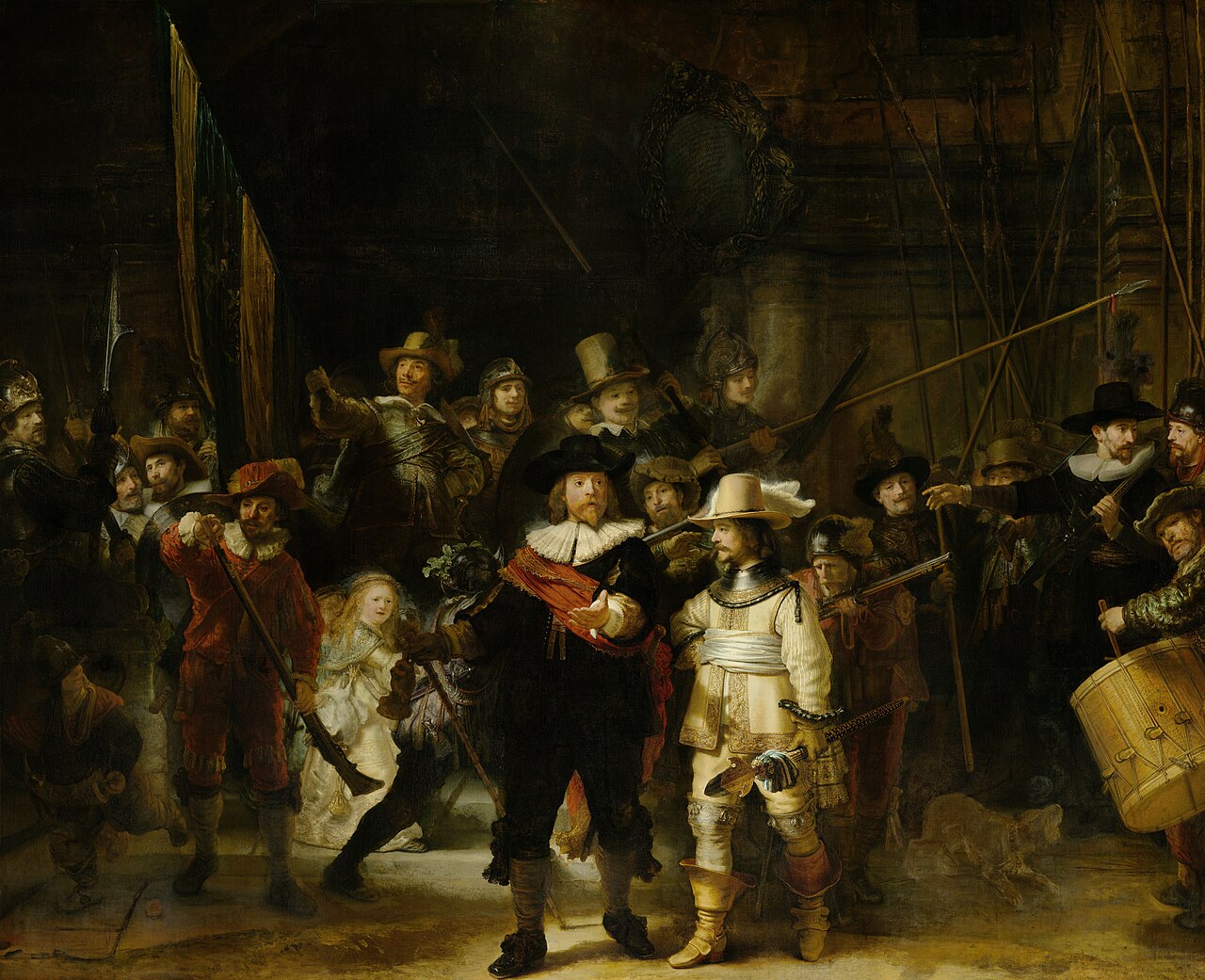


Composition and visual features
The canvas measures approximately 379.5 by 453.5 cm and presents a scene filled with movement: figures turn, reach and step forward, while strong diagonals and contrasts of light and shadow (chiaroscuro) guide the eye. A brightly lit central pair—the captain, Frans Banning Cocq, and his lieutenant, Willem van Ruytenburch—act as focal points. Rembrandt emphasizes individuality and action, with secondary figures emerging from shadow, varied gestures and a sense of depth created by overlapping forms and varied scale. Small elements, including a girl who carries a bird and a dog in the foreground, function as symbolic or identifying details associated with the company’s emblems and civic identity.
History and provenance
Originally painted for a civic guardroom in Amsterdam, the work has been relocated several times and since the 19th century has been a central attraction of the Rijksmuseum. In the early 18th century the canvas was trimmed to fit a new setting, cutting away portions of the original composition; later moves and re-hangings also affected its presentation. The painting’s popular name, The Night Watch, arose after varnish darkening made the scene appear nocturnal, though Rembrandt did not intend it as a night scene.
Conservation, research and reception
Over centuries the painting has undergone cleaning, restoration and scientific study. Technical examinations (including infrared and X‑ray imaging) have revealed pentimenti and changes in the underdrawing, showing how Rembrandt reworked the composition while painting. The canvas has also survived vandalism and deliberate attacks in the 20th century; conservators have focused on stabilizing the surface and recovering Rembrandt’s paintwork while documenting earlier interventions. Scholars and the public alike value the painting for its inventive approach to group portraiture, narrative energy and masterful handling of light.
Notable facts
- Artist: Rembrandt van Rijn.
- Date: 1642.
- Full title: The Company of Frans Banning Cocq and Willem van Ruytenburch.
- Medium and size: Oil on canvas; roughly 379.5 × 453.5 cm.
- Location: The Rijksmuseum, Amsterdam, where it remains a centerpiece.
The Night Watch continues to be intensively studied and exhibited. It is cited in discussions of seventeenth‑century civic culture, the development of portraiture and Rembrandt’s mature artistic strategies. For further general information on the artist and related works, see resources on Rembrandt and Dutch Golden Age painting.
Related articles
Author
AlegsaOnline.com The Night Watch (Rembrandt) — The Company of Frans Banning Cocq Leandro Alegsa
URL: https://en.alegsaonline.com/art/98531