
The Karate Kid Part III (1989) — film overview and legacy
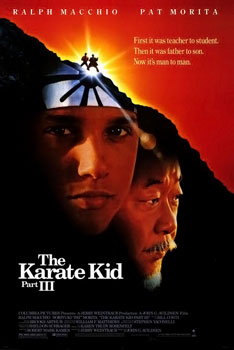
1989 sequel to The Karate Kid directed by John G. Avildsen. Follows a revenge plot by John Kreese and Terry Silver against Daniel LaRusso and Mr. Miyagi; introduced a memorable antagonist and received mixed reviews.
Overview
The Karate Kid Part III is a 1989 American martial arts drama film and the second sequel to the original The Karate Kid (1984). It continues the story of Daniel LaRusso and his mentor Mr. Miyagi and shifts the series toward a darker, revenge-driven narrative. The picture reunites lead actors Ralph Macchio and Pat Morita with director John G. Avildsen, writer Robert Mark Kamen, composer Bill Conti and fight choreographer Pat E. Johnson.
Image gallery
2 Images
Plot summary
Following the events of the earlier films, John Kreese seeks vengeance against Daniel LaRusso and Mr. Miyagi. He recruits wealthy friend Terry Silver to carry out an elaborate scheme of manipulation and sabotage. Silver poses as a benefactor to win Daniel's trust while privately undermining his confidence and encouraging ruthless tactics. He also brings in an aggressive fighter to challenge Daniel at competition, escalating the personal stakes. The film explores themes of manipulation, the corrosive effects of revenge and the struggle to maintain honor when pressured to abandon one's principles.
Cast and production
- Ralph Macchio as Daniel LaRusso — returning protagonist.
- Pat Morita as Mr. Miyagi — the mentor whose methods and moral code are tested.
- Robyn Lively as Jessica Andrews — Daniel's friend and romantic interest in this entry.
- Thomas Ian Griffith as Terry Silver — the primary antagonist; this film marked his first major screen role.
- Sean Kanan appears as the physically imposing rival hired to challenge Daniel.
The film kept much of the original creative team: Avildsen returned to direct, Robert Mark Kamen provided the screenplay framework, Bill Conti composed the score, and Pat E. Johnson led stunt and fight choreography. Production choices emphasized more confrontational fight staging and psychological manipulation rather than the quieter coming-of-age beats of the first film.
Development and filming
Development for the sequel focused on raising the dramatic stakes by introducing a behind-the-scenes antagonist who could operate through deception rather than open hostility. Casting brought new performers into established roles and relied on returning stars to maintain continuity. Filming preserved many visual motifs from prior films while staging several more aggressive action set pieces. The production worked to balance tournament sequences with scenes intended to show how a mentor–student relationship can be targeted by external influences.
Themes and style
Part III stresses the difference between disciplined training and abusive or mercenary instruction, contrasting Mr. Miyagi's patient methods with Terry Silver's cynical, ends-justify-the-means approach. The screenplay examines how ambition and fear can tempt a young protagonist to adopt dishonorable methods, and how community and mentorship can resist such erosion. Stylistically, the film alternates between soap-opera interpersonal drama and conventional sports-tournament beats, using more tense, confrontational moments to underline its themes.
Reception
On release the film received mixed to negative reviews from many critics. Praise tended to focus on committed performances by the leads, while criticism targeted the tonal shift and a plot some saw as contrived. Public and fan response was similarly mixed: some viewers appreciated the darker turn and the new antagonist, while others felt the entry lacked the emotional clarity of the original. Over time the film has been discussed as a transitional chapter in the franchise, notable chiefly for introducing Terry Silver as a memorable foil.
Soundtrack, choreography and technical notes
Bill Conti's score continued to provide the series with musical continuity while aligning the music to more aggressive scenes. Pat E. Johnson's fight choreography remained a central technical element, emphasizing believable strikes and tournament staging. The production design and costume choices aimed to keep a late-1980s visual identity consistent with prior entries while supporting the film's heightened dramatic tone.
Legacy and later references
While often ranked below the original film by critics and many fans, Part III expanded the franchise's roster of antagonists and narrative possibilities. The character of Terry Silver proved durable and was revisited in later franchise continuations and adaptations, which drew upon the events and characterization introduced in this installment. The film's emphasis on manipulation and corrosive influence has been cited in discussions of how sequels reshape central relationships in long-running series.
Home media and further reading
The Karate Kid Part III has been released on multiple home media formats since its theatrical run and is commonly included in series box sets. For readers seeking more context, consult entries on the original The Karate Kid, profiles of leading performers such as Ralph Macchio and Pat Morita, and background on director John G. Avildsen and the place of the film within late-1980s martial arts cinema. Critical retrospectives and interviews with cast and crew provide additional perspective on the production's intentions and its reception over time.
Notable facts
- The film introduced Thomas Ian Griffith in a prominent antagonist role that would remain associated with the franchise.
- Fight choreography and the series' musical themes provided continuity with earlier entries.
- Part III is frequently discussed as a turning point in the series' tone and an example of how sequels can change the moral focus of established characters.
Related articles
Author
AlegsaOnline.com The Karate Kid Part III (1989) — film overview and legacy Leandro Alegsa
URL: https://en.alegsaonline.com/art/98257