
The Great Train Robbery (1903 film)
A concise encyclopedia article on Edwin S. Porter’s 1903 film The Great Train Robbery, its story, innovative techniques, production background, and lasting influence on narrative cinema.
Overview
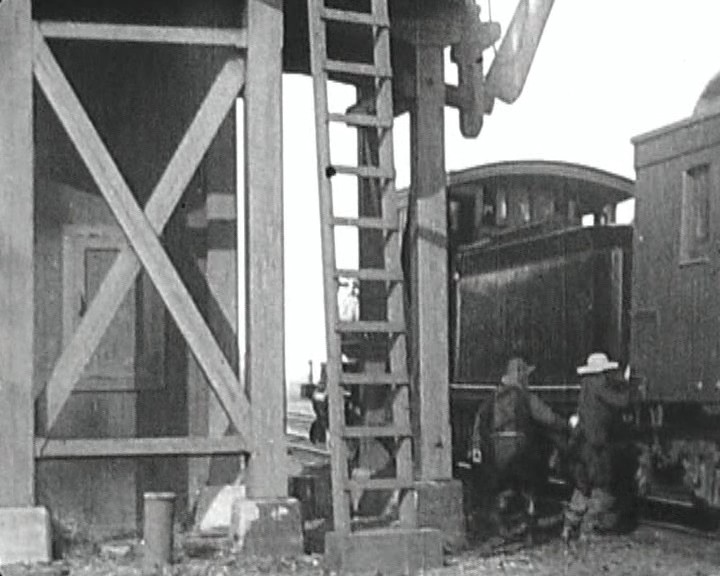
The Great Train Robbery is a 1903 American western silent movie directed and photographed by Edwin S. Porter. Running about 12 minutes, it tells a short, coherent narrative about an armed robbery of a train, the criminals' escape, and the capture of some of the gang. The picture is often cited as a milestone in early cinema for its successful use of sequential storytelling and for bringing many film techniques together in a single popular short.
Image gallery
10 Images




Plot and structure
The film unfolds in a series of scenes that show the planning and execution of the robbery, an assault on the train, and a pursuit of the outlaws. Its editing stitches discrete scenes into a clear linear story rather than a mere recorded event. The movie is also famous for a closing shot in which one of the bandits points a pistol directly at the camera and fires — an image that became one of early cinema’s most recognizable moments.
Techniques and stylistic innovations
While not the first film to use individual tricks, the production assembled several then-novel approaches into a longer, more elaborate narrative. These include:
- Cross-cutting to imply simultaneous action at different locations.
- Camera movement and varying shot compositions to follow action more dynamically.
- On-location shooting for exterior realism rather than relying solely on studio sets.
- Occasional hand-colouring of prints to heighten dramatic moments.
Porter had experimented with some of these ideas in an earlier film, Life of an American Fireman, and in moviemaking techniques generally; The Great Train Robbery consolidated them in a format that audiences found exciting and easy to follow.
Production and release
The film credits show that Edwin S. Porter not only directed but also wrote, produced, and photographed the picture, reflecting the multi-role approach common in early film production. Shooting took place on location in Milltown, New Jersey, and for distribution it circulated widely in nickelodeons and touring programs, helping to popularize the new narrative short. Contemporary descriptions also call it a landmark silent film achievement.
Legacy and importance
The Great Train Robbery is frequently taught and cited as an important step toward modern film grammar. Its emphasis on continuity editing, clearly motivated cuts, and an easily grasped story influenced filmmakers who followed and helped establish the conventions of the Western and the action film. The picture’s commercial success demonstrated that longer, story-driven films could attract audiences.
Preservation and notable facts
The film has been recognized for its cultural and historical significance and has been selected for preservation by national archives. It remains widely available in restored prints and anthologies of early cinema. Other notable points include:
- Some surviving copies show hand-colored frames used to dramatize fires or other effects.
- Its final shot, aimed at the viewer, anticipated later direct-address techniques and publicity strategies.
- It exemplifies how a single short film can combine technical experiments and popular storytelling to shape an emerging art form.
For readers seeking further background on the director and production context, sources and collections of early motion pictures often include detailed notes on Porter's role as writer and producer (credit, production) and on his career (Edwin S. Porter).
Related articles
Author
AlegsaOnline.com The Great Train Robbery (1903 film) Leandro Alegsa
URL: https://en.alegsaonline.com/art/98100