
The Day Before the Revolution (short story)
A 1974 short story by Ursula K. Le Guin that revisits Odo, the founding thinker of Anarres, exploring memory, aging, and the personal side of revolutionary ideas connected to The Dispossessed.
Overview
"The Day Before the Revolution" is a 1974 science fiction short story by Ursula K. Le Guin. It serves as a companion piece to her novel The Dispossessed, returning readers to the social and philosophical world that produced the anarchist society known as Anarres. Rather than describing a mass uprising, the story concentrates on the intimate perspective of Odo, the thinker and activist whose ideas inspired the revolution. The narrative dwells on memory, identity, and the private consequences of public ideas.
Image gallery
2 Images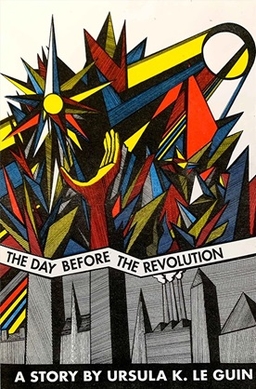

Plot summary
The plot is compact and meditative. It follows an elderly woman identified with Odo as she navigates ordinary moments, recollects past sacrifices, and contemplates the movement she helped begin. Events are not presented as a conventional chronology of political action; instead the story juxtaposes present sensations with recollected episodes, revealing how personal history and public legacy intertwine in a single life.
Themes and style
Le Guin uses spare, lyrical prose to examine several recurring themes: the nature of political legacy, the experience of aging, and the gap between revolutionary ideals and everyday practice. The story emphasizes interiority and small domestic details, using them to illuminate broader ethical questions. Critics and readers have noted how Le Guin compresses a lifetime of thought into evocative snapshots rather than extended argument.
Relation to the Hainish universe and The Dispossessed
Although short, the piece enriches the background of the Hainish Cycle by offering a human scale view of the intellectual origins of Anarres. It clarifies, without repeating, material from The Dispossessed and invites readers to consider the emotional as well as theoretical roots of a political movement. For readers interested in different formats, consult general introductions to the short form and genre surveys.
Narrative voice and characterization
The story is notable for its warm and sympathetic portrayal of an older protagonist. Le Guin avoids heroic mythologizing; instead she presents Odo as fallible, corporeal, and reflective. The narrative voice shifts between close interior monologue and a restrained, observant third-person perspective, a technique that foregrounds both thought and sensation.
Reception and legacy
From its first appearance the story attracted attention for its emotional depth and concision. It is widely anthologized and discussed in studies of Le Guin's political imagination. Readers often recommend it as an accessible entry point to Le Guin's larger political concerns and as a concise complement to full-length treatments of anarchism in speculative fiction. For author context see biographical resources on Ursula K. Le Guin.
Themes in criticism and study
- Legacy: how revolutionary thought becomes collective practice and ritual.
- Aging and embodiment: the lived body as repository of political memory.
- Ethics of everyday life: the recurring tension between ideals and small acts.
Further reading and resources
Those seeking editions, essays, or teaching materials can look to collected stories and critical works that place Le Guin's tale in conversations about utopia and anarchism. Suggested starting points include discussions of the short story as a form and critical introductions, commentaries on anarchist themes in literature and political theory, and historical notes on the fictional revolution that established Anarres. For bibliographic listings and scholarly guides consult general literary databases and curated collections of short fiction and specialized author bibliographies on Le Guin.
Notes on reading
Readers approaching the story for the first time will find its power in restraint: it does not explain every historical detail of its fictional movement, but it offers a concentrated human portrait that illuminates why political ideas matter to ordinary lives. That quality makes the piece valuable both as a standalone work and as part of the larger Hainish corpus.
Related articles
Author
AlegsaOnline.com The Day Before the Revolution (short story) Leandro Alegsa
URL: https://en.alegsaonline.com/art/97857