
Tesla coil: high-voltage resonant transformer and radio-frequency oscillator
A Tesla coil is a resonant transformer and RF oscillator invented by Nikola Tesla that produces high-voltage, low-current discharges for demonstration, experimentation and musical effects.
Overview
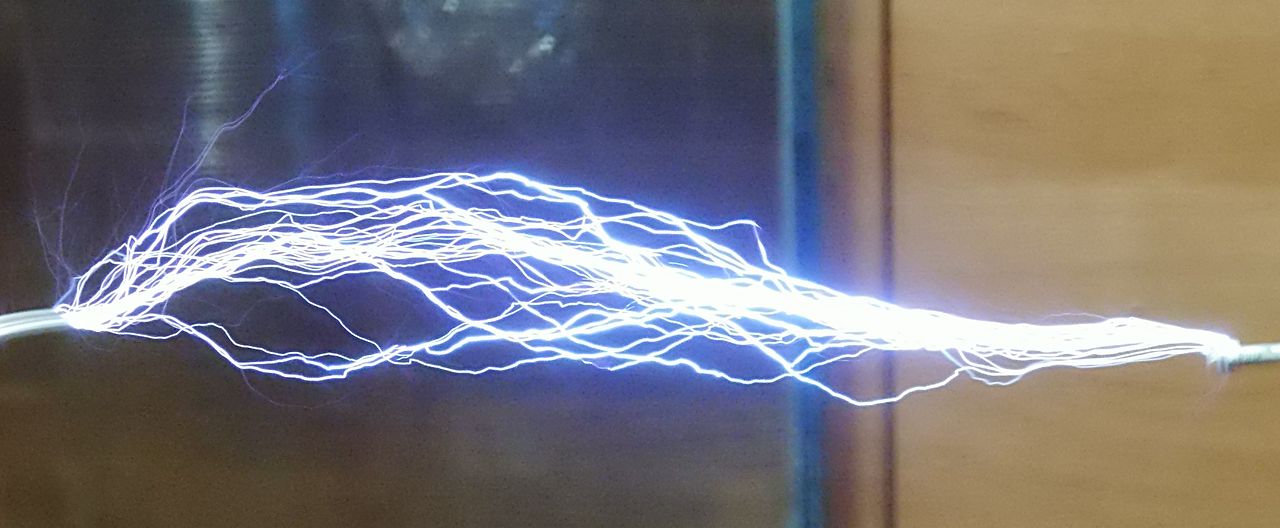
A Tesla coil is an electrical machine invented by Nikola Tesla in the late 19th century to generate high-voltage, low-current, radio-frequency electricity. It is a resonant transformer and oscillator that can produce visible, often dramatic, electrical discharges that resemble miniature lightning. Modern Tesla coils are widely used for educational demonstrations, museum exhibits, art installations, and hobbyist projects.
Image gallery
10 Images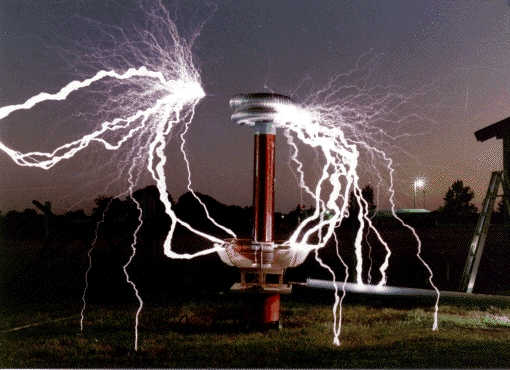





Basic design and operation
Most Tesla coils consist of two coupled resonant circuits: a primary low-voltage circuit and a secondary high-voltage circuit. Energy is stored temporarily in a primary capacitor or tank circuit and then released in a pulse through a spark gap or an electronic switching device. The resulting oscillation in the primary is magnetically coupled to the secondary coil. When the primary and secondary are tuned to the same resonant frequency, energy transfers efficiently and the secondary builds very high voltages at radio frequencies.
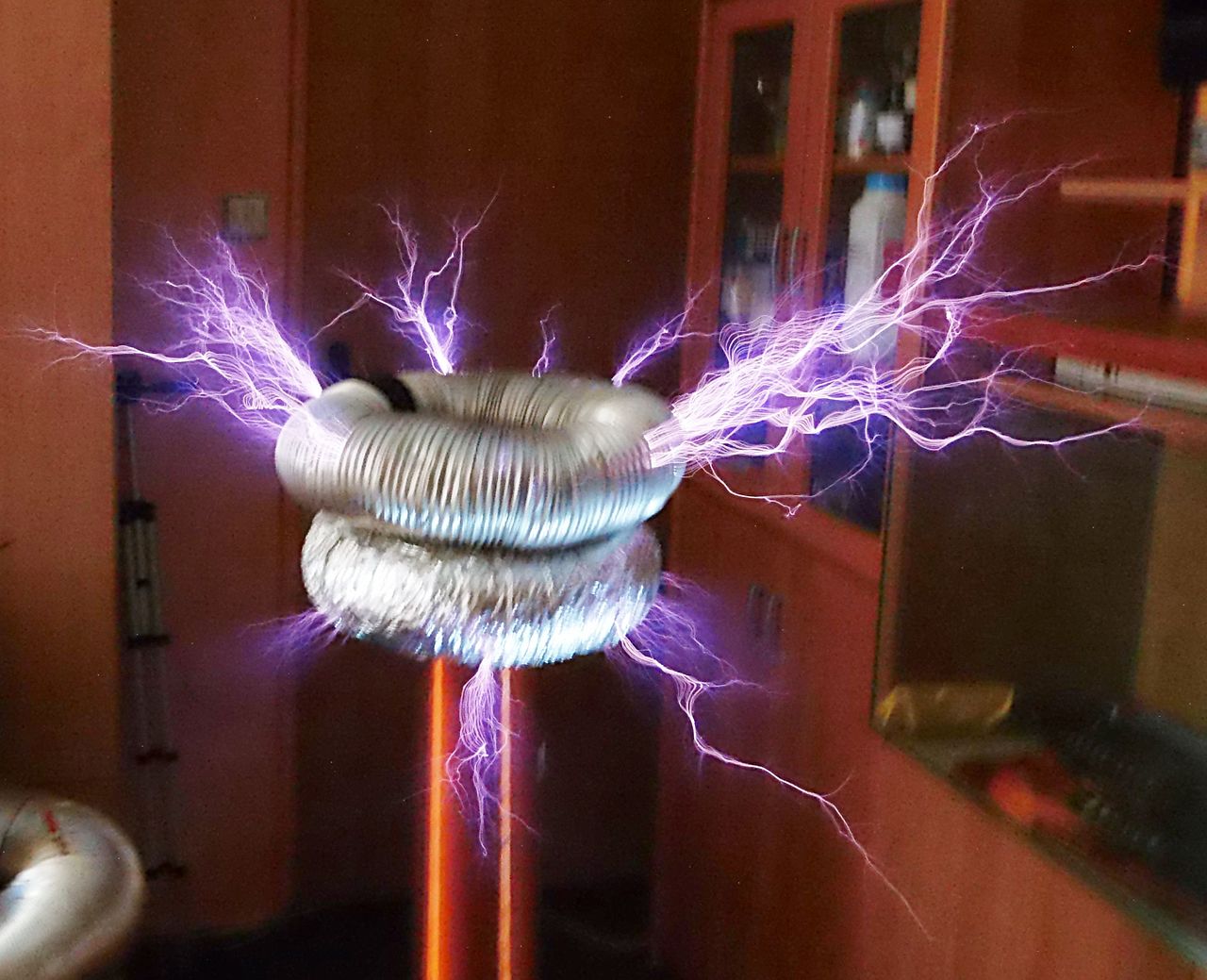
- Typical components: a power source, a primary coil and capacitor (the primary tank), a spark gap or switching element, a secondary coil, and a top-load (commonly a toroid) to control discharge shape and voltage.
- Key principle: the device relies on resonance and electromagnetic induction to amplify voltage without a direct conductive connection between primary and secondary circuits.
Types and modern variations
Historically the earliest coils used simple spark-gap oscillators. Contemporary builders also use solid-state switches, such as transistors or MOSFETs, to make more controlled and energy-efficient units. Variations include single-resonant coils, double-resonant systems, large demonstration coils that produce very long arcs, and compact educational models. Some designs emphasize continuous radio-frequency output while others prioritize intermittent high-energy sparks.
Applications and demonstrations
Tesla coils are primarily demonstration devices. They make electrical fields and discharge phenomena visible and tangible for teaching physics, particularly concepts of resonance, inductance, capacitance and high-frequency behavior. Performers and hobbyists build "singing" or musical coils that modulate the spark rate to produce audible tones, turning high-voltage discharges into an artistic effect. Very large coils are sometimes used in controlled experiments to study electrical breakdown, ozone production and electromagnetic compatibility under high-field conditions.
History and context
Invented and promoted by Tesla around 1891, the coil was part of his broader research into high-frequency alternating current and experiments in wireless power transmission. While the specific coil designs were not adopted as a mainstream means of delivering commercial power, they informed early work in radio and high-frequency engineering and remain a vivid demonstration of resonant transformer behavior.
Safety and practical considerations
Although Tesla coils usually operate at low average current, the high voltages and radio-frequency emissions present real hazards. Direct contact with a high-voltage discharge can cause burns or cardiac disturbance; secondary effects include ignition of flammable materials, interference with nearby electronics, and the generation of ozone and nitrogen oxides in air. Responsible operators use grounding, adequate separation, protective enclosures, and compliance with local regulations. Beginners should follow step-by-step guidance from trusted sources such as a technical overview or community safety guides and avoid improvising high-power experiments.
Related topics and resources
- Tesla coils are distinct from conventional power transformers because they operate at much higher frequencies and depend on resonant coupling rather than only winding ratios.
- They differ from electrostatic devices (for example Van de Graaff generators) and from conventional radio transmitters, though there are historical overlaps with early radio work and spark-gap transmitters; see radio‑frequency contexts for related principles.
- For historical background, technical descriptions and community projects consult introductory guides or an article on electrical machines, biographies and museum resources about Tesla, and galleries of lightning-style discharge demonstrations.
For readers who want to learn the underlying physics, a clear starting point is a focused discussion of electromagnetic induction, resonance and oscillatory circuits, supplemented by tutorials and safe, supervised hands-on projects. Museum exhibits and specialized texts provide photographs, circuit diagrams and historical context for the device and its inventor Nikola Tesla.
Additional practical resources and community forums often include construction tips, safety checklists and example builds for different scales of coil; search educational archives, maker communities and demonstration repositories to compare approaches and confirm safety practices before attempting your own project.
Author
AlegsaOnline.com Tesla coil: high-voltage resonant transformer and radio-frequency oscillator Leandro Alegsa
URL: https://en.alegsaonline.com/art/97191