
Electromagnetic induction
Electromagnetic induction is the generation of voltage or current in a conductor by a changing magnetic field; it underpins electric generators, transformers, induction heating, and many sensors.
Electromagnetic induction is the physical process by which an electrical voltage or an electric current is produced in a material that conducts electricity when the magnetic environment around it changes. The phenomenon occurs when the magnetic field through a loop, coil or other conductor varies in time, or when the conductor moves through a magnetic field so that the magnetic flux linked to it changes. A simple classroom demonstration is moving a magnet into or out of a coil — the changing magnetic flux through the coil induces an electromotive force and, if the circuit is closed, a current flows. The same basic principle applies when a magnet is moved relative to a solenoid or when the magnetic field itself varies in intensity or direction.
Image gallery
9 Images


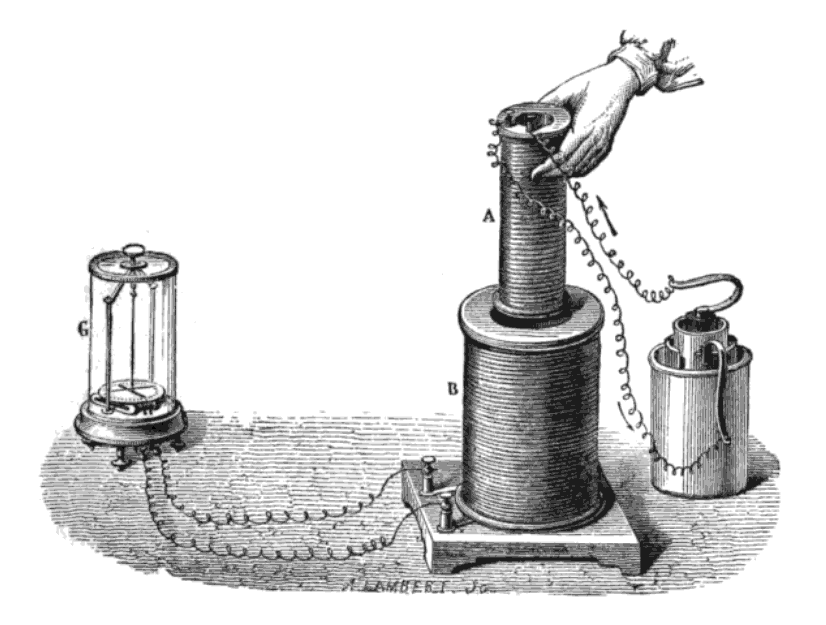


Principle
At the heart of induction is Faraday's law: the magnitude of the induced electromotive force (emf) is proportional to how rapidly the magnetic flux through a circuit changes. The direction of the induced emf is such that it opposes the change in flux, a qualitative statement known as Lenz's law. Practical consequences are that faster changes cause larger voltages, coils with more turns produce greater emf for the same change in flux, and the geometric orientation and area of the conductor loop determine how much flux is linked to it.
Key characteristics and components
- Magnetic flux: the product of magnetic field strength, area and the cosine of the angle between field and surface normal — changes in any of these can induce emf.
- Coils and turns: multi-turn windings concentrate flux linkage and multiply the induced voltage approximately in proportion to the number of turns.
- Relative motion: either the magnetic source or the conductor may move; what matters is the change in flux seen by the circuit.
- Eddy currents and damping: changing fields in bulk conductors create circulating currents that dissipate energy as heat and can produce magnetic braking.
History and theoretical context
Electromagnetic induction was discovered experimentally by Michael Faraday in 1831 and was later incorporated into the mathematical framework of electromagnetism by James Clerk Maxwell. Faraday's experiments established the direct link between changing magnetic conditions and electrical effects; subsequent work codified the quantitative relationships and clarified the roles of relative motion, circuit geometry and conservation laws. Today, Faraday's law appears as one of Maxwell's equations in classical electromagnetic theory.
Applications and examples
Induction is central to modern electrical technology. Key applications include:
- Electric generators: mechanical motion converts to electrical power by rotating coils in magnetic fields.
- Transformers: alternating current in one coil induces a different voltage in a nearby coil, enabling efficient voltage conversion for power transmission.
- Induction motors and wireless charging: devices that use changing magnetic fields to produce force or transfer energy without direct electrical contact.
- Induction heating and eddy-current sensors: localized heating by induced currents and non-contact measurement techniques used in industry and medicine.
Related concepts and notable facts
Electromagnetic induction connects to several important ideas: magnetic flux and flux linkage, electromagnetic damping, and mutual versus self-induction (a coil inducing voltage in itself versus in another coil). It explains why a steady magnetic field that does not change relative to a conductor produces no continuous emf, and why alternating fields or motion are required to sustain alternating currents. For further technical depth and demonstrations, see sources that treat Faraday's law, Lenz's law and Maxwell's equations in detail (voltage, current, conductor, magnetic flux, solenoid).
Questions and answers
Q: What is electromagnetic induction?
A: Electromagnetic induction is the production of a voltage or current in a conductor by a changing magnetic flux.
Q: How does electromagnetic induction occur?
A: Electromagnetic induction occurs when a magnet is moved in a solenoid, thus changing the magnetic flux.
Q: Will there be a produced voltage across an electrical conductor if a magnet is stationary in respect to it?
A: No, there will be no produced voltage (electrostatic potential difference) across an electrical conductor if the magnet is stationary.
Q: Who stated about the production of a voltage and the flow of alternating current in relation to electromagnetic induction?
A: Michael Faraday stated about the production of a voltage and the flow of alternating current in relation to electromagnetic induction in 1831.
Q: Does continuous movement of a magnetic field in the opposite direction cause the production of a voltage?
A: Yes, continuous movement of a magnetic field in the opposite direction causes the production of a voltage, leading to the flow of alternating current.
Q: When an electric current is produced in a conductor by a changing magnetic field, what phenomenon is it known as?
A: The phenomenon is known as electromagnetic induction when an electric current is produced in a conductor by a changing magnetic field.
Q: Is electromagnetic induction possible without a magnetic field?
A: No, electromagnetic induction is not possible without a magnetic field.
Related articles
Author
AlegsaOnline.com Electromagnetic induction Leandro Alegsa
URL: https://en.alegsaonline.com/art/30725