
Table Mountain — Cape Town's flat-topped landmark
Prominent flat-topped mountain above Cape Town, South Africa: geology, biodiversity, hiking and cableway access, role in conservation and local culture.
Table Mountain is the conspicuous, flat-topped massif that dominates the skyline above Cape Town in South Africa. Rising above the central city and Table Bay, it is one of the region's most recognisable natural features. The mountain's broad plateau and steep cliffs make it a focal point for visitors, residents and scientists alike.
Image gallery
10 Images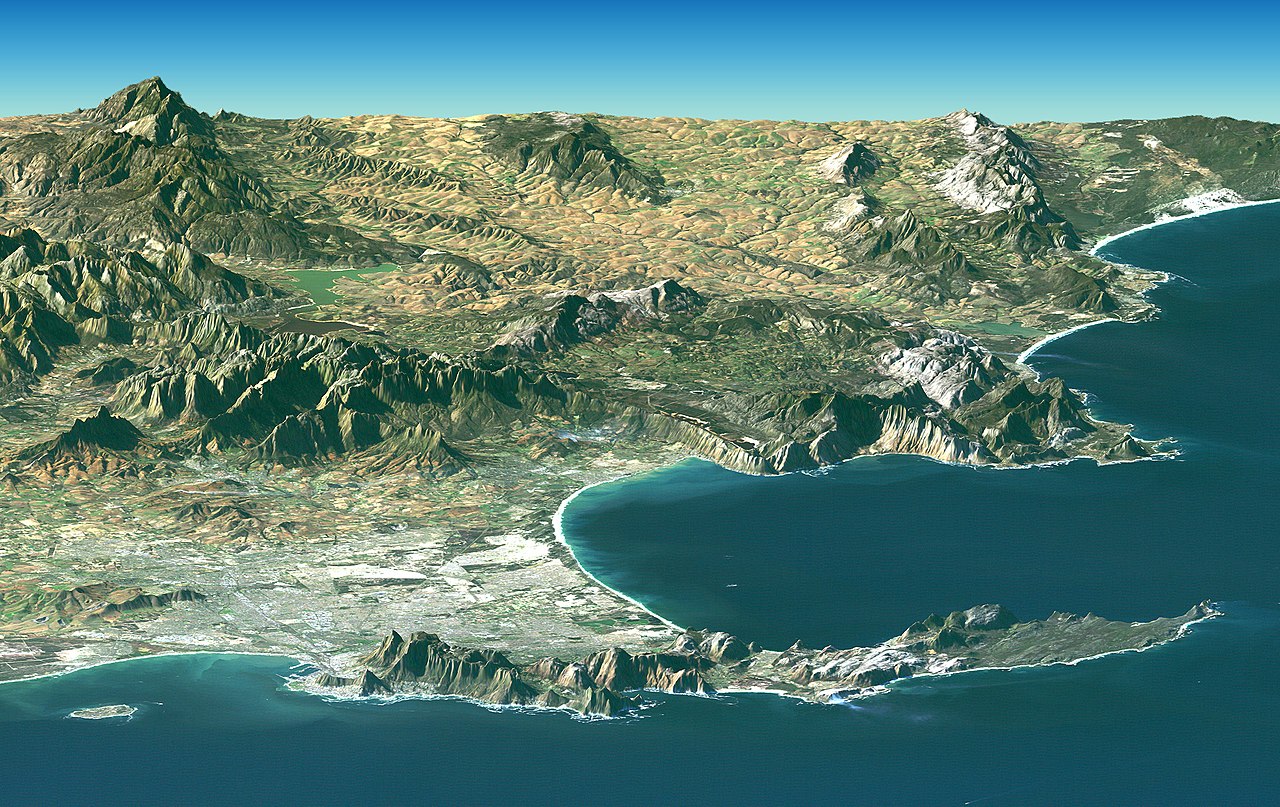


Geology and physical characteristics
The mountain reaches approximately 1,084.6 metres above sea level and is formed from a hard layer of quartzitic sandstone resting on older granite. The resistant sandstone weathers into the sheer, almost vertical faces and the pronounced flat summit that give the mountain its name. Neighboring peaks such as Devil's Peak and Lion's Head form a dramatic amphitheatre around the central city and Table Bay.
Flora, fauna and conservation
Table Mountain supports a remarkable diversity of plants characteristic of the Cape Floristic Region, many of them members of the fynbos vegetation type and many endemic to the mountain itself. This botanical richness contributes to the wider area's recognition as part of the Cape Floral Region World Heritage Site. Much of the plateau and surrounding slopes are protected within Table Mountain National Park, which aims to conserve habitat while allowing controlled public access.
Access, routes and recreation
The mountain is accessible both to hikers and to those who prefer mechanical transport. Several well‑trodden footpaths lead to the plateau, the most direct being Platteklip Gorge; other popular routes approach via the eastern and southern slopes. A cableway carries visitors from the lower station to the top in minutes, offering panoramic views as an alternative to the longer ascent. Climbers, trail runners and paragliders also use the slopes, and the plateau provides sweeping lookout points over the city and sea.
Cultural significance and notable features
Table Mountain is a civic symbol for Cape Town, appearing on municipal insignia and in tourism materials. A frequent meteorological spectacle, the so‑called "tablecloth" of cloud that spills over the summit is a well‑known local phenomenon. The mountain is a major magnet for visitors; for practical information about visiting, transport and conservation rules see visitor resources.
Practical considerations and distinctions
- Safety: weather on the plateau can change rapidly; hikers should be prepared and check conditions before setting out.
- Biodiversity value: the mountain's plant communities are of global botanical interest and subject to active conservation management.
- Recreation: both easy and challenging routes exist, making it accessible to a wide range of outdoor enthusiasts.
Whether for natural history, outdoor activity or iconic skyline photography, Table Mountain remains an enduring landmark with geological, ecological and cultural importance.
Questions and answers
Q: Where is Table Mountain located?
A: Table Mountain is located in Cape Town, South Africa.
Q: What is the height of Table Mountain?
A: The height of Table Mountain is 1084.6 meters (3,563-feet).
Q: What is Table Mountain made of?
A: Table Mountain is made of sandstone and granite.
Q: What surrounds the central part of Cape Town besides Table Mountain?
A: Besides Table Mountain, nearby mountains and Table Bay surround the central part of Cape Town.
Q: What is the significance of Table Mountain?
A: Table Mountain is a significant tourist attraction and is featured in the flag of Cape Town and other local government insignia.
Q: How can visitors reach the top of Table Mountain?
A: Visitors can reach the top of Table Mountain by using the Table Mountain Aerial Cableway or by hiking.
Q: What park is Table Mountain a part of?
A: Table Mountain is part of the Table Mountain National Park.
Related articles
Author
AlegsaOnline.com Table Mountain — Cape Town's flat-topped landmark Leandro Alegsa
URL: https://en.alegsaonline.com/art/95799
Sources
- photojournal.jpl.nasa.gov : "Cape Town, South Africa, Perspective View"
- capetown.gov.za : Cape Town local government services website
- web.uct.ac.za : "Geology of the Cape Peninsula"
- capetown.at : "The Geology of Table Mountain"