
Supersonic Acrobatic Rocket-Powered Battle-Cars
A vehicular-soccer video game by Psyonix for PlayStation 3 (2008–2009). Noted for rocket-boosted cars, aerial maneuvers and a campaign of mini-games; later evolved into the successful sequel Rocket League.
Supersonic Acrobatic Rocket-Powered Battle-Cars (commonly abbreviated SARPBC) is a vehicular-soccer video game developed by Psyonix for the PlayStation 3. The core concept places small, rocket-assisted cars in enclosed arenas where teams attempt to move a large ball into the opponent's goal using driving, jumping and boost-assisted aerial maneuvers. The unusual, descriptive title became a memorable part of the game's identity and reflected its hybrid nature, combining elements of driving physics with sport-like objectives.
Image gallery
1 Image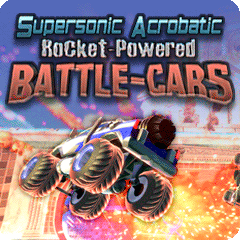
Gameplay and mechanics
The gameplay centers on physics-driven interactions between cars and the ball. Players control a single vehicle that can accelerate, brake, jump and use a limited boost to gain speed and altitude. Successful play relies on timing, positioning and the use of acrobatic moves—flips, aerial hits, and redirects—to influence the ball's trajectory. Matches are played in enclosed arenas with walls and ceilings that allow play to continue beyond a flat pitch, encouraging three-dimensional strategies.
Modes and structure
SARPBC offered a mix of single-player and multiplayer content. The single-player campaign consisted of a series of themed mini-games and AI tournaments intended to teach mechanics and provide solo challenges. Multiplayer options included competitive matches against other players over the network as well as local play; the game supported online matchmaking through the console's network service. The emphasis on quick, high-energy rounds made it suited to both casual sessions and more competitive play.
Development, release and platform
The title was created by Psyonix as an experimental blend of racing and sports gameplay. It launched in North America in October 2008 and arrived in Europe in February 2009 as a PlayStation 3 exclusive. For more information about the original title, see the game's page: Supersonic Acrobatic Rocket-Powered Battle-Cars. The platform on which it first appeared was the PlayStation 3.
Reception and legacy
Upon release, the game attracted attention for its novel concept and skill-based, physics-led gameplay, though reviews were mixed regarding presentation and broader appeal. Importantly, SARPBC established the foundational mechanics—boost management, aerial control and arena design—that would be refined and popularized by Psyonix's later work. Community interest persisted around the game’s distinctive style of play, and it has been recognized as the direct predecessor to its more widely known successor.
Sequel and continuing influence
Psyonix developed a follow-up that simplified and polished the core ideas. The sequel, Rocket League, was released in July 2015 and brought the vehicular-soccer formula to a much larger audience across multiple platforms. Rocket League expanded on matchmaking, customization and core physics while gaining substantial competitive and cultural traction. As a result, SARPBC is often discussed today in the context of its role as the experimental precursor that shaped a highly successful franchise.
- Key features: boost-powered cars, aerial play, enclosed arenas, physics-driven ball interactions.
- Modes: single-player mini-games and AI tournaments, online multiplayer, local play.
- Significance: foundational title leading to Rocket League and broader recognition of vehicular-soccer as a genre.
Questions and answers
Q: What is Supersonic Acrobatic Rocket-Powered Battle-Cars?
A: Supersonic Acrobatic Rocket-Powered Battle-Cars is a vehicular soccer video game for the PlayStation 3.
Q: When was Supersonic Acrobatic Rocket-Powered Battle-Cars released in North America?
A: Supersonic Acrobatic Rocket-Powered Battle-Cars was released in North America in October 2008.
Q: Can Supersonic Acrobatic Rocket-Powered Battle-Cars be played against AI?
A: Yes, Supersonic Acrobatic Rocket-Powered Battle-Cars has tournaments against AI which can only be played in single-player mode.
Q: Is there a sequel to Supersonic Acrobatic Rocket-Powered Battle-Cars?
A: Yes, there is a sequel to Supersonic Acrobatic Rocket-Powered Battle-Cars titled Rocket League.
Q: When was Rocket League released?
A: Rocket League was released in July 2015.
Q: On which platforms was Rocket League originally released?
A: Rocket League was originally released for the PlayStation 4 and Microsoft Windows.
Q: Was Rocket League released on the Nintendo Switch?
A: Yes, in 2017, Rocket League was also released on the Nintendo Switch.
Related articles
Author
AlegsaOnline.com Supersonic Acrobatic Rocket-Powered Battle-Cars Leandro Alegsa
URL: https://en.alegsaonline.com/art/95082