
Rocket League: overview of the vehicular soccer video game
Rocket League is a physics-driven vehicular association football video game developed by Psyonix and later acquired by Epic Games. It features rocket-powered cars, multiple modes, competitive play and wide platform support.
Overview
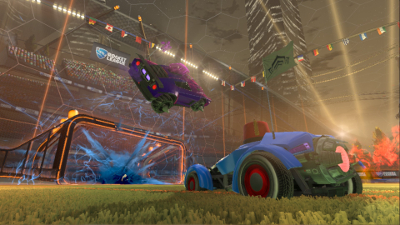
Rocket League is a physics-driven video game in which players pilot rocket-powered vehicles to play a stylized form of association football. Developed and published by Psyonix, the title launched in 2015 and is a follow-up to the earlier experimental project Supersonic Acrobatic Rocket-Powered Battle-Cars. The game blends driving, aerial maneuvers and ball control to create fast, short matches that emphasize skill, positioning and teamwork.
Image gallery
8 Images




Gameplay and characteristics
Players control customizable cars equipped with short-duration boost and limited air control. The objective is to strike a large ball into the opponents' goal while defending one’s own net. Matches typically take place in enclosed arenas with walls and ceilings that allow continuous play and acrobatic moves. The core mechanics include driving, jumping, boosting, and performing aerials and flips to redirect the ball; physics and rebound behavior are central to the game's skill expression.
Modes, platforms and play formats
Rocket League supports both single-player and multiplayer modes. Single-player options include training and a Season-like mode that pits the player against AI-controlled opponents. Multiplayer is offered in ranked and casual playlists with common formats such as 1v1, 2v2, 3v3 and 4v4; custom matches and private lobbies are also available. The game was initially released for Microsoft Windows and PlayStation 4, later arriving on Xbox One and OS X and Linux. It supports cross-platform play in many modes and has received numerous updates that add arenas, cosmetics and gameplay refinements.
Development, ownership and business model
Rocket League evolved from Psyonix's earlier work and benefitted from a design that focused on short, repeatable matches and strong online support. After its initial success the studio and game were acquired by Epic Games. Following that period the title moved toward a broader-access model and continued to receive developer support, seasonal content and collaborations with other brands. The release history and post-launch strategy helped the game remain active in both casual and competitive communities.
Competitive scene and cultural impact
The game's accessible rules and deep mechanical ceiling have made it a staple of grassroots and professional competitive play. Tournaments, leagues and community events highlight both team tactics and individual mechanical skill. Rocket League is often cited for bridging casual and esports audiences: matches are easy to understand for newcomers yet provide high-level nuance for dedicated players. Its combination of sports and vehicular action has led to crossover promotions, licensed cosmetic items and visibility in broader gaming culture.
Notable facts and legacy
- Rocket League is sometimes described as a vehicular take on soccer, pairing driving physics with a ball-and-goal objective.
- It is commonly called a spiritual sequel to the studio's prior vehicle-soccer experiment, and it refined many of the same ideas into a commercial hit.
- Early commercial success included millions of players in the years after launch; the title has remained influential for its blend of accessibility and competitive depth.
Together, these elements explain why Rocket League is frequently referenced in discussions of innovative sports-style games and successful post-launch support models. For detailed patch notes, esports schedules and community resources, consult official channels and publisher pages.
Game Design
In Rocket League you try to shoot the most balls into the opponent's goal within five minutes. For this purpose, the player has cars at his disposal. The game is played in 1-vs.-1, 2-vs.-2, 3-vs.-3 or 4-vs.-4 mode. Here, further game mode specifications can be set. Foremost and most played modes are the Ranked mode ("Ranked") and a normal mode ("Casual"). Until the Rocket Pass update on September 5, 2018, a "Rocket Labs" mode (experimental arenas), a "Snow Free" mode (using a puck instead of a ball), a "Baskets" mode (inspired by basketball), a "Rumble" mode (using various power-ups), and a "Dropshot" mode (scoring by shooting the ball through holes in the ground) also existed, all exclusively in the "Casual" variant. Rocket Labs mode has been scrapped (experimental arenas are still playable in Rumble and private modes, however), with the remaining game types only available as ranked matches.
Gameplay
Before the game
In the menu before starting the game it is possible to customize and design your car in the garage. Apart from different bodies and the associated difference in ball handling, these changes are purely visual. Examples include the paint job, tires, boost, etc.
Completing games unlocks the various items.
In the game
The arenas resemble a football field in their construction, but are limited by walls. The physics of the vehicles and the ball differ significantly from reality, especially with regard to gravity. Thus, you can drive along walls and, with sufficient speed, along the ceiling for a short period of time. In the arena, there are recurring "boost" cells that you can collect to give your car a short-term turbo boost. Furthermore, it is possible to perform various jumps with the vehicles.
As a rule, a match lasts five minutes, and at the end of this time the match does not end until the ball touches the ground or a goal is scored. In the event of a tie, there is an overtime period until a decisive goal is scored. As a rule, Team Orange always plays against Team Blue. Since the update in August 2018, teams that have already been combined before the start of the game can also choose other colors.
During the game, there are always icons in the upper right corner that represent game actions that are happening at that moment. Own actions are displayed enlarged in the upper half of the screen. Each player receives points for some of his actions.
Actions followed by winning points are:
- one touch of the ball (+2)
- a goal scored (+100), possibly additional points through
- Goal from own half of field (+10)
- Goal in reverse (+10)
- Goal by bicycle kick (+10)
- Goal where the car was on the roof when the shot was taken (turtle goal) (+10)
- Goal where you have pushed the opponent in such a way that he has kicked the ball into his own goal (bank shot) (+10)
- Goal scored after touching the ball in the air, above the height of the crossbar (volley goal) (+30)
- Goal in injury time (Golden Goal) (+50)
- one shot on goal (+10)
- a successful goal for a team partner (+50)
- blocking a shot on the own goal (parry) (+50)
- defending the ball on the goal line (brilliant save) (+75)
- removing the ball from one's own penalty area (free kick) (+20)
- destroying enemy vehicles seven times in one game (obliteration) (+25)
- a pass into the opponent's penalty area (entry) (+20)
- three saves and/or brilliant saves (saviour) (+25)
- three goals scored (hat trick) (+25)
- three assists (playmaker) (+25)
Actions without a subsequent point win are:
- finishing the game as the winner
- finishing the game as the player with the most points (Most Valuable Player)
- the first contact with the ball at kick-off
League system
Rocket League has a distinct, multi-tiered league system. A player can obtain a rank in any mode for which ranked competition ("Ranked") is offered (1v1, 2v2, 3v3, Solo 3v3, Rumble, Dropshot, Baskets, Snow Free) after ten ranked matches. This rank only applies to the mode currently being played, so a player may have a different rank in 1v1 mode than in 3v3 mode.
| Rank | Division | League |
| Supersonic Legend | ||
| grand champion | III | 1–4 |
| II | ||
| I | ||
| Champion | III | |
| II | ||
| I | ||
| Diamond | III | |
| II | ||
| I | ||
| Platinum | III | |
| II | ||
| I | ||
| Gold | III | |
| II | ||
| I | ||
| Silver | III | |
| II | ||
| I | ||
| Bronze | III | |
| II | ||
| I | ||
| Unranked | ||
A rank is pronounced as follows: Diamond II, III results in "Diamond Two, League Three". Higher numbered leagues and divisions are ranked higher than lower ones. Diamond II is therefore better than Diamond I. The highest rank available, Supersonic Legend, no longer has a division. Classically, rank refers to the rank in the league system, not the misleadingly named level rank or the corresponding rank designation.
ascents and descents
| MMR subdivision 3v3 | ||||
| Rank | Div I | Div II | Div III | Div IV |
| Supersonic Legend 38 players (0.00 %) | 1.915 – 1.918 | - — | - — | - — |
| Grand Champion III 272 players (0.02 %) | 1.796 – 1.813 | 1.814 – 1.844 | 1.848 – 1.881 | 1.893 – 1.905 |
| Grand Champion II 1,453 players (0.13 %) | 1.671 – 1.693 | 1.695 – 1.726 | 1.728 – 1.750 | 1.762 – 1.779 |
| Grand Champion I 5,244 players (0.45 %) | 1.554 – 1.573 | 1.575 – 1.607 | 1.608 – 1.637 | 1.642 – 1.659 |
| Champion III 11,705 players (1.01 %) | 1.435 – 1.453 | 1.455 – 1.486 | 1.488 – 1.518 | 1.522 – 1.539 |
| Champion II 18,770 players (1.62 %) | 1.335 – 1.348 | 1.351 – 1.375 | 1.379 – 1.405 | 1.407 – 1.424 |
| Champion I 29,331 players (2.52 %) | 1.233 – 1.248 | 1.253 – 1.277 | 1.284 – 1.305 | 1.307 – 1.319 |
| Diamond III 43,017 players (3.70 %) | 1.134 – 1.148 | 1.150 – 1.174 | 1.181 – 1.204 | 1.207 – 1.220 |
| Diamond II 60,720 players (5.22 %) | 1.035 – 1.048 | 1.050 – 1.077 | 1.084 – 1.103 | 1.107 – 1.120 |
| Diamond I 71,601 players (6.16 %) | 935 – 948 | 951 – 976 | 978 – 1.005 | 1.007 – 1.020 |
| Platinum III 60,610 players (5.22 %) | 854 – 863 | 865 – 887 | 888 – 910 | 912 – 920 |
| Platinum II 67,873 players (5.84 %) | 775 – 783 | 785 – 807 | 808 – 830 | 832 – 841 |
| Platinum I 78,705 players (6.77 %) | 695 – 703 | 704 – 727 | 728 – 751 | 752 – 760 |
| Gold III 67,992 players (5.85 %) | 615 – 623 | 624 – 647 | 648 – 671 | 672 – 681 |
| Gold II 41,309 players (3.55 %) | 550 – 558 | 559 – 577 | 578 – 596 | 597 – 603 |
| Gold I 31,406 players (2.70 %) | 492 – 498 | 499 – 517 | 518 – 536 | 537 – 544 |
| Silver III 19,651 players (1.69 %) | 429 – 438 | 439 – 457 | 458 – 476 | 477 – 482 |
| Silver II 11,653 players (1.00 %) | 365 – 378 | 379 – 397 | 398 – 416 | 417 – 433 |
| Silver I 5,975 players (0.51 %) | 309 – 318 | 319 – 337 | 338 – 356 | 357 – 373 |
| Bronze III 2,224 players (0.19 %) | 241 – 258 | 260 – 277 | 282 – 295 | 297 – 300 |
| Bronze II 791 players (0.07 %) | 192 – 197 | 206 – 217 | 226 – 236 | 237 – 252 |
| Bronze I 269 players (0.02 %) | 116 – 116 | - — | 155 – 164 | 178 – 179 |
| Unranked 531,600 players (45.74 %) | 424 – 1.580 | - — | - — | - — |
| MMR subdivision 2v2 | ||||
| Supersonic Legend 134 players (0.01 %) | 1.865 – 1.885 | - — | - — | - — |
| Grand Champion III 536 players (0.05 %) | 1.752 – 1.773 | 1.775 – 1.807 | 1.808 – 1.832 | 1.843 – 1.857 |
| Grand Champion II 3,023 players (0.26 %) | 1.627 – 1.653 | 1.654 – 1.674 | 1.688 – 1.709 | 1.722 – 1.739 |
| Grand Champion I 14,702 players (1.27 %) | 1.515 – 1.533 | 1.534 – 1.566 | 1.568 – 1.595 | 1.602 – 1.618 |
| Champion III 20,508 players (1.77 %) | 1.413 – 1.428 | 1.432 – 1.457 | 1.463 – 1.485 | 1.487 – 1.503 |
| Champion II 28,452 players (2.46 %) | 1.313 – 1.328 | 1.332 – 1.357 | 1.358 – 1.385 | 1.387 – 1.399 |
| Champion I 42,654 players (3.68 %) | 1.214 – 1.228 | 1.233 – 1.256 | 1.262 – 1.285 | 1.287 – 1.304 |
| Diamond III 52,747 players (4.56 %) | 1.115 – 1.128 | 1.130 – 1.156 | 1.159 – 1.185 | 1.187 – 1.200 |
| Diamond II 62,476 players (5.40 %) | 1.014 – 1.028 | 1.032 – 1.056 | 1.058 – 1.085 | 1.087 – 1.100 |
| Diamond I 58,843 players (5.08 %) | 934 – 943 | 945 – 967 | 968 – 988 | 992 – 1.002 |
| Platinum III 58,057 players (5.02 %) | 854 – 863 | 865 – 887 | 888 – 909 | 912 – 920 |
| Platinum II 63,766 players (5.51 %) | 773 – 783 | 785 – 807 | 808 – 829 | 832 – 840 |
| Platinum I 70,886 players (6.12 %) | 694 – 703 | 704 – 727 | 728 – 750 | 752 – 762 |
| Gold III 68,371 players (5.91 %) | 614 – 623 | 624 – 647 | 648 – 670 | 672 – 680 |
| Gold II 49,586 players (4.28 %) | 547 – 558 | 559 – 577 | 578 – 596 | 597 – 605 |
| Gold I 42,717 players (3.69 %) | 491 – 498 | 499 – 517 | 518 – 536 | 537 – 545 |
| Silver III 29,096 players (2.51 %) | 430 – 438 | 439 – 457 | 458 – 476 | 477 – 485 |
| Silver II 20,076 players (1.73 %) | 369 – 378 | 379 – 397 | 398 – 416 | 417 – 425 |
| Silver I 11,390 players (0.98 %) | 312 – 318 | 319 – 337 | 338 – 356 | 357 – 360 |
| Bronze III 5,196 players (0.45 %) | 247 – 258 | 261 – 277 | 278 – 296 | 297 – 307 |
| Bronze II 1,980 players (0.17 %) | 192 – 198 | 202 – 217 | 218 – 236 | 237 – 250 |
| Bronze I 908 players (0.08 %) | 0 – 0 | 126 – 139 | 150 – 170 | 173 – 178 |
| Unranked 451,531 players (39.00 %) | 388 – 1.540 | - — | - — | - — |
| MMR subdivision 1v1 | ||||
| Rank | Div I | Div II | Div III | Div IV |
| Supersonic Legend 181 players (0.02 %) | 1.348 – 1.372 | - — | - — | - — |
| Grand Champion III 302 players (0.03 %) | 1.287 – 1.298 | 1.300 – 1.316 | 1.318 – 1.333 | 1.337 – 1.352 |
| Grand Champion II 1,145 players (0.12 %) | 1.226 – 1.238 | 1.240 – 1.254 | 1.258 – 1.276 | 1.277 – 1.291 |
| Grand Champion I 3,212 players (0.33 %) | 1.166 – 1.178 | 1.180 – 1.187 | 1.200 – 1.215 | 1.217 – 1.225 |
| Champion III 3,720 players (0.38 %) | 1.105 – 1.118 | 1.120 – 1.133 | 1.139 – 1.155 | 1.157 – 1.165 |
| Champion II 4,478 players (0.46 %) | 1.045 – 1.058 | 1.060 – 1.074 | 1.078 – 1.095 | 1.097 – 1.106 |
| Champion I 6,112 players (0.63 %) | 987 – 998 | 1.000 – 1.013 | 1.018 – 1.034 | 1.037 – 1.044 |
| Diamond III 7,191 players (0.74 %) | 925 – 938 | 940 – 957 | 960 – 975 | 977 – 985 |
| Diamond II 10,115 players (1.03 %) | 867 – 878 | 880 – 896 | 898 – 915 | 917 – 926 |
| Diamond I 15,056 players (1.54 %) | 807 – 818 | 820 – 836 | 839 – 855 | 857 – 866 |
| Platinum III 17,237 players (1.76 %) | 747 – 758 | 759 – 777 | 779 – 795 | 797 – 802 |
| Platinum II 23,309 players (2.38 %) | 687 – 698 | 699 – 717 | 718 – 735 | 737 – 745 |
| Platinum I 32,970 players (3.37 %) | 635 – 638 | 639 – 657 | 658 – 676 | 677 – 686 |
| Gold III 30,132 players (3.08 %) | 573 – 578 | 579 – 597 | 598 – 616 | 617 – 626 |
| Gold II 31,626 players (3.24 %) | 513 – 518 | 519 – 537 | 538 – 556 | 557 – 565 |
| Gold I 25,066 players (2.56 %) | 454 – 458 | 459 – 477 | 478 – 496 | 497 – 502 |
| Silver III 12,656 players (1.29 %) | 389 – 398 | 399 – 417 | 418 – 436 | 437 – 453 |
| Silver II 7,028 players (0.72 %) | 323 – 338 | 339 – 357 | 358 – 376 | 377 – 394 |
| Silver I 2,764 players (0.28 %) | 275 – 278 | 279 – 297 | 302 – 316 | 317 – 334 |
| Bronze III 913 players (0.09 %) | 208 – 218 | 220 – 237 | 239 – 256 | 257 – 259 |
| Bronze II 183 players (0.02 %) | - — | - — | 187 – 195 | 197 – 207 |
| Bronze I 110 players (0.01 %) | 0 – 0 | - — | - — | - — |
| Unranked 741,988 players (75.91 %) | 453 – 1.180 | - — | - — | - — |
In Competitive Mode in Rocket League, players are ranked according to an MMR (Match Making Rating) system. However, a player's MMR value is not normally viewable and is only visible on PC with the BakkesMod modification.
During the first ten placement matches, the player receives or loses up to 50 MMR per match won and lost. This quickly assigns appropriate ranks to players. After the placement matches, the player receives either +8 or -8 MMR per match.
Seasons and inactivity
The ranks earned do not remain permanent. They are only valid for one season, which usually lasts for several months. At the end of each season, all players receive special rewards depending on the rank they have earned. To receive a season reward for a rank, a player must have ten wins at that rank or higher. Each reward must be earned; a silver reward cannot be earned until the bronze reward has been earned. Therefore, in order to receive all rewards, the player must play at least 70 matches (6 ranks of 10 wins + 10 placement matches).
After the end of a season, the next one starts immediately afterwards. Each player will be subject to a soft reset in each mode in which they have earned a rank. This resets all ranking matches and the player must replay them in each mode. As a rule of thumb, if the player wins half of the games, he will get his previous rank back. If he wins more or less games, they will count as a normal ranked game. So you always end up near your outdated rank.
In case of inactivity, i.e. not playing a competition-based mode for several weeks during an ongoing season, the player is subjected to a Slightly Soft Reset. This requires him to replay a portion of his placement matches, usually two or three. The games are scored as normal competitive play and count towards rank. The season reward progress remains.
Ranks and Items
The points (XP) earned in the game increase the level. A level increase is rewarded with a random item, and ranks can also be unlocked depending on the level. These are displayed under the name and give an indication of the approximate total playing time of the player.
| Level | Rank |
| from 20 | Veteran |
| from 40 up | Expert |
| from 60 | Master |
| from 80 | Legend |
| from 100 | Rocketmaster |
| from 200 | Elite challenger |
| from 300 | All-Star |
| from 400 | Superstar |
| from 500 | Biggest rival |
| from 600 | Outstanding champion |
| from 700 | Supersonic Legend |
| from 800 | Ultimate ball artist |
| from 900 | Rocketmaster Elite |
| from 1000 | Rocket Demigod |
Just like points, until the December 2019 update, after playing a game with a certain probability, you received crates that contained items and could be opened with paid keys or free decoders. Psyonix announced a new looting system on October 1, 2019, to replace crates and keys at the end of the year. The move was explained as trying to make the whole process less luck-based and show players directly what exactly they're getting for their money. The new system is called "Blueprints". Since the Blueprint update, instead of boxes, the player receives so-called Blueprints, which are attributed to a special cosmetic item. By paying credits, the new real money currency introduced in this update, you can craft and use this item. Since the March 2020 update, Blueprints can be traded with other players, just like crates before.
Related articles
Author
AlegsaOnline.com Rocket League: overview of the vehicular soccer video game Leandro Alegsa
URL: https://en.alegsaonline.com/art/83559
Sources
- gamespot.com : "Rocket League Passes New Milestones"