
Super Mario Galaxy 2
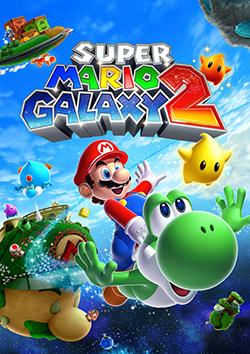
Super Mario Galaxy 2 is a critically acclaimed 2010 platform game for the Wii. A direct sequel to Super Mario Galaxy, it refines gravity-based platforming, adds Yoshi and new power-ups, and builds on its predecessor’s design.
Overview
Super Mario Galaxy 2 is a 2010 platform video game developed for the Wii. It is a direct sequel to Super Mario Galaxy, retaining the series’ distinctive planetoid gravity and free-form spatial platforming while introducing new mechanics and levels. The objective remains familiar: guide Mario through a sequence of themed galaxies to recover Power Stars and rescue Princess Peach.
Image gallery
7 Images



Gameplay and characteristics
The game preserves the original’s emphasis on short, highly varied courses built around spherical or irregular platforms. Players navigate with the Wii Remote and Nunchuk controls, using jumps, spin attacks and midair maneuvers. A secondary player can assist by collecting Star Bits and interacting with the environment in a cooperative role.
- Yoshi: For the first time in the Galaxy subseries, Mario can ride Yoshi, enabling ground-based maneuvers, tongue attacks and special abilities.
- New power-ups: The game adds distinctive items such as the Cloud Flower (creates temporary platforms) and the Rock Mushroom (turns Mario into a rolling boulder), which complement returning transformations.
- Collectibles and replayability: Stars, Star Bits and hidden objectives encourage revisiting stages with new abilities to access alternate routes.
Development and release
The title was announced at E3 2009 and released in 2010 across regions. It arrived in Japan in the second quarter of 2010, on May 23, 2010 in North America, on June 11, 2010 in Europe, and during June–August 2010 in Australia. The design reused and refined the engine and ideas of its predecessor, focusing on tighter level design and platforming challenges.
Reception and legacy
Critics praised the game for imaginative stage design, inventive use of gravity, and polished controls. It is often noted for increasing the series’ emphasis on precision platforming and for providing some of the most inventive single-level concepts in modern Mario titles. Many players and reviewers ranked it among the stronger entries on the Wii.
Notable distinctions
Compared with its predecessor, the sequel is considered more platforming-focused and slightly more challenging, with new tools (including the new power-ups) that change how stages are approached. The presence of Yoshi and the addition of creative items like the Cloud Flower broadened the franchise’s movement options while keeping the original’s cinematic, stage-by-stage structure.
Related articles
Author
AlegsaOnline.com Super Mario Galaxy 2 Leandro Alegsa
URL: https://en.alegsaonline.com/art/94996
Sources
- mariowiki.com : "Cloud Flower - Super Mario Wiki, the Mario encyclopedia"
- mariowiki.com : "Rock Mushroom - Super Mario Wiki, the Mario encyclopedia"