
Stepper motor: operation, types, control methods and applications
A stepper motor is an electric motor that moves in discrete steps. This article explains its construction, common types, driving methods (full/half/microstepping), applications, advantages and limitations.
Overview
A stepper motor is a type of electric motor designed to rotate in a series of precise, discrete steps rather than continuous rotation. Each step corresponds to a fixed angular increment, so the shaft can be positioned accurately by counting steps. Stepper motors are widely used where repeatable position control is needed without necessarily using an encoder or continuous feedback loop.
Image gallery
10 Images



Construction and key characteristics
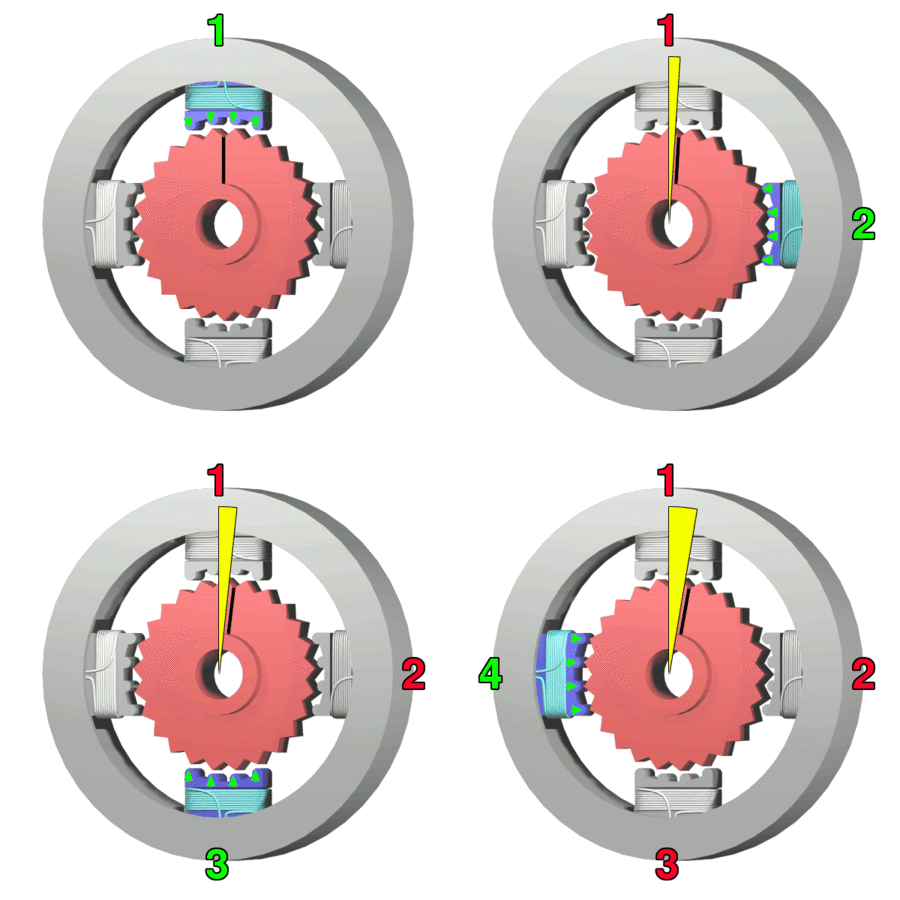
Fundamentally, a stepper motor consists of a stator with multiple windings (coils) and a rotor that has either permanent magnets or toothed iron poles. Energizing the stator coils in a controlled sequence creates a rotating magnetic field that pulls the rotor to successive stable positions. Important characteristics include step angle (the angular increment per step), holding torque (torque when powered and stationary), detent torque (unpowered holding due to rotor magnetism), and resolution (steps per revolution).
Common types
- Permanent magnet (PM): rotor contains permanent magnets; simple construction and typical for low-cost applications.
- Variable reluctance (VR): rotor is toothed soft iron and aligns with energized stator poles; used where inertia and simplicity are factors.
- Hybrid stepper: combines features of PM and VR designs to achieve finer step angles and higher torque; common in precision equipment.
Drive modes and control
Stepper motors are driven by electronic controllers that sequence current through coils. Driving methods affect smoothness, torque, and resolution:
- Full stepping: moves the rotor by one whole step per input pulse; simplest and provides maximum torque per step.
- Half stepping: alternates between full-step and intermediate positions to double apparent resolution and reduce vibration.
- Microstepping: divides each full step into many smaller steps by applying proportional currents to coils, producing smoother motion and finer angular resolution.
Electrical arrangements include unipolar and bipolar windings. Modern drivers commonly use current-chopping and PWM techniques to regulate coil current and prevent overheating. Typical interfaces present step and direction signals to a driver IC or module; the driver handles the coil sequencing and current control. For more on the required circuitry, see drive electronics resources.
Applications and historical notes
Stepper motors have been adopted across many fields where controlled, repeatable motion is required. Common uses include printers and plotters, where accurate carriage positioning is essential; many printers and older disk drive actuators historically relied on stepper motion. They are also prevalent in CNC machines, 3D printers, camera platforms, small robots, and laboratory instruments. Historically, stepper motors became popular with the rise of digital control systems because their discrete-step nature matched digital command sequences.
Advantages, limitations and comparisons
Advantages of stepper motors include straightforward open-loop control for many tasks, good low-speed torque, and deterministic positioning without encoders in many systems. Limitations include reduced torque at high speeds, potential resonance and vibration at certain stepping rates, and heat generated in coils. Unlike servo motors, which typically employ closed-loop feedback for high-performance dynamic control, stepper systems are often simpler and less expensive but may require encoders or closed-loop drivers for demanding accuracy or torque requirements.
Practical considerations
- Selecting a motor involves matching step angle, torque, and electrical requirements to the application.
- Drivers and power supplies must be sized for current and voltage to achieve required speed and torque.
- Microstepping improves smoothness but does not always increase absolute positional accuracy unless the system is mechanically precise.
Overall, stepper motors remain a versatile solution for many motion-control tasks where predictable, repeatable movement and relatively simple electronics are desirable.
Related articles
Author
AlegsaOnline.com Stepper motor: operation, types, control methods and applications Leandro Alegsa
URL: https://en.alegsaonline.com/art/93783