
Star network topology
A star network connects every node to a central device (hub, switch or access point). It is widely used in LANs for its simplicity, ease of troubleshooting and clear physical layout.
Overview
A star network is a common network topology in which each device on the network links individually to a single central node. That central node—often a network switch, hub, or wireless access point—receives and forwards traffic between endpoints. Physically the layout resembles a star, with spokes radiating from the center to connected devices. Logically, traffic patterns depend on the central device's behavior: a hub repeats frames to all ports while a switch forwards only to a specific destination.
Image gallery
1 Image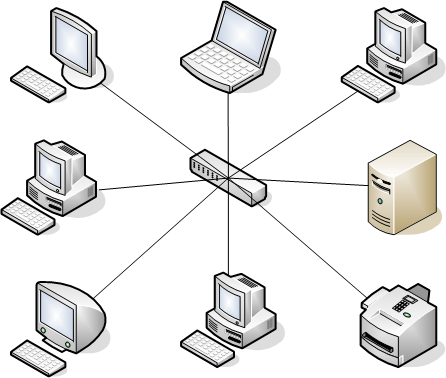
Structure and components
Typical components include end hosts with network interface controllers (NICs), the central device, patch panels and cabling (twisted-pair copper or fiber). Variants include the simple star, extended or hierarchical star (multiple switches connected in a tree), and redundant designs that add backup central devices for resilience.
Advantages and disadvantages
- Advantages: straightforward to install and expand, easy isolation and troubleshooting of individual links, predictable performance when using switches, and well suited to structured cabling.
- Disadvantages: the central node is a single point of failure unless redundancy is provided; more cabling is required compared with bus topologies; cost and capacity depend on the central device.
History and development
The star layout became popular as Ethernet evolved from shared-media hubs to switched architectures. Early LANs often used hubs that behaved like repeaters; switched Ethernet improved throughput and made the star the default physical topology for most office networks. Wireless local area networks also use a logical star structure centered on an access point.
Uses, examples and comparisons
Star topologies dominate modern wired LANs, small office/home networks and many campus segments. They are commonly used in data closets where a switch aggregates desktop connections and uplinks to core devices. Compared with ring, bus or mesh topologies, the star balances simplicity with manageability; hybrid networks often combine stars into larger hierarchical or mesh-connected architectures.
For practical guidance and diagrams, learn more about star networks from introductory networking resources.
Related articles
Author
AlegsaOnline.com Star network topology Leandro Alegsa
URL: https://en.alegsaonline.com/art/93439