
Network topology: types, characteristics and applications
How links and devices are arranged in a computer network — physical vs logical layouts, common topologies (bus, star, ring, mesh), design trade-offs and typical uses.
Overview
Network topology describes the arrangement of links and devices that form a computer network. It covers both the physical layout of cables, wireless links and hardware and the logical paths that data follow. Physical and logical topologies may differ: a set of devices laid out physically in a circle can implement a logical star, for example. Topology is a fundamental concept in designing networks because it affects performance, fault tolerance, cost and scalability.
Image gallery
7 Images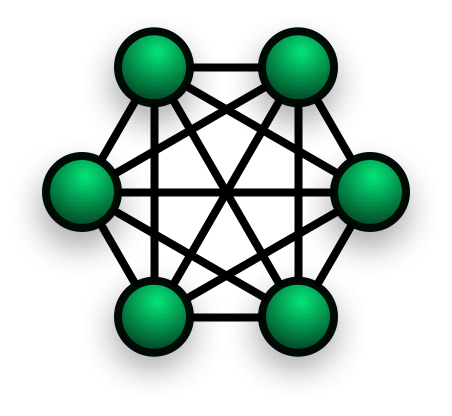


Main types
- Bus: A single shared medium to which devices attach. Simple and inexpensive, but limited by collisions and scale.
- Star: Each device connects to a central hub or switch. Common in homes and offices because failures are often isolated to a single link.
- Ring: Devices form a closed loop where each node connects to two neighbors. Data circulates in one or two directions; some ring systems use token passing to control access.
- Mesh: Multiple interconnections between devices, offering redundancy and high availability. Full mesh connects every node to every other; partial mesh connects key nodes.
- Tree (hierarchical): A branching structure that combines star or bus segments into a layered layout used in larger networks.
- Hybrid: Combinations of the above to meet specific technical or economic needs.
Characteristics and design considerations
When choosing a topology engineers balance throughput, latency, reliability, cost and ease of expansion. Mesh topologies provide resilience but increase cabling and complexity. Star and tree designs simplify management but concentrate failure risk at central devices. The choice also interacts with protocols and devices; for example, modern switched Ethernet behaves logically like a collection of point-to-point links even when cabling appears as a star.
History and development
Early network experiments and telephone systems shaped common topologies. Local area network technologies explored different models—shared-medium bus systems, token-based rings, and later switched fabrics—each influencing where topology was most useful. More recently, data center fabrics, virtualization and software-defined networking have introduced overlay topologies where virtual links map onto physical infrastructure.
Uses, examples and important distinctions
Topologies are chosen according to use cases: small home and office networks usually adopt star configurations for simplicity, campus and enterprise networks apply hierarchical tree designs, and critical infrastructure or backbone networks may use mesh structures for redundancy. It is important to distinguish physical topology (actual cables and wireless links) from logical topology (the path that frames or packets follow) and to remember that the same physical arrangement can support multiple logical topologies depending on protocols and devices. For more foundational terms see nodes and related glossary entries.
Questions and answers
Q: What is network topology?
A: Network topology refers to the layout of connections, nodes, and links in a computer network.
Q: What are the two main types of network topology?
A: The two main types of network topology are physical topology and logical topology.
Q: What are the names used in network topology for describing the layout of connections?
A: The names used in network topology, such as ring or star, are only rough descriptions.
Q: Can a circle arrangement of computers on a home network be considered a ring network?
A: No, a circle arrangement of computers on a home network does not necessarily represent a ring network.
Q: What is physical topology?
A: Physical topology refers to the physical arrangement of computers and other network devices in a network.
Q: What is logical topology?
A: Logical topology refers to the way that data flows in a network and how devices communicate with each other.
Q: Why are the names used in network topology only rough descriptions?
A: The names used in network topology are only rough descriptions because a network can have different layouts and configurations that may not fit perfectly into one specific category.
Related articles
Author
AlegsaOnline.com Network topology: types, characteristics and applications Leandro Alegsa
URL: https://en.alegsaonline.com/art/69290
Sources
- atis.org : "network topology"