
Spore (video game)
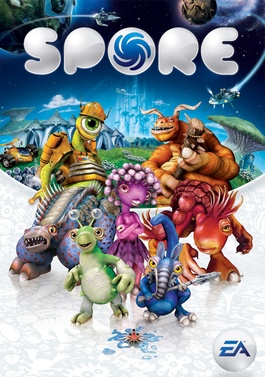
Spore is a sandbox life-simulation by Will Wright that lets players create and evolve a species across five gameplay phases, from a single-cell start to interstellar exploration and user-created content sharing.
Overview
Spore is a single-player, sandbox-style video game created by Will Wright and developed by Maxis for Electronic Arts. Wright was already known for open-ended simulation titles such as The Sims and SimCity. Released in early September 2008, Spore invites players to guide a life form through sweeping stages of development, emphasizing player creativity, procedural generation and community sharing.
Image gallery
6 Images



Gameplay phases and structure
The game is organized into five major phases that represent different scales of a species' progression. Each phase uses distinct mechanics while contributing to an ongoing narrative of change. The five stages are commonly described as:
- Cell stage: a microscopic, aquatic start focused on survival and simple feeding;
- Creature stage: emergence onto land, where anatomy, movement and social behaviors develop;
- Tribal stage: early social organization and simple economy; referred to as the Tribal phase;
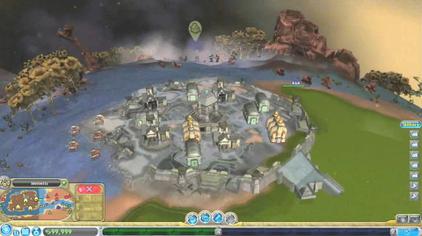
- Civilization stage: broader strategy, trade and conquest across a planet in the Civilization phase;
- Space stage: interstellar exploration, diplomacy and empire-building in a space environment often called the galactic era.
Across these phases, players make choices that shape behavior and capabilities. Decisions include dietary preferences, social tactics and whether a society pursues military, religious or commercial approaches. The game frames progression as an extended process of evolution, beginning with a simple germ-like origin and continuing through cultural and technological milestones.
Editors and player creation
A defining aspect of Spore is its set of creation tools. Separate editors let players design creatures, vehicles, buildings and even planets by assembling modular parts. In the creature editor, for example, placing limbs, mouths and sensory organs changes animation, abilities and social signals. Editors balance artistic freedom with gameplay impact: appearance, proportions and part placement all influence how creations perform in the game world.
Sporepedia and sharing
Spore integrated an online repository called the Sporepedia where player-made creations are cataloged. Each shared design is represented by a compact data file and thumbnail that other players can download and instantiate in their own games. This system encouraged a vibrant community of creators who exchanged creatures, buildings and vehicles, enabling rapid distribution and remixing of designs.
Development, release and editions
During its development the game underwent several design changes; earlier concepts included additional or different phases, but the final retail release organized play into the five stages described above. Spore was released in September 2008 for major desktop platforms. An expansion pack added mission-based content and an adventure editor to the base game, enabling players to create scripted scenarios and more complex objectives.
Reception, controversies and legacy
Critics and players praised Spore for its ambition, creative tools and the scale of ideas it brought together. Reviewers also noted trade-offs: individual phases vary in depth, and some players found that certain mechanics were simplified relative to the potential suggested by the game's scope. The title also prompted controversy related to copy-protection and distribution policies at launch, which were discussed widely in the gaming press.
Community and long-term influence
Spore's emphasis on user-generated content, procedural generation and cross-scale simulation influenced later games that seek to combine creativity with emergent systems. A dedicated community produced tutorials, mods and vast libraries of shared creations, keeping the game active well after its initial release. For many players, Spore's enduring appeal lies in experimentation: crafting whimsical creatures or elaborate civilizations and watching them interact within a simulated ecosystem.
Technical notes and platforms
Spore was developed for desktop platforms and released through traditional retail and digital distribution. Its editors were designed to export compact descriptions of creations so they could be easily shared; this design decision helped foster a lively exchange of designs and contributed to the game's popularity among creators and hobbyists.
Further reading and community resources are available through official and fan sites linked from the game's online services.
Related articles
Author
AlegsaOnline.com Spore (video game) Leandro Alegsa
URL: https://en.alegsaonline.com/art/92788