
Soxhlet extractor
A Soxhlet extractor is a glass laboratory apparatus for repeated solid–liquid extraction. It automates solvent contact with solids and is widely used to isolate compounds such as oils and pigments.
The Soxhlet extractor is a specialized piece of glassware used for continuous or repeated extraction of soluble components from a solid sample using a volatile solvent. Invented in the late 19th century by Franz von Soxhlet, it remains a standard technique in laboratories where exhaustive extraction is required but direct filtration or simple maceration proves inefficient. It is typically assembled from a boiling flask, an extraction chamber that holds the solid sample, and an overhead condenser that returns condensed solvent to the chamber. For general information about laboratory apparatus, see laboratory equipment overview.
Image gallery
1 Image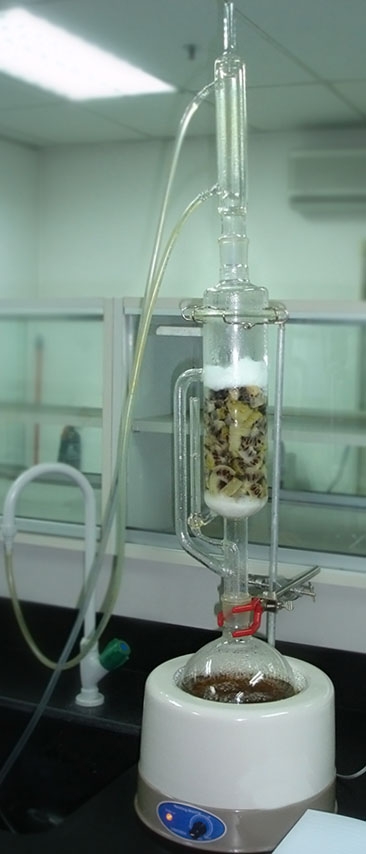
Design and main parts
A typical Soxhlet apparatus comprises three principal components: the round-bottom boiling flask that contains the extraction solvent, the central extraction chamber (often fitted with a thimble to hold the solid matrix), and the reflux condenser mounted above. The extraction chamber is connected to the flask by a short siphon tube. The condenser cools vaporized solvent so it drips back into the chamber; when the chamber fills to the siphon level the solvent and dissolved analyte are drawn back into the boiling flask. Common glassware items used in the assembly include a flask and condenser similar to those shown in many equipment catalogs — see boiling flask and condenser references.
How it works
Operation is cyclic: solvent in the flask is heated, vapor rises and condenses in the condenser, and liquid continuously wets the solid sample. Extracted material accumulates in the boiling flask via the siphoning action; the process repeats automatically until the extraction is essentially complete. The siphon action is analogous to the mechanism of a Pythagorean cup and ensures periodic flushing of concentrated extract into the receiving flask rather than continuous overflow. Details of Soxhlet's original description can be found in historical summaries on the invention.
Applications and examples
- Determination of fat and oil content in food and biological samples (gravimetric analysis).
- Extraction of lipophilic natural products such as essential oils, pigments, and sterols.
- Preliminary sample preparation in environmental and material analyses when exhaustive extraction is needed.
Advantages, limitations and variations
Soxhlet extraction offers thorough contact between solvent and sample without requiring large solvent volumes used in repetitive manual extractions. However, it can be slow and uses flammable solvents and heat, which pose safety and environmental concerns. Modern alternatives include accelerated solvent extraction, ultrasonic or microwave-assisted extraction, and solid-phase extraction, which may be faster or more selective. When selecting a solvent and procedure, practitioners weigh efficiency, selectivity, safety and downstream processing requirements.
Because of its simplicity and proven effectiveness, the Soxhlet extractor remains a useful technique in teaching and routine analysis, despite the availability of more advanced automated methods. For additional technical details and assembly diagrams consult equipment suppliers or laboratory manuals via links like lab resources and component references such as condenser guides.
Related articles
Author
AlegsaOnline.com Soxhlet extractor Leandro Alegsa
URL: https://en.alegsaonline.com/art/92377