
Southwest National Park (Tasmania)
Tasmania's largest national park, part of the Tasmanian Wilderness World Heritage Area. Remote, roadless landscapes with deep Aboriginal history, rugged coastlines, and limited access for visitors and management.
Overview
The Southwest National Park occupies a vast tract of remote wilderness in south‑west Tasmania, Australia. Covering roughly 618,000 hectares (about 1.5 million acres), it is the largest single protected area in the state and a core component of the Tasmanian Wilderness World Heritage Area. The park extends from near the island's south‑eastern highlands to the exposed west and south coasts, and it is widely recognised for its sense of remoteness, intact ecosystems and dramatic weather.
Image gallery
9 Images




Landscape and ecology
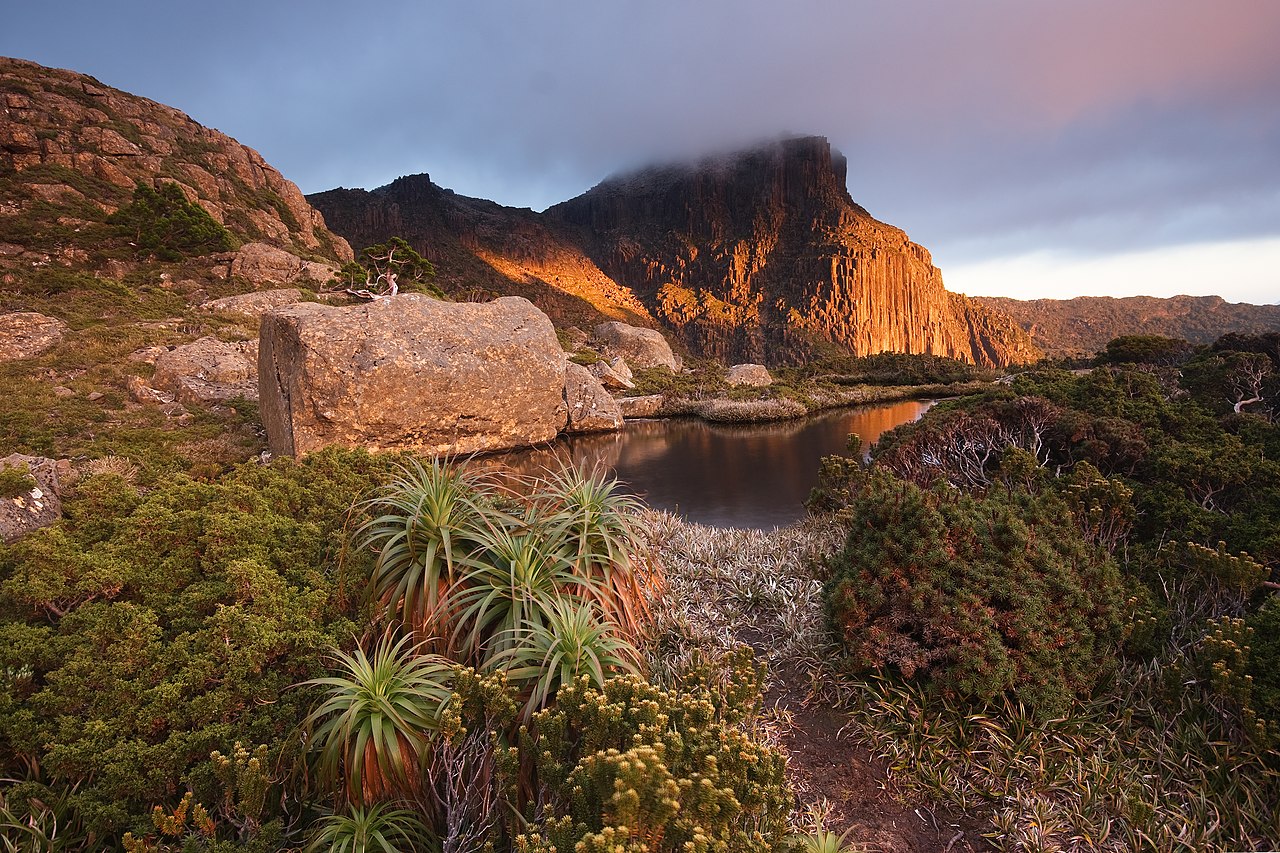
The park contains a mosaic of mountains, moorland, buttongrass plains, temperate rainforest, rivers, lakes and rugged shoreline. Coastal buttresses and jagged fjords give way inland to plateau country dotted with glacial features. Vegetation ranges from dense rainforest in sheltered valleys to alpine shrubs and cushion plants in higher, wind‑swept areas. The area supports many endemic and specialised species adapted to cool, wet conditions and nutrient‑poor soils.
History and cultural significance
People from Tasmanian Aboriginal communities have used and visited the south‑west for many thousands of years; archaeological and cultural evidence indicates a long history of seasonal travel and resource use. European exploration and settlement in the region has been very limited because of the harsh terrain and climate. Small infrastructure associated with twentieth‑century developments, notably hydroelectric construction west of Hobart, marks some of the few major alterations to the landscape.
Access, settlements and facilities
Access is intentionally restricted to preserve wilderness values. Apart from the access road to the hydroelectric township of Strathgordon, there are essentially no public roads through the park; the majority of the southern and western reaches are accessible only by foot, boat or light aircraft. The tiny settlement of Melaleuca in the extreme south‑west provides a basic airstrip and minimal visitor facilities for park management and hikers.
- Road access: principal road terminates at Hobart‑district approach and the Strathgordon hydro area
- Hydroelectric works: historical infrastructure tied to power development projects
- Air access: small runway at Melaleuca used for landing and emergency access facilities
Recreation, management and conservation challenges
Visitors come for multi‑day bushwalking, kayaking, wilderness photography and the opportunity to experience an uncultivated landscape. Park managers aim to balance public access with strict conservation objectives: maintaining fire regimes, protecting fragile vegetation, controlling invasive species and recognising Aboriginal heritage are all ongoing priorities. Climate variability, changing fire patterns and the logistics of managing a remote protected area remain significant challenges for conservation authorities.
Notable distinctions
As a large, largely roadless area within a World Heritage listing, Southwest National Park is often cited as one of Australia's premier examples of temperate wilderness. Its combination of cultural continuity, geological variety and ecological integrity makes it important both for national conservation and for international understanding of temperate wildlands.
Questions and answers
Q: Where is the Southwest National Park located?
A: The Southwest National Park is located in the south-west of Tasmania, Australia.
Q: How large is the Southwest National Park?
A: The Southwest National Park covers a total of 618,267 hectares or 1,527,770 acres, making it the largest national park in Tasmania.
Q: What is unique about the weather in the park?
A: The weather in the Southwest National Park can change quickly and can be severe.
Q: What is the history of human activity in the park?
A: Tasmanian Aborigines have visited the Southwest National Park for at least 25,000 years. European settlers made a few trips into the park, but there have been few long lasting settlements and little change to the natural environment.
Q: Is there a road that goes through the park?
A: There is only one road in the Southwest National Park, which leads to the hydroelectricity township of Strathgordon.
Q: How can the southern and western parts of the park be reached?
A: The southern and western parts of the park can only be reached by foot, boat, or light aircraft.
Q: Is there a town within the Southwest National Park?
A: The tiny town of Melaleuca is located in the extreme south-west of the Southwest National Park, with a runway for airplanes to land and basic facilities for the National Parks Service.
Related articles
Author
AlegsaOnline.com Southwest National Park (Tasmania) Leandro Alegsa
URL: https://en.alegsaonline.com/art/92346
Sources
- parks.tas.gov.au : "Reserve Listing - National Parks"
- parks.tas.gov.au : "Southwest National Park-Introduction"
- parks.tas.gov.au : "Southwest National Park-Access"