
Æsir–Vanir War — Norse myth of gods' conflict and reconciliation
A major myth in Norse mythology recounting a war between the Æsir and Vanir, its negotiated truce, the creation of Kvasir, and the episode's significance for Viking-age belief and poetic tradition.
Overview
The Æsir–Vanir War is a foundational story from Norse mythology that tells of armed hostilities and a subsequent peace between two distinct groups of deities. Rather than a single battle with firm tactical detail, the narrative survives in poetic fragments and later prose that emphasize conflict, diplomacy and the ritual sealing of an agreement. It explains how the two divine houses came to coexist and how certain gods passed from one group to the other.
Image gallery
4 Images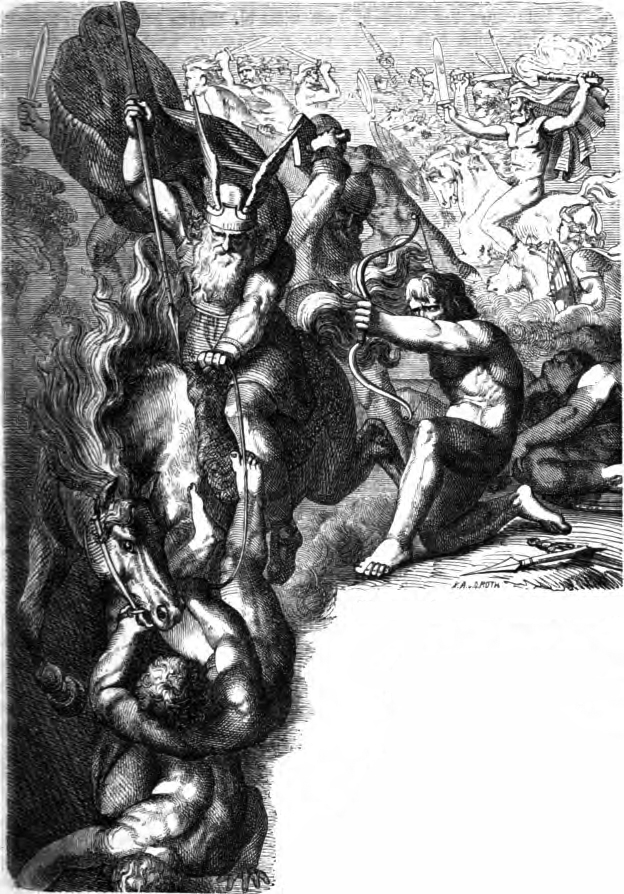


Participants and characteristics
The opposing sides are traditionally identified as the Æsir and the Vanir. Broadly described, the Æsir are associated with sovereignty, war and rulership, while the Vanir are often linked to fertility, wealth and the productive forces of nature. Individual deities commonly named in accounts include figures who later occupy prominent roles in the Norse pantheon and whose functions overlap between the two groups.
Narrative of the war and truce
Sources record that the conflict ran until both sides agreed to a truce. As part of the peace-making ritual they exchanged hostages and performed a symbolic act: the gods spat into a communal vessel and mixed the saliva. From that mingling a wise being was created— Kvasir—renowned for his knowledge. The truce also involved an exchange of members; some Vanir gods went to live among the Æsir and vice versa, signaling political and religious reconciliation.
Aftermath and cultural consequences
The end of the war marks the incorporation of Vanir elements into the wider Norse divine order and is often read as an origin for later myths. Kvasir's fate is also important: he was later slain by two dwarves, and his blood mixed with honey produced the so-called mead of poetry—a mythic source of inspiration and poetic skill in skaldic tradition. The exchange of deities helps explain why certain gods carry attributes associated with both groups.
Interpretations and notable facts
- Scholars consider the episode an etiological myth—accounting for cultural or religious change, possibly reflecting the historical merging of cults or tribes.
- The principal textual witnesses appear in the Poetic Edda and the Prose Edda, where the account is concise and fragmentary rather than systematically narrated.
- The ritual mixing of saliva and the subsequent creation of a wise being is an unusual motif that links social reconciliation with the origin of wisdom and poetic authority.
As a mythic theme, the Æsir–Vanir War combines elements of violence, diplomacy and creative outcome. It functions both as a story about divine relations and as a symbolic explanation for how different religious traditions and poetic authority were assimilated into the Norse worldview.
Related articles
Author
AlegsaOnline.com Æsir–Vanir War — Norse myth of gods' conflict and reconciliation Leandro Alegsa
URL: https://en.alegsaonline.com/art/90775