
Barnum's American Museum — 19th-century popular museum and showplace
A 19th-century New York institution that blended natural history, curiosities and live attractions under P. T. Barnum; famed for spectacle, promotion, and its destruction by fire in 1865 and 1868.
Overview
Barnum's American Museum was a prominent entertainment and exhibition venue in lower Manhattan that combined scientific specimens, oddities, theatrical displays and living performers. Its collections traced their origins to a late 18th-century municipal repository of natural history curiosities. During the first half of the 19th century the collection was organized and shown to the public, and by the middle of that century the museum was widely identified with the showman P. T. Barnum, who transformed the institution into a highly successful popular attraction.
Image gallery
4 Images


Collections and attractions
The museum's displays mixed traditional museum material — preserved animals, geological specimens, antiquities and wax figures — with attractions intended primarily to entertain. Visitors could see staged tableaux, mechanical devices, live performers, and what were then called "curiosities" or "oddities." Barnum emphasized novelty and sensation: rather than presenting only specimens for careful study, the museum offered performances and exhibits designed to attract large, paying audiences and to be talked about in the press and on the street.
Notable performers and exhibits
- P. T. Barnum — owner and promoter whose name became synonymous with theatrical publicity and spectacle.
- General Tom Thumb — a dwarf performer who became an international celebrity after appearances at the museum.
- Commodore Nutt — another well-known performer associated with Barnum's shows.
- The "Siamese Twins," Chang and Eng, were among the living attractions that drew crowds and debate about exhibition of human differences.
Origins, ownership and location
The earliest elements of the museum grew out of a City Hall collection of natural history objects assembled at the end of the 18th century. Around 1800 the holdings were put on public display in New York, and a succession of proprietors enlarged and rearranged the presentations. One of the early custodians was John Scudder, who helped establish the institution at the busy intersection of Broadway and Ann Street. Over time the place developed into a hybrid institution: part cabinet of curiosities, part theater, part commercial enterprise centered in the rapidly expanding city of New York and its bustling Broadway thoroughfare (Broadway and Ann Street).
Fires and decline
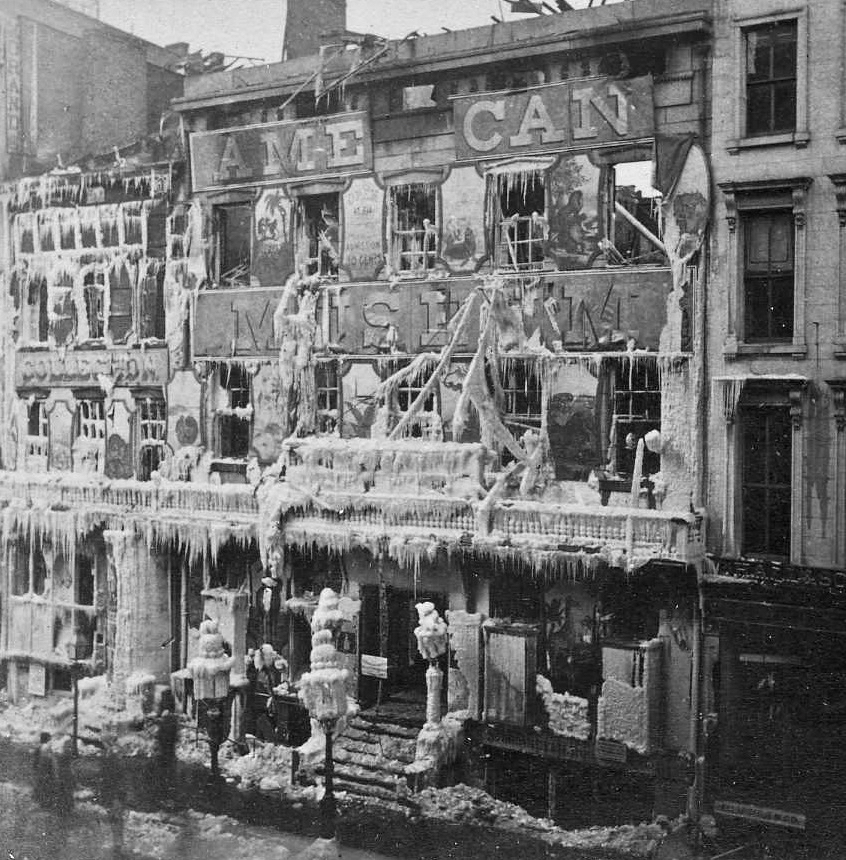
The museum's history was marked by catastrophic fires. In 1865 the principal building was destroyed by fire; Barnum rebuilt at a new site, but that replacement building also burned in 1868. After the second conflagration the museum did not reopen in the same form. These losses helped to end a chapter in mid‑19th‑century popular culture and to scatter much of the collection and the performers who had made the museum famous.
Legacy and significance
Barnum's American Museum occupies an important place in the history of museums and mass entertainment. It illustrates how mid‑19th‑century audiences engaged with science, spectacle and celebrity before the rise of modern museums devoted chiefly to public education. The institution is often remembered both for its role in creating modern promotional techniques and for raising ethical questions about the display of human subjects and the blending of education with commercial spectacle. Today the museum is referenced in studies of popular culture, museum history and the development of American show business.
For further reading and archival references, consult specialized works on 19th‑century American entertainment, museum history and biographies of Barnum and several performers associated with his displays.
Related articles
Author
AlegsaOnline.com Barnum's American Museum — 19th-century popular museum and showplace Leandro Alegsa
URL: https://en.alegsaonline.com/art/9058