
Separating Funnel
Laboratory glassware used to separate immiscible liquid phases (liquid–liquid extraction). Describes design, operation, uses, common problems (emulsions), safety and alternatives.
Overview
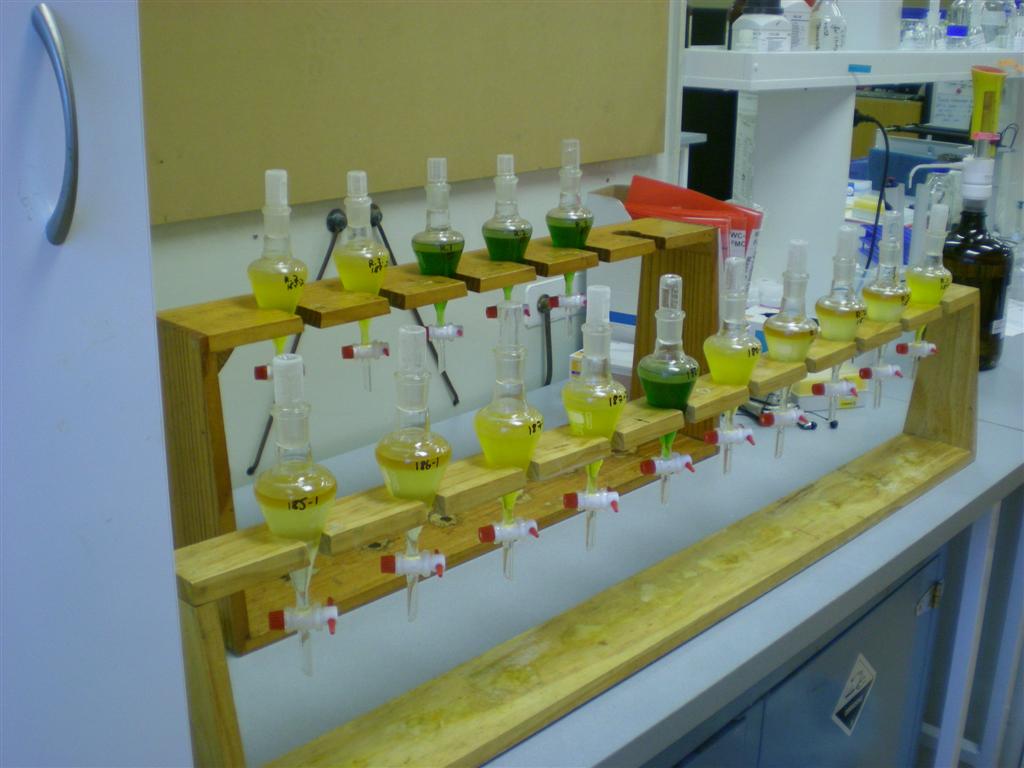
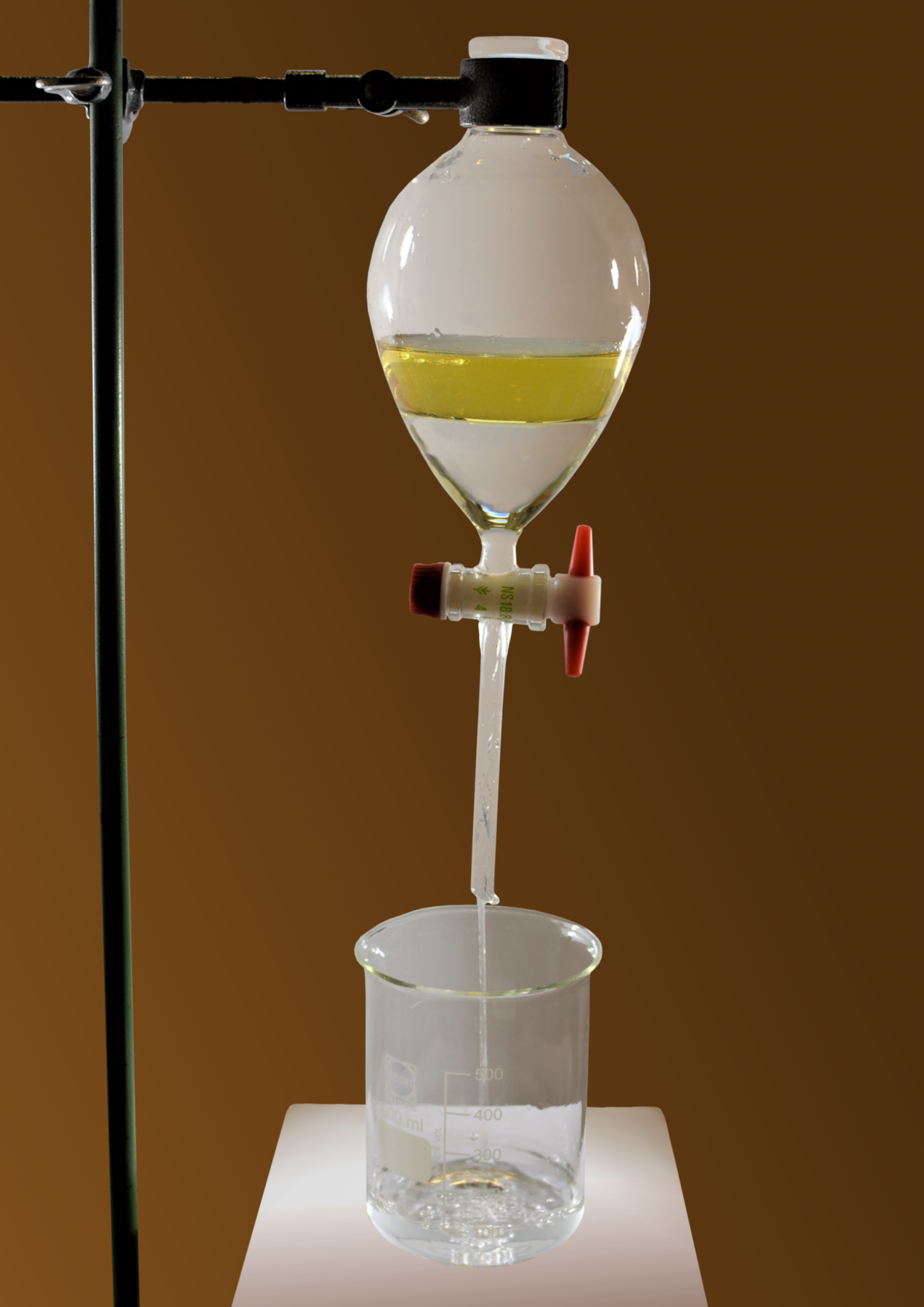
A separating funnel (also spelled separatory funnel) is a common piece of laboratory glassware used to separate two immiscible liquid layers, for example oil and water. It relies on differences in density and immiscibility so that two phases form distinct layers which can be drained apart. In chemistry it is widely used for liquid–liquid extraction: transferring a solute from one solvent into another.
Image gallery
3 Images
Design and main parts
Typical separating funnels are made of glass (borosilicate) and have a conical or pear-shaped body with a narrow stem at the bottom and a ground-glass or rubber stopcock to control flow. The top is closed with a stopper to allow shaking without loss of material. Common sizes range from a few tens of milliliters to several liters. Variants include plastic funnels for corrosive or impact-prone applications and cylindrical models with flat bottoms for laboratory convenience.
Operation: basic steps
- Place the funnel in a ring clamp over a receiving vessel and add the two immiscible liquids.
- Fit the stopper, hold the stopper in place, invert and shake gently to allow mass transfer, then vent frequently by opening the stopcock to release built-up pressure.
- Allow the funnel to stand until two clear layers form; identify which is upper and lower by density or color.
- Open the stopcock and drain the lower layer into the receiver; close the stopcock before the interface reaches the outlet.
- Pour or drain the remaining upper layer into a separate container if needed.
Uses and examples
Separating funnels are essential in organic synthesis and analytical chemistry for washing reaction mixtures, extracting organic compounds from aqueous solutions, and performing solvent partitioning. Typical solvent pairs are water and an organic solvent such as diethyl ether, dichloromethane, or ethyl acetate. After extraction, the organic phase is often dried over anhydrous salts and filtered.
Problems, safety and alternatives
Emulsions—stable mixes of the two phases—are a common complication and can be reduced by gentle swirling, adding salt, centrifugation, or allowing extended settling time. Pressure can build up when volatile solvents or acid–base reactions are present; always vent regularly and point the stopcock away from people. Avoid using cracked or chipped glassware. When handling highly corrosive or radioactive liquids, use appropriate materials and containment; plastic funnels and mechanical separators are alternatives for scale-up, and continuous liquid–liquid extractors or centrifuges replace batch funnels in industrial settings.
Notable facts: the separating funnel remains a simple, low-cost tool for phase separation and is taught early in laboratory courses because it illustrates basic principles of density, solubility, and phase equilibria.
Related articles
Author
AlegsaOnline.com Separating Funnel Leandro Alegsa
URL: https://en.alegsaonline.com/art/88893