
Saturn I — Early U.S. heavy-lift launch vehicle
Saturn I was NASA's first heavy-lift rocket family member, built as a clustered-stage vehicle to test Apollo hardware and technologies and to pave the way for Saturn IB and Saturn V.
Overview
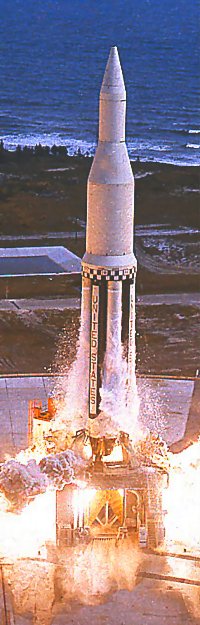
The Saturn I was an early American heavy-lift launch vehicle developed in the late 1950s and early 1960s to support the national space effort and the Apollo program. Known informally as "Cluster's Last Stand," it used clustered tanks and engines to create a larger first stage from existing components. The vehicle was designed and managed by the Marshall Space Flight Center under the leadership of rocket engineers led by Wernher von Braun; it played a crucial role in validating components and procedures for later crewed missions. For program context see NASA and the broader Apollo program.
Image gallery
10 Images




Design and main components
The Saturn I used a distinctive clustered approach rather than a single large tank: its S‑I first stage assembled multiple propellant tanks and several engines into one unit to achieve higher thrust without waiting for entirely new engine development. The first stage was powered by a cluster of H‑1 engines derived from earlier missile work; the second stage, the S‑IV, used multiple RL10 engines burning liquid hydrogen. This modular, testable arrangement made the vehicle useful as a stepping stone: a practical compromise between using proven hardware and meeting new performance needs. Technical overviews and archival material are available at a general technical summary.
Development and flight history
Development began amid intense schedule pressure to support orbital and Apollo-related tests. The Saturn I underwent a sequence of progressively more capable flights during the early 1960s. NASA flew the original Saturn I configuration multiple times as it matured into a reliable testbed; overall the original Saturn I flew ten times before being superseded in operational use by the improved Saturn IB. Records, mission lists, and program notes can be found through institutional references such as historical collections and agency reports (program notes, technical reports).
Uses and significance
The vehicle's principal use was to test launch procedures, structural designs and stages that later supported crewed flights. It launched boilerplate and early test versions of Apollo spacecraft and verified the clustered-engine approach, fueling and stage separation methods, and ground support systems. As a development platform it reduced risk for subsequent rockets by proving many elements in flight rather than only in the laboratory.
Distinctions and legacy
- Clustered first-stage architecture: allowed rapid assembly from modified existing hardware.
- Transition vehicle: the Saturn I established key technologies and operational experience later used on the Saturn IB (uprated first stage and S‑IVB second stage) and the larger Saturn V lunar launcher.
- Program impact: though never used for crewed lunar missions, Saturn I flights were essential to maturing engines, stages and integration approaches that made crewed Apollo missions possible. For biographical context on leadership and engineering influences see materials about Wernher von Braun.
Today the Saturn I is remembered as a pragmatic stepping stone in the transition from missile-derived rockets to purpose-built launch vehicles capable of supporting complex human spaceflight missions. For additional summary and archival links, consult institutional resources and curated collections referenced above (technical summary, agency history).
Related articles
Author
AlegsaOnline.com Saturn I — Early U.S. heavy-lift launch vehicle Leandro Alegsa
URL: https://en.alegsaonline.com/art/87492
Sources
- astronautix.com : "Saturn I"
- commons.wikimedia.org : Saturn (rocket)