
Riddarholmen Church (Riddarholmskyrkan)
Medieval former monastery church on Stockholm’s Riddarholmen, preserved as a royal burial site and historic landmark notable for its Gothic masonry, funerary monuments and later spire.
The Riddarholmen Church, known in Swedish as Riddarholmskyrkan, stands on the island of Riddarholmen beside Stockholm’s old town. Located in central Stockholm, Sweden, it is one of the city’s oldest surviving buildings and has an important place in national ceremonial life. The church today is associated with the Church of Sweden and is best known as a memorial and burial church for members of the Swedish monarchy and other leading figures.
Image gallery
7 Images


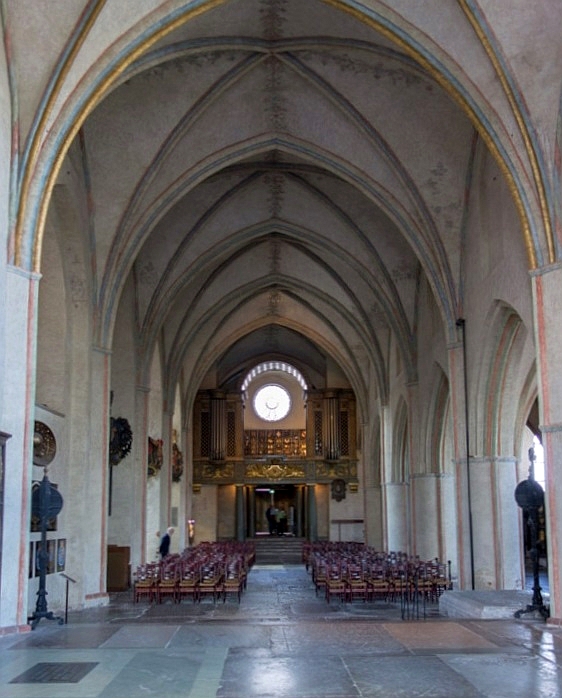
Architecture and layout
The church preserves a largely medieval plan built in brick and stone, reflecting the Gothic tradition brought to the region during the Middle Ages. Its simple nave and chancel originally served a mendicant monastic community; later centuries added monuments, chapels and structural repairs. A tall, slender spire crowns the tower in a form that is a post-medieval replacement rather than an original medieval feature. Interior surfaces are sober in places but punctuated by richly carved tombs, effigies and heraldic decorations.
History and development
Founded as part of a friary, the building survived the upheavals of the Reformation and the shifting role of the church in Swedish society. Over time its use changed from an active parish or monastic church to a ceremonial site where funerary services and commemorations for royalty and statesmen are held. Continuous care and periodic restorations have sought to balance preservation of the medieval fabric with conservation of later funerary art.
Notable burials and monuments
The interior is dominated by tomb monuments of differing styles: simple stone slabs, sculpted sarcophagi, cast-metal monuments and monumental epitaphs that reflect changing tastes from the early modern period to the 19th century. Many Swedish monarchs and members of the aristocracy are interred or commemorated here, making the church a central repository of royal memory. Visitors can read inscriptions and view coats of arms that record family ties and state service.
Conservation, access and significance
Riddarholmen Church is managed in cooperation with ecclesiastical and cultural heritage authorities. It is treated as both a place of remembrance and a visitor site, open to the public at set times and used for occasional ceremonial services. As an architectural and historical landmark it provides a direct link to Stockholm’s medieval past and the evolution of Swedish funerary tradition. For further reading and official visitor information consult the institutional pages referenced above: Riddarholmskyrkan, Stockholm, Sweden, Church of Sweden and historical surveys of the Middle Ages.
- Origins: a medieval friary church with Gothic masonry.
- Function: chiefly a royal and state funerary church rather than a parish church.
- Interior: a concentration of tombs, epitaphs and heraldic art spanning several centuries.
- Setting: prominent historic landmark on Riddarholmen, adjacent to Stockholm’s older central islands.
Related articles
Author
AlegsaOnline.com Riddarholmen Church (Riddarholmskyrkan) Leandro Alegsa
URL: https://en.alegsaonline.com/art/82817