
Republic of Molossia
A self-declared micronation established by Kevin Baugh near Dayton, Nevada; a privately owned miniature state with ceremonial institutions, a small territory and public outreach.
Overview
The Republic of Molossia is a self-declared, unrecognized micronation centered on the private property of its founder, Kevin Baugh. Often described in popular media as a hobbyist project elevated into a symbolic territorial entity, Molossia models many trappings of a state—names, ceremonies, symbols and administrative roles—while remaining legally part of the United States. Observers commonly classify it as a micronation, a term used for small, self-styled entities that claim independence but lack international recognition.
Image gallery
7 Images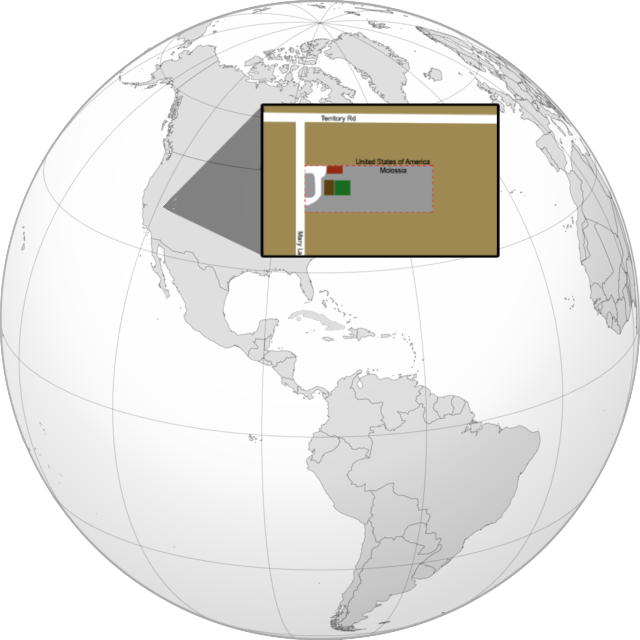



Territory and symbols
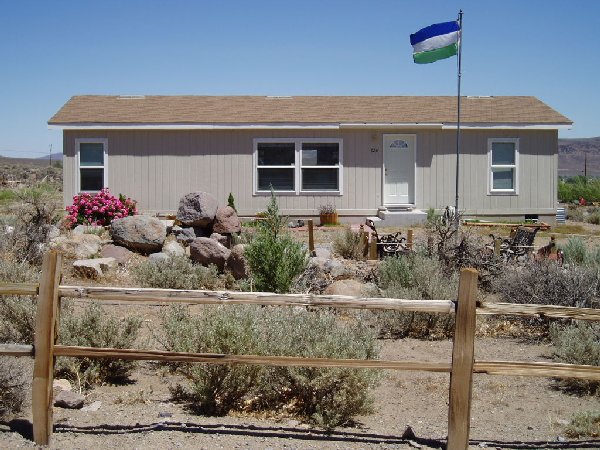
Molossia's core consists of Baugh's residence, known as the Government House, and adjacent land near Dayton in western Nevada. The site is tiny compared with recognized countries and functions more as a themed property than a geopolitical unit. Over time Molossia has adopted visible state-like features: a flag, a seal, national colours and commemorative items. It has also produced memorabilia such as stamps, lapel pins and novelty passports to represent its distinct identity to visitors and the wider micronation community.
History and development
The project traces back to Baugh's youth in the late 1970s when he created an early iteration as a personal pastime. After several changes of form and name—Baugh served in earlier roles such as prime minister of other informal realms—the present Republic of Molossia was established in the 1990s and converted from a monarchical to a republican style of government on paper. Baugh has been widely reported as serving as president since 1999. The micronation once claimed additional property beyond Nevada, including a parcel in Pennsylvania, though its practical territory remains the family property outside Dayton.
Government, culture and activities
Molossia carries out ceremonial functions typical of micronations. It stages events, welcomes visitors by appointment, maintains a website and participates in exchanges with other micronationalists. Activities often emphasise play, satire and community, blending historical references and invented traditions. The founder and his supporters treat the republic both as a personal creative undertaking and as a way to engage with tourists, media and hobbyists who study alternative forms of statecraft.
Legal status and public perception
Like other micronations, Molossia lacks formal recognition by established states and international organizations and remains under the jurisdiction of the United States. Its claims are symbolic and generally tolerated as private expression on private land. Commentators and scholars of micronationalism frequently regard Molossia as an example of the phenomenon in which leisure, identity and performance intersect; one author described it as a hobby intensively developed into a miniature polity.
Notable facts and distinctions
- The name "Molossia" reportedly derives from the Spanish word morro, meaning a small rocky hill; the founder distinguishes this origin from the ancient Molossian tribe of Greece.
- Molossia has become one of the better-known micronations in the United States, often featured in travel and human-interest coverage for its imaginative presentation of sovereign trappings on a very small scale.
- While largely ceremonial, the project illustrates broader themes about citizenship, state symbols and how people create and maintain collective identity outside conventional political institutions.
For readers interested in micronationalism as a cultural phenomenon, Molossia offers a compact, well-documented case study of how private initiatives can mimic state forms while remaining firmly within the framework of local law and social performance.
Related articles
Author
AlegsaOnline.com Republic of Molossia Leandro Alegsa
URL: https://en.alegsaonline.com/art/82235
Sources
- molossia.org : Our New National Anthem
- molossia.org : "Newsbites"
- molossia.org : "Republic of Molossia - Official Website"
- npr.org : "'Lonely Planet' Explores Micronations"