
Renal cell carcinoma: overview, presentation, diagnosis, and management
A concise encyclopedia article on renal cell carcinoma, covering its types, causes, symptoms, diagnosis, treatment options and prognosis, with links to related topics.
Overview
Renal cell carcinoma (RCC) is the most common form of cancer that arises in the renal cortex of the kidneys. It develops from the epithelial cells of renal tubules and encompasses several distinct histological subtypes. When detected at an early, localized stage RCC is often curable by surgical removal; when disease has metastasized to distant organs it becomes more challenging to control and usually requires systemic therapy.
Image gallery
9 Images


Characteristics and subtypes
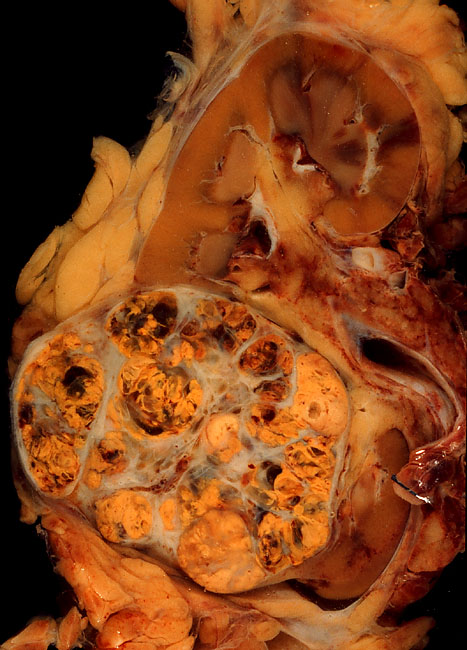
RCC is not a single disease but a group of tumors with different microscopic appearances and molecular features. Common subtypes include clear cell carcinoma, papillary carcinoma, and chromophobe carcinoma, each with differing behavior and typical appearances on imaging and pathology. Tumors vary in size, growth pattern and tendency to invade local structures or spread through blood vessels.
Causes and risk factors
Risk factors for RCC include smoking, obesity, long-standing high blood pressure, certain inherited conditions (for example von Hippel–Lindau syndrome), and some occupational exposures. Age and male sex are associated with higher incidence. Exact causes are complex and involve genetic and environmental interactions.
Symptoms and diagnosis
Early RCC may be asymptomatic and discovered incidentally on imaging. When present, symptoms can include flank pain, blood in the urine, an abdominal mass or unexplained weight loss and fever. Diagnosis typically relies on imaging (ultrasound, CT or MRI) and is confirmed by pathological examination of tissue obtained at biopsy or following surgical removal.
Treatment and prognosis
Localized RCC is usually managed with partial or radical nephrectomy. For small tumors, nephron-sparing surgery or ablative techniques may be options. Advanced or metastatic RCC is treated with systemic therapies that include targeted agents against angiogenesis pathways, immune checkpoint inhibitors, or combinations of these approaches. Choice of therapy depends on tumor subtype, extent of disease and patient factors. Follow-up is important because recurrence can occur years after initial treatment.
Notable facts and distinctions
- Clear cell RCC is the most frequent subtype and often has characteristic genetic changes.
- RCC can invade the renal vein and extend into the inferior vena cava in some cases.
- Because presentation is variable, multidisciplinary care and individualized treatment planning are central to management.
For further general information see related topics on renal anatomy and metastatic disease through the provided links, or consult specialized clinical guidelines for detailed management recommendations.
Related articles
Author
AlegsaOnline.com Renal cell carcinoma: overview, presentation, diagnosis, and management Leandro Alegsa
URL: https://en.alegsaonline.com/art/82100
Sources
- login.medscape.com : "Medscape Log In"
- docguide.com : "Oncophage Improves Overall Survival in Intermediate-risk Kidney-cancer Patients - DocGuide"
- urotoday.com : urotoday.com/38/browse_categories/renal_cancer/liver_resection_for_metastatic_disease_pro…