
Back to the Future Part III
1990 final film of the Back to the Future trilogy: a science-fiction Western directed by Robert Zemeckis, starring Michael J. Fox and Christopher Lloyd, notable for its Old West setting and train-climax.
Back to the Future Part III is the 1990 conclusion to the Back to the Future trilogy, combining time-travel science with a Western backdrop. The film blends elements of science fiction and the Western genre in a feature-length movie directed by Robert Zemeckis. It follows the characters established in the first two films as the story moves to 1885 Hill Valley and the American frontier.
Image gallery
6 Images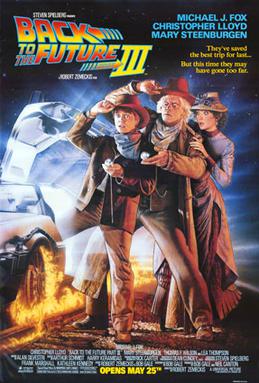


Plot and setting
The narrative centers on Marty McFly's effort to rescue his friend Doctor Emmett Brown after Doc becomes stranded in 1885. To return to their original time Marty and Doc must repair and accelerate their time machine — a modified car — while navigating the conventions and dangers of the Old West. A memorable sequence uses a steam locomotive to help the time machine reach the speed required for time travel, and the film mixes action, romance and period humor.
Principal cast
The movie features Michael J. Fox as Marty McFly and Christopher Lloyd as Doc Brown, with Mary Steenburgen in a prominent supporting role as Clara Clayton. Other familiar performers include Thomas F. Wilson in the role of Biff Tannen and Lea Thompson as Lorraine McFly. Notably, Crispin Glover, who portrayed George McFly in the original film, did not appear in the second or third installments.
Production and style
Produced in the context of an already successful franchise, Part III was developed to complete the characters' arc and to provide a distinct visual and tonal contrast with the contemporary and futuristic settings of the earlier entries. Director Zemeckis and his team used practical stunts and period production design to evoke the 1880s, while composer Alan Silvestri's score continued the musical identity of the series. Parts II and III were planned and produced together, which helped maintain continuity in effects and storytelling.
Reception and legacy
On release, Back to the Future Part III was generally regarded as a satisfying, if different, conclusion to the trilogy: critics and audiences praised the chemistry of the leads and the film's affectionate take on Western tropes, even as some noted it moved away from the sharper invention of the first installment. Its train stunt, romantic subplot, and final resolutions for the main characters have kept it visible in popular culture and home-video collections, and it remains the closing chapter of one of the most enduring time-travel series in contemporary cinema.
Notable elements
- Fusion of genres: science-fiction premise within a Western setting.
- Iconic set-pieces: the locomotive-assisted time-travel sequence.
- Character resolution: ties together arcs begun in the earlier films.
Questions and answers
Q: Who directed Back to the Future Part III?
A: Robert Zemeckis directed Back to the Future Part III.
Q: What genre does Back to the Future Part III belong to?
A: Back to the Future Part III is a science fiction Western movie.
Q: When was Back to the Future Part III released?
A: Back to the Future Part III was released in 1990.
Q: Who are the main cast members of Back to the Future Part III?
A: The main cast members of Back to the Future Part III are Michael J. Fox, Christopher Lloyd, Mary Steenburgen, Thomas F. Wilson, Crispin Glover and Lea Thompson.
Q: Is Back to the Future Part III the final movie of the trilogy?
A: Yes, Back to the Future Part III is the third and final movie of the Back to the Future trilogy.
Q: What is the plot of Back to the Future Part III?
A: The plot of Back to the Future Part III revolves around Marty McFly traveling back to the Wild West to save his friend Doc Brown.
Q: Are there any notable awards won by Back to the Future Part III?
A: Back to the Future Part III was not particularly successful in terms of awards, but it received nominations for Saturn Award for Best Science Fiction Film and Best Music.
Tags
Related articles
Author
AlegsaOnline.com Back to the Future Part III Leandro Alegsa
URL: https://en.alegsaonline.com/art/8102