
Province of Salamanca (Spain)
Western Spanish province in Castile and León, bordering Portugal. Capital Salamanca is renowned for its medieval university and UNESCO-listed old city. Predominantly rural with 362 municipalities and varied landscapes.
The province of Salamanca lies in western Spain, forming part of the autonomous community of Castile and León. It takes its name from its capital city, Salamanca, whose historic centre and university are among the province's best-known features. The territory borders the provinces of Zamora, Valladolid, Ávila and Cáceres, and on its western flank it shares an international boundary with Portugal. In 2018 the province had an estimated population of 331,473 people, concentrated mainly in the capital and a few larger towns.
Image gallery
1 Image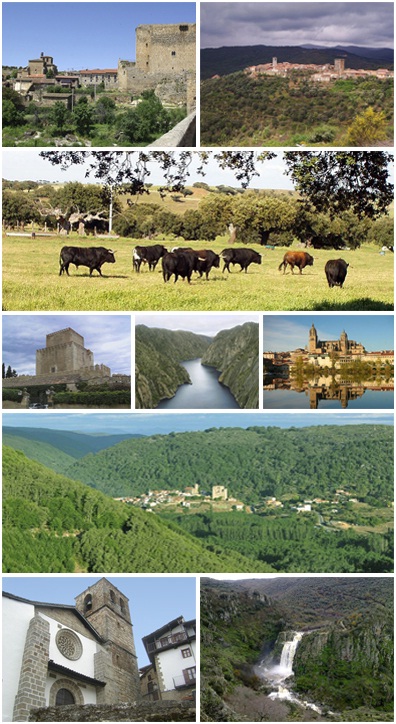
Geography and landscape
Salamanca occupies part of the western edge of the northern Meseta (the central plateau). The landscape combines cereal plains and agricultural land with upland ranges and wooded valleys. Notable mountain areas include the Sierra de Francia and the Sierra de Béjar, while the Tormes River flows through the city of Salamanca and contributes to local river valleys. Along the border with Portugal the Duero/No-Do and related canyon systems form dramatic cliffs and distinctive ecosystems that are important for conservation and tourism.
Administrative divisions and population
Administratively the province is organized as a province composed of 362 municipalities. These are grouped in a variety of traditional and functional subdivisions, including 11 comarcas, 32 mancomunidades (associations of municipalities) and five judicial districts. More than half of the municipalities are small villages of fewer than 300 inhabitants, reflecting a dispersed rural settlement pattern and the broader issue of demographic decline in many inland parts of Spain.
- Municipalities: 362
- Comarcas (traditional): 11
- Mancomunidades (cooperative bodies): 32
- Judicial districts: five
History, culture and heritage
The city of Salamanca has been an intellectual and cultural centre for centuries. Its university, founded in the early 13th century, made the city an important centre of learning in medieval and early modern Spain. The old city, with its Romanesque and Renaissance architecture, plazas and historic façades, is recognised as a UNESCO World Heritage Site and attracts scholars and visitors from around the world. Beyond the capital, the province preserves Romanesque churches, fortified villages and examples of vernacular rural architecture.
Cultural life includes religious festivals, municipal fairs and events linked to agricultural cycles. Gastronomy draws on Castilian traditions: local markets and restaurants emphasise cured meats, cheeses and simple, seasonal dishes prepared from cereals, legumes and regional livestock products. Cross-border links with Portugal add layers of historical exchange in language, customs and cuisine for border communities.
Economy and contemporary issues
The provincial economy blends agriculture (notably cereals and legumes), livestock rearing and food-processing activities with services concentrated in urban centres such as education, health care and tourism. Rural depopulation and an ageing population are persistent challenges; provincial and local bodies promote rural development, infrastructure improvements, conservation of historic sites and initiatives to support small businesses and tourism as ways to strengthen local economies.
Transport, tourism and natural areas
Road and rail connections link Salamanca to Madrid and other regional capitals, and local roads connect villages and mountain areas. Visitors to the province typically combine a stay in the historic city of Salamanca—its university buildings, the Plaza Mayor and cathedral complex—with trips into nearby natural areas such as the Sierra de Francia, Las Batuecas and the Arribes-like river landscapes on the Portuguese border. Protected areas and scenic valleys support outdoor activities, birdwatching and cultural tourism centred on the province's built and natural heritage.
For further administrative and travel information consult provincial resources or regional tourism guides, or the official pages maintained by the autonomous community of Castile and León and the provincial council. Local matters and municipal cooperation are often coordinated through organizations and portals that serve the province and link communities within Salamanca and across the frontier with Portugal.
See also nearby provinces: Zamora, Valladolid, Ávila and Cáceres, and national context: Spain and the role of provincial administration at the provincial level.
Related articles
Author
AlegsaOnline.com Province of Salamanca (Spain) Leandro Alegsa
URL: https://en.alegsaonline.com/art/79692
Sources
- books.google.com : The Gazetteer of the World Prominence given to Great Britain and Colonies, Indian Empire, United States of America
- lasalina.es : "Municipios"