
Proto-Indo-Europeans
Speakers of the reconstructed Proto-Indo-European language who lived after the last Ice Age; their language, society and migrations gave rise to the Indo-European family.
Overview
The term "Proto-Indo-Europeans" denotes the prehistoric people who spoke the ancestor of the Indo-European languages. They are inferred from linguistic reconstruction rather than contemporary written records. Their existence is generally placed after the last Ice Age, and their speech is called the Proto-Indo-European language (PIE). PIE itself is unattested but partially reconstructed by comparing features of its descendant languages.
Image gallery
4 Images


Language and reconstruction
Scholars reconstruct PIE through the comparative method, identifying regular sound correspondences and shared grammatical patterns across its daughter languages. Reconstructions propose a complex system of inflection for nouns and verbs, an accent and vowel alternation system known as ablaut, and a consonant inventory that in some analyses includes so-called "laryngeal" sounds. From reconstructed roots researchers deduce aspects of vocabulary covering kinship, numbers, animals, plants and technology.
Origins and migrations
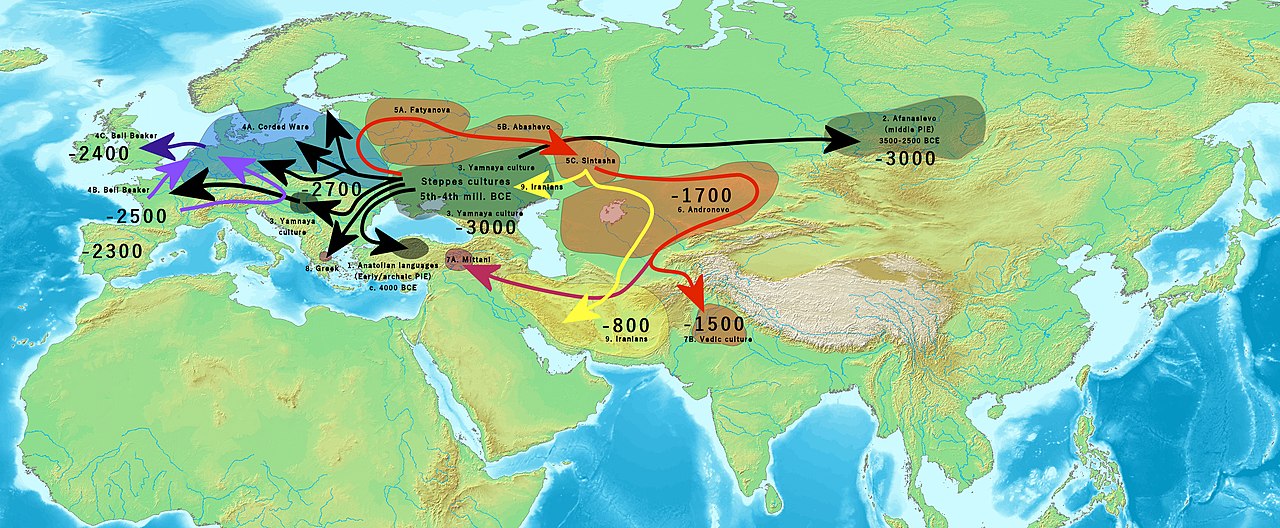
Multiple hypotheses address where and when the Proto-Indo-Europeans lived. The most widely cited model places their homeland on the Pontic–Caspian steppe of eastern Europe and western Asia, associated with steppe cultures in the late Neolithic and early Bronze Age. An alternate Anatolian hypothesis locates the earliest speakers earlier in Anatolia. Archaeology, comparative linguistics and recent ancient DNA studies have been combined to explore migration routes and timing, though some questions remain debated.
Society, economy and culture
Reconstructed vocabulary and archaeological contexts suggest a society familiar with pastoralism, the domesticated horse, wheeled vehicles and metalworking. Kinship terminology implies extended family structures; religious vocabulary points to a pantheon and ritual practices that may underlie later Indo-European mythologies. Material remains attributed to related archaeological cultures include burial mounds, settlements and distinctive pottery and metalwork.
Evidence and legacy
- Linguistic reconstruction: comparative grammar and lexicon.
- Archaeology: material culture and burial practices.
- Genetics: patterns of ancient DNA that illuminate population movements.
The Proto-Indo-Europeans are significant because the languages that descend from their speech — including Sanskrit, Latin, Greek, Persian and the Germanic, Celtic and Slavic families — are spoken by a large portion of the world today. Research remains active and interdisciplinary, combining linguistic, archaeological and genetic evidence to refine our understanding while acknowledging uncertainties in chronology and geography.
Related articles
Author
AlegsaOnline.com Proto-Indo-Europeans Leandro Alegsa
URL: https://en.alegsaonline.com/art/79533
Sources
- isrl.uiuc.edu : "Diffusion of genes and languages in human evolution"
- isrl.uiuc.edu : The Evolution of Language: Proceedings of the 6th International Conference (EVOLANG6)