
Professor James Moriarty — Sherlock Holmes's Criminal Mastermind
Profile of Professor James Moriarty, the fictional criminal genius from Sir Arthur Conan Doyle's Sherlock Holmes tales: character, role in the stories, origins, and cultural legacy.
Overview
Professor James Moriarty is a fictional antagonist in the canon of Sherlock Holmes stories by Sir Arthur Conan Doyle. He is commonly portrayed as a brilliant but morally corrupt intellectual who organizes and directs a wide-ranging criminal network. Holmes himself famously calls Moriarty the "Napoleon of crime," a phrase that evokes strategic genius applied to crime rather than warfare.
Image gallery
3 Images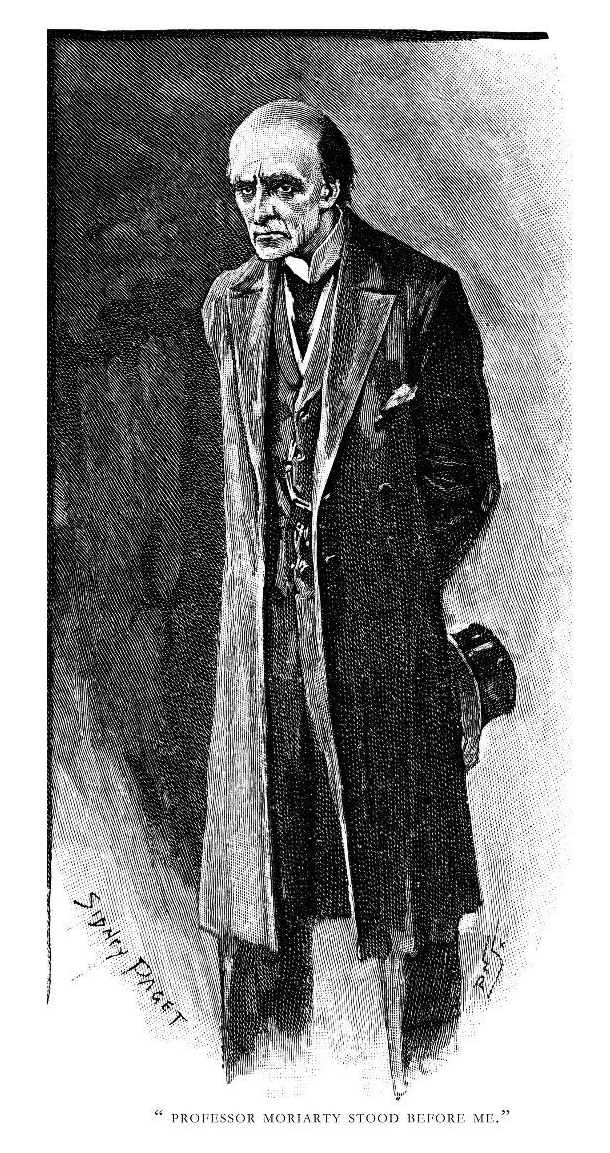
Character and traits
Moriarty is depicted as both an academic and a cunning criminal. In several accounts he is described as a former or current mathematical professor whose analytical talents make him a dangerous planner and strategist. Unlike many villains who act in public, Moriarty rarely commits crimes personally; instead he plans, coordinates, and protects a hierarchy of operatives. His intelligence, composure, and reputation for cold calculation set him apart from common thieves and violent offenders.
Role in the stories
The character plays a central dramatic role in the story often titled "The Final Problem," in which Holmes confronts what he treats as the greatest single threat to his work. Moriarty is also central to the novel-length tale "The Valley of Fear," and his organization or agents are referenced in a few other narratives. In the climactic sequence of their confrontation, Moriarty pursues Holmes to continental Europe, where the two apparently fall together at the Reichenbach Falls. That encounter was written by Doyle to create a decisive ending for Holmes, though later developments in the broader body of work reversed or reinterpreted that outcome.
Creation and inspiration
Doyle created Moriarty in part to give his detective a worthy and conclusive adversary, a foil capable of justifying a permanent exit for Holmes from the series. The label "Napoleon of crime" was reportedly taken from the words of a Scotland Yard inspector who was comparing a real criminal's influence to the historical figure. Doyle used that image as a ready-made shorthand for a criminal mastermind who could match Holmes intellectually. Although Moriarty appears directly only in a small number of the original tales, Doyle's construction of the character provided a powerful narrative device.
Legacy and adaptations
Despite a limited number of canonical appearances, Moriarty has become an enduring symbol of the archvillain in popular culture. Writers, dramatists, and filmmakers have expanded his role in pastiches, adaptations, and reinterpretations, often elaborating his background, motives, and rivalry with Holmes. The contrast of a learned academic turned underworld leader remains a potent archetype: Moriarty embodies the idea that intellect can be applied to criminal ends as easily as to science or scholarship.
Notable distinctions and facts
- Moriarty is primarily defined by intellect and organization rather than brute force or notoriety for overt crimes.
- The phrase likening him to Napoleon helps explain why he is often featured as Holmes's intellectual equal and nemesis.
- Although created to terminate Holmes's career in the original sequence, the character's symbolic power contributed to the detective's later revival and to numerous fictional continuations and reinterpretations.
- The dramatic chase that ends at the Reichenbach Falls has become one of the most famous scenes in detective fiction, often referenced or reimagined in other works.
Readers interested in primary texts and scholarly commentary can consult editions of the Holmes stories and critical essays for deeper analysis. Some modern retellings build extensive backstories for Moriarty, while scholarly treatments typically focus on his narrative function and the way he reflects contemporary anxieties about knowledge, authority, and criminality. For further background and resources, see related character studies and annotated editions of the canon: Sherlock Holmes stories, critical biographies of Sir Arthur Conan Doyle, and historical discussions of law enforcement exemplified by the Scotland Yard tradition. Other narrative elements, such as the flight to continental Europe and Holmes's apparent fate during Moriarty's revenge, remain focal points for both literary analysis and popular adaptation interpretations.
Questions and answers
Q: Who is Professor James Moriarty?
A: Professor James Moriarty is a fictional character in some of the Sherlock Holmes stories written by Sir Arthur Conan Doyle.
Q: What is Moriarty's description in the Sherlock Holmes stories?
A: Moriarty is a criminal mastermind whom Holmes describes as the "Napoleon of crime".
Q: Where did Arthur Conan Doyle get the phrase "Napoleon of crime" from?
A: Doyle got the phrase from a Scotland Yard inspector who was referring to a real-life criminal.
Q: Why was Moriarty introduced as a character in the Sherlock Holmes stories?
A: Moriarty was introduced to allow Doyle to kill Sherlock Holmes and only featured in two of the Sherlock Holmes stories.
Q: In which Sherlock Holmes story did Professor Moriarty first appear?
A: Professor Moriarty's first and only appearance occurred in The Adventure of the Final Problem.
Q: How does the encounter between Holmes and Moriarty end?
A: The encounter ends with both Holmes and Moriarty falling to their deaths in Switzerland on top of the Reichenbach Falls.
Q: Does Moriarty feature in any other Sherlock Holmes stories?
A: Moriarty also plays a role in the book-length The Valley of Fear, and his agents are mentioned in a few other stories.
Author
AlegsaOnline.com Professor James Moriarty — Sherlock Holmes's Criminal Mastermind Leandro Alegsa
URL: https://en.alegsaonline.com/art/79360