
Prime counting function (π(x))
The prime counting function π(x) returns the number of prime numbers less than or equal to x. This article explains its definition, basic properties, historical development, asymptotics, and uses.
Overview
The prime counting function, traditionally written as π(x), denotes the number of prime numbers less than or equal to a real number x. Despite the symbol, it has no relation to the constant pi ≈ 3.14159. It is a staircase or step function that increases by one exactly at each prime. Example small values illustrate the idea: π(1)=0, π(2)=1 and π(3)=2.
Definition and basic identity. Formally, π(x) = #{p ≤ x : p is prime}. If p_n denotes the n-th prime, then π(p_n) = n. The function is integer-valued, nondecreasing, and constant on intervals between consecutive primes. Because of its step nature, π(x) is often studied via continuous approximations and smoothed versions.
Historical development and the prime number theorem. Observations in the 18th and 19th centuries by mathematicians such as Gauss and Legendre led to the conjecture that primes become less frequent at a rate governed by logarithms. The Prime Number Theorem (PNT), proved near the end of the 19th century, states that π(x) is asymptotic to x / log x as x → ∞. A more accurate approximation for many ranges is the logarithmic integral, li(x), and deeper analysis connects π(x) to the zeros of the Riemann zeta function through explicit formulas.
Key properties and approximations. Important facts include that π(x) ~ x / ln x and that li(x) tends to approximate π(x) more closely for large x. The function satisfies inequalities and bounds proved by Chebyshev, Rosser, Dusart and others which quantify the error between π(x) and its approximations. The jumps of π(x) occur at prime arguments; on a plot it appears as a series of horizontal segments with unit upward steps at primes.
Computation and algorithms. Exact values of π(x) for large x are computed using techniques such as the Meissel–Lehmer method, combinatorial sieves and improved variants that reduce complexity. High-precision computations have produced values of π(x) for very large x, useful for testing conjectures and for applications in computational number theory.
Applications and significance. Beyond being a central object in analytic number theory, π(x) informs our understanding of the distribution of primes, which underlies the security of many cryptographic systems. Estimates for π(x) are used in algorithms that generate large primes and in theoretical work on gaps between primes, primes in arithmetic progressions, and random models of primes.
Image gallery
1 Image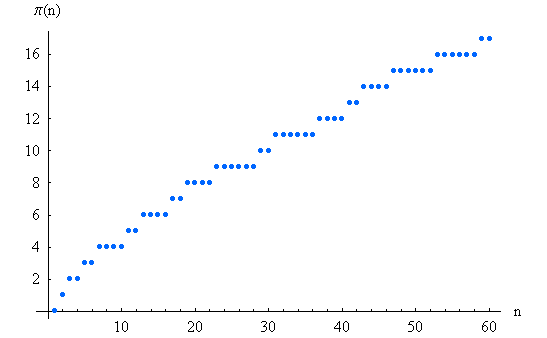
Further notes and resources
- Introductory exposition and definitions: Basic primer on primes and π(x).
- Historical background and proofs of the PNT: History and proof sketches.
- Advanced treatments, explicit formulas and Riemann’s work: Analytic theory and the zeta connection.
- Computational methods and tables of values: Algorithms and high-precision computations.
The prime counting function remains a focal point of research and education in number theory, linking elementary questions about primes to deep analytic structures and unsolved problems such as the Riemann hypothesis, which would imply strong statements about the error term in the approximation of π(x).
Related articles
Author
AlegsaOnline.com Prime counting function (π(x)) Leandro Alegsa
URL: https://en.alegsaonline.com/art/79034