
Power Pad: the floor controller for the NES
A floor-based input mat for the Nintendo Entertainment System (NES), the Power Pad let players use hands and feet to control games, notable for games like World Class Track Meet and the rare Stadium Events.
The Power Pad is a floor mat controller created for use with the Nintendo Entertainment System and its Japanese counterpart. It allowed players to stand, step or press with hands and feet to operate in-game actions rather than using a standard handheld controller. The accessory is remembered both for its unusual form factor and for a small set of dedicated games designed to make direct use of its layout.
Image gallery
3 Images

Design and operation
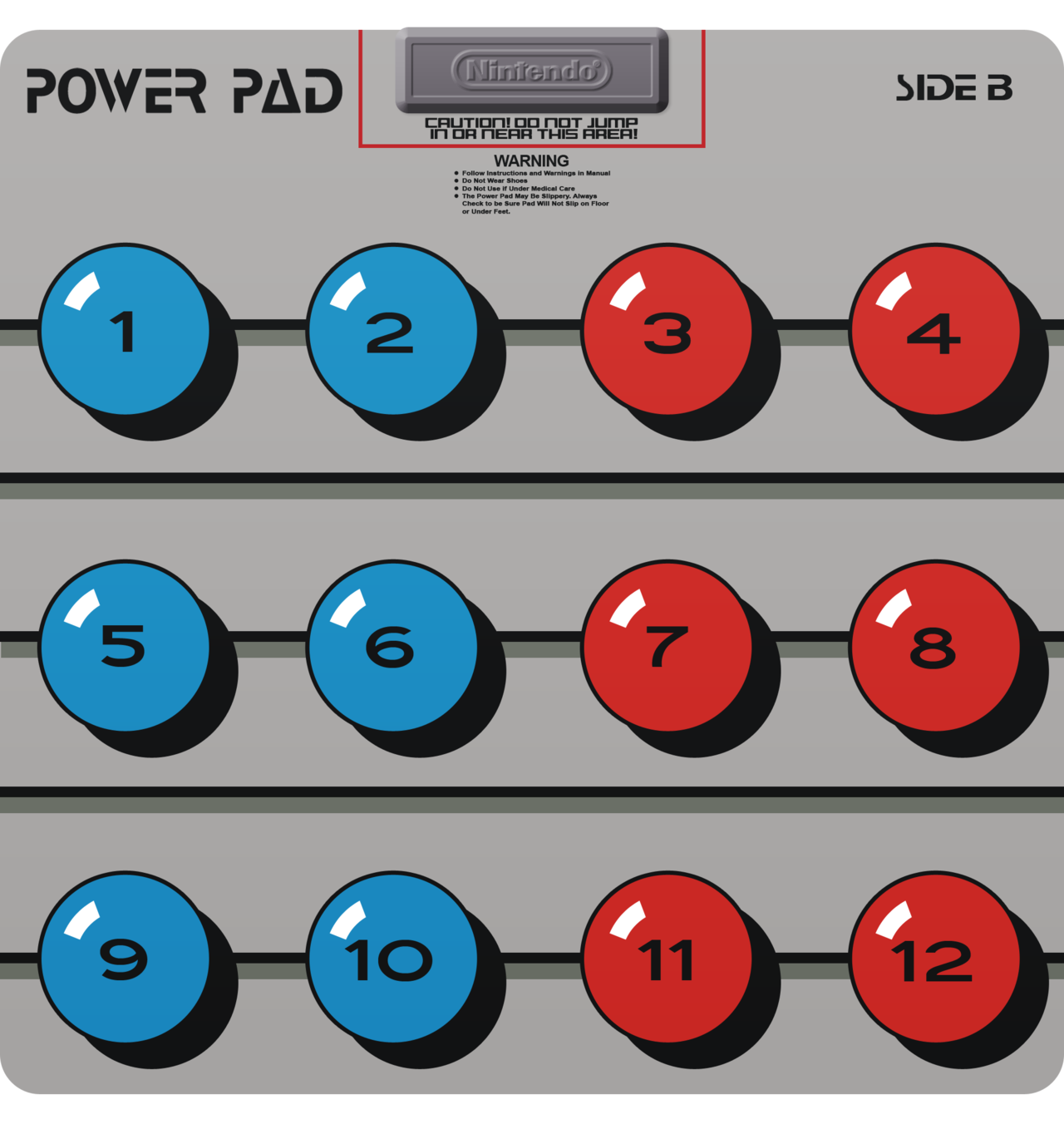
The device is a thin, flexible pad that connects to the console's controller port. It has two distinct sides intended for different control schemes. "Side A" contains eight pressure-activated areas arranged roughly in the pattern of a typical D-pad, while "Side B" presents twelve numbered buttons in two rows. Players lay the pad on the floor and step or press the marked zones to register input. The pad detects contact through simple pressure switches rather than analogue sensing.
History and regional releases
Introduced in the mid-to-late 1980s, the mat was sold in Japan, North America and Europe with minor regional branding differences. A handful of games were developed specifically for it; after an initial run of titles by third-party publishers, Nintendo marketed the device under its name in some regions. One early title published before Nintendo acquired publishing rights is now particularly famous among collectors.
Games and typical uses
- Sports and track-and-field mini-games that simulate running, jumping and relays.
- Fitness- and rhythm-style applications that encourage physical movement.
- Party and multiplayer titles where stepping speed and coordination determine the outcome.
Notable games include those that emphasize sprinting and timed footwork. Because only a few cartridges supported the pad, its use was limited compared with standard controllers.
Legacy and notable facts
The Power Pad is an early example of motion-oriented input and a direct predecessor to later dance mats and motion peripherals. A particular cartridge associated with the device became a collector's rarity after Nintendo rebranded and reissued related software, making sealed copies highly sought after. Today the pad is cited in histories of unconventional game controllers and the evolution of physical interactivity in video games.
Related articles
Author
AlegsaOnline.com Power Pad: the floor controller for the NES Leandro Alegsa
URL: https://en.alegsaonline.com/art/78533