
Poverty line
Definition, measurement and uses of the poverty line: how thresholds are set, income vs consumption measures, absolute and relative poverty, policy uses and limitations.
Overview
The poverty line (also called the poverty threshold) is a statistical boundary used to separate those judged to lack sufficient resources from those considered to have enough for basic living needs. It is not a description of wealth but a benchmark for identifying people who may need social assistance, targeted benefits, or special programmes. Different institutions and governments set poverty lines in different ways, depending on policy goals, available data and public expectations.
Image gallery
9 Images


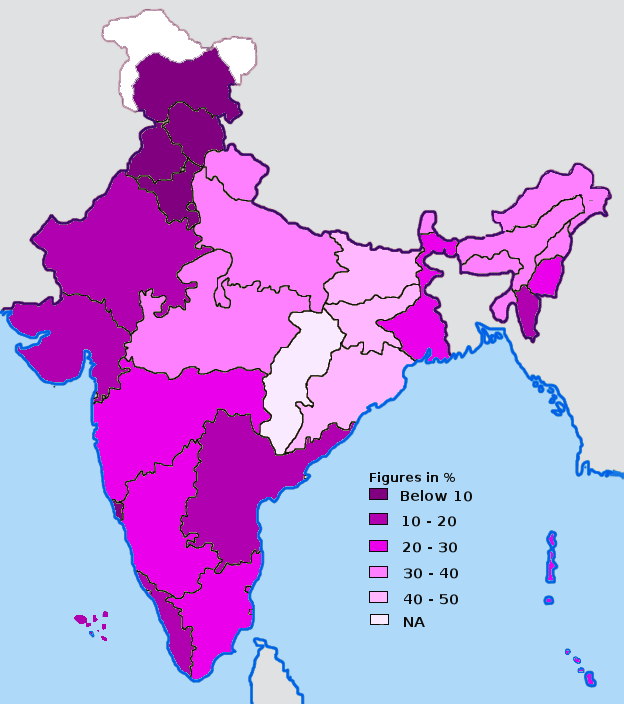
How it is defined and measured
At its simplest, a poverty line is an amount of money relative to a period (for example, per day or per year). Measures can be based on income or on consumption. Income-based lines look at earnings, wages, transfers and other receipts; consumption-based lines record what households actually spend on goods and services. Analysts also adjust thresholds for household size and composition using equivalence scales, and for price differences through purchasing power parity when making cross-border comparisons.
Types and characteristics
- Absolute poverty: a fixed minimum that reflects the cost of a defined basket of essentials (food, basic shelter and hygiene). It focuses on whether people can meet basic physical needs.
- Relative poverty: a threshold set in relation to the overall distribution of living standards in a society (for example, a share of median income). It highlights inequality and social inclusion rather than minimum survival.
- National vs international lines: countries typically set national lines that reflect local prices and norms; international agencies use standardized benchmarks to compare poverty across countries or regions.
History and institutional practice
The concept of a poverty threshold emerged from efforts to quantify need so governments and charities could distribute resources more systematically. Over the 20th and 21st centuries, methods evolved as survey data improved and economists refined ways to correct for household size, inflation and differences in cost of living. Some nations publish official poverty lines that vary by family size or composition; others rely on multiple indicators, combining income thresholds with measures of access to services.
Uses, examples and policy importance
Poverty lines are used to estimate the number of people in need, to target social programmes such as food support, housing assistance or health care subsidies, and to monitor progress on poverty reduction. Policymakers may adopt different lines depending on purpose — a lower threshold for emergency relief and a higher one for minimum acceptable living standards. For example, in the United States and many other settings thresholds are scaled by household size because larger families need more resources. National lines can be shaped by the state of the economy and public priorities.
Limitations and important distinctions
Poverty lines are useful but imperfect. They reduce a complex set of deprivations — including poor health, lack of education, low-quality housing and limited social participation — to a single monetary cut-off. They may miss seasonal income variation, informal transfers and non-market subsistence activities. Measurement also depends on survey accuracy and on whether the chosen basket of goods reflects local diets and needs (food, water, shelter, clothing and basic health). For these reasons analysts often supplement a poverty line with other indicators such as multidimensional poverty indices, unemployment rates, and access-to-service statistics.
Further reading
- Technical discussions compare income and consumption approaches and explain equivalence scales; many resources are available from national statistics offices and international bodies: food security research, housing and shelter policy analyses.
- Comparative and practical guides help interpret how poverty lines operate across different policy contexts and time periods.
Related articles
Author
AlegsaOnline.com Poverty line Leandro Alegsa
URL: https://en.alegsaonline.com/art/78502
Sources
- siteresources.worldbank.org : siteresources.worldbank.org/INTTURKEY/Resources/361616-1130337498708/ExecutiveSummary2.pdf
- irp.wisc.edu : irp.wisc.edu