
Phrenology: 19th-century theory linking skull shape to personality
Phrenology is a disproven 19th-century belief that skull shape indicates mental traits. It influenced early localization ideas but was rejected as unscientific and is now viewed as a pseudoscience.
Overview
Phrenology was a nineteenth‑century approach that claimed the contours of the skull reflected underlying brain "organs" and therefore a person’s character, abilities and tendencies. It gained popular appeal in Europe and North America as a method for assessing temperament, aptitude and criminal propensity. Today it is regarded by scientists as a pseudoscience.
Image gallery
8 Images



Methods and central claims
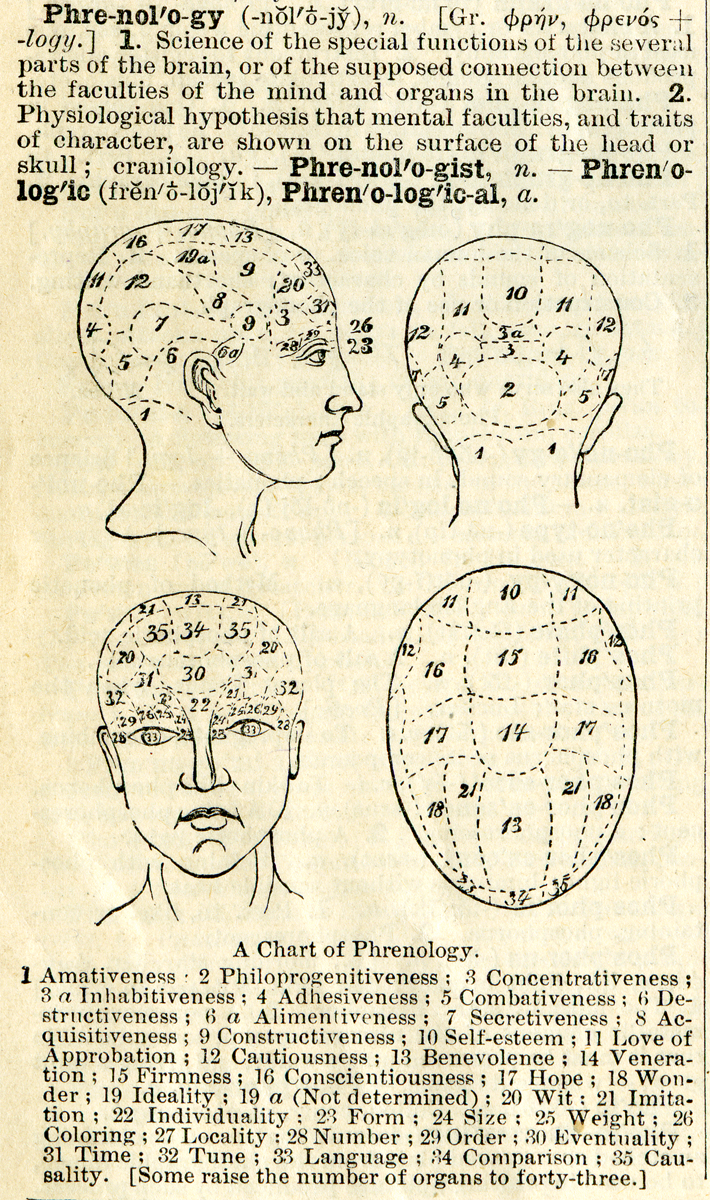
Practitioners examined bumps and depressions on the scalp and assigned them to mapped areas that supposedly corresponded to traits such as combativeness, benevolence or cautiousness. Typical procedures included palpation (feeling the skull) and consulting printed phrenological charts that divided the skull into named regions. Key claims were that mental faculties were localized in discrete patches of the brain and that skull shape adapted to those faculties.
History and development
Phrenology developed in the late 18th and early 19th centuries, most closely associated with figures such as Franz Joseph Gall and his followers. It peaked in popularity in the mid‑1800s through lectures, clinics and societies, and left a visible presence in popular culture and vocational advice services of the era.
Uses, criticism and legacy
Historically phrenology was used for hiring, marriage counseling and criminal assessment. Critics pointed out methodological flaws: inconsistent measurements, lack of experimental support and cultural bias. Over decades, improved anatomical and physiological research showed there is no reliable link between external skull shape and personality. Nonetheless, phrenology’s emphasis on brain localization contributed, indirectly, to later neuroscientific work that legitimately maps functions to brain regions—though by rigorous methods rather than skull reading.
Notable facts
- Phrenological terminology and charts were once common in medical and popular literature.
- The movement intersected with social issues and was sometimes misused to justify stereotypes.
- Its historical importance lies more in influence on public imagination and early neuroscience than in scientific validity.
Related articles
Author
AlegsaOnline.com Phrenology: 19th-century theory linking skull shape to personality Leandro Alegsa
URL: https://en.alegsaonline.com/art/76622